Hawaiians Fight To Save Their Beaches
p. 32 · Read in the full issue
Save Their Beaches
Citizens battle land-hungry developers over public access. By Michael Moriarty
HAPUNA Beach, on the western shore of the island of Hawaii, is the only extensive white sand beach on that island readily accessible to the public.
The beach’s southern part is backed by Hapuna State Park; backing the northern part is land owned by neighbouring Mauna Kea Beach Hotel. Other white sand beaches exist, but are difficult to reach: some require four-wheel drive vehicles and others, while technically public property from the vegetation line, can only be reached through private property.
In many cases landowners have done all they can to prevent the public getting to “their” beach as is the case with Kau naoa Beach, the next beach north of Ha puna. This lovely arc of while sand lies directly in front of the Mauna Kea Beach Hotel, one of the most “exclusive” hotels in the world. Mauna Kea’s management has striven to prevent the public actually using the beach: while I was a high school student, for example, my social studies class took a field trip to the island of Ha
waii from Oahu. We walked over rocky territory from adjacent Hapuna beach (the only access then available to Kaunaoa beach) and on arrival we were informed by the hotel’s security guards that this was a private beach and we would have to leave.
Our instructor, Mr Hubert Boyd, chal lenged the guards, stating that we were on public property. For this he was roughly handled and. if he had not called off the class, some of the students would have come to his defence. Needless to say, the incident provided one of the finest civics lessons of my school years.
Some years later a lawsuit resulted in the opening up of the beach to the public but the county government blundered by allowing the hotel to institute a system of access whereby only 10 parking spots were allocated for public use. If passes for those spots had been issued, no more members of the public were allowed to park: the only alternative was a rough walk in from Hapuna State Park. This option essentially rules out picnickers and fami-
lies with small children.
Thus the situation stood for years. Now, after a series of ownership changes at Mauna Kea Beach Hotel the present owner, the Seibu Corporation, is trying to execute a 17-year-old plan to build a resort behind the northern half of Hapuna Beach.
The first legal shots were fired over the County of Hawaii’s decision to waive the Environment Impact Statement required of developments these days. Some citizens were angered by the decision and filed a suit saying the EIS should be required.
This fight has evolved into a struggle to stop the development altogether, through a referendum. The “Stop Hapuna Initia tive Petition” is an attempt to have the question of a resort at Hapuna placed on the agenda for Hawaii County elections in November. Meanwhile, Seibu Corpora tion has started its own well financed drive to stop the initiative: massive mailouts (nearly every county resident received one), and a blitz of radio spots touting the need for jobs and featuring local citizens backing the development.
The west shore of the Big Island is already developing faster than anywhere else in the State of Hawaii: the initial in flux of construction workers raised rents from the SUS4OO-$5OO range to the SUSBOO-$l2OO range almost immedi ately, and real estate values soared to match. Single construction workers can easily afford this but families trying to survive on hotel workers’ wages find the new prices prohibitive and are practically excluded from the housing market. Mean while, the existing hotels are having a hard lime finding labour; in some cases they have had to set up a bus service from the distant Hamakua coast to ensure an ade quate supply of employees.
While this question festers, it is inter esting to note that Seibu Corporation has now decided to open up 20 more parking spaces for the public a grand total of 30 at the Mauna Kea Beach Hotel. While many citizens are cynical, it has not gone unobserved that the public has at least gained something out of the initiative at tempt, even if it ultimately fails. □
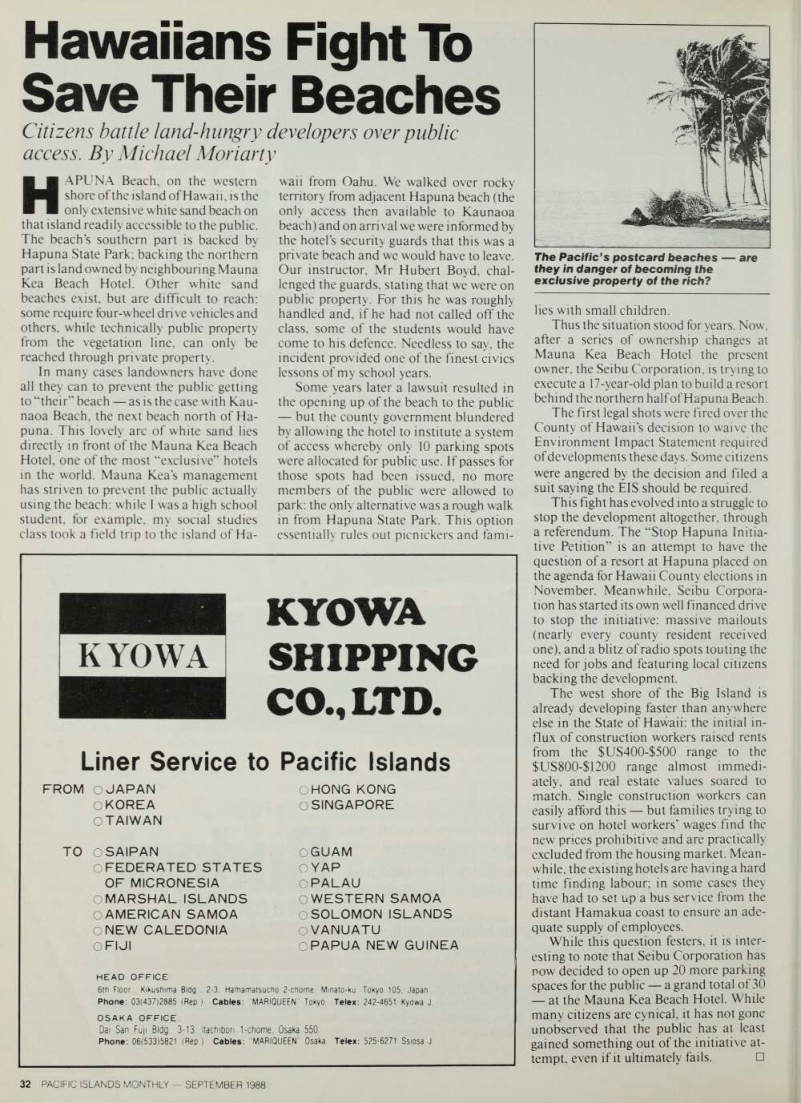
The Pacific’s postcard beaches - are they in danger of becoming the exclusive property of the rich?