Armed For Peace
p. 30 · Read in the full issue
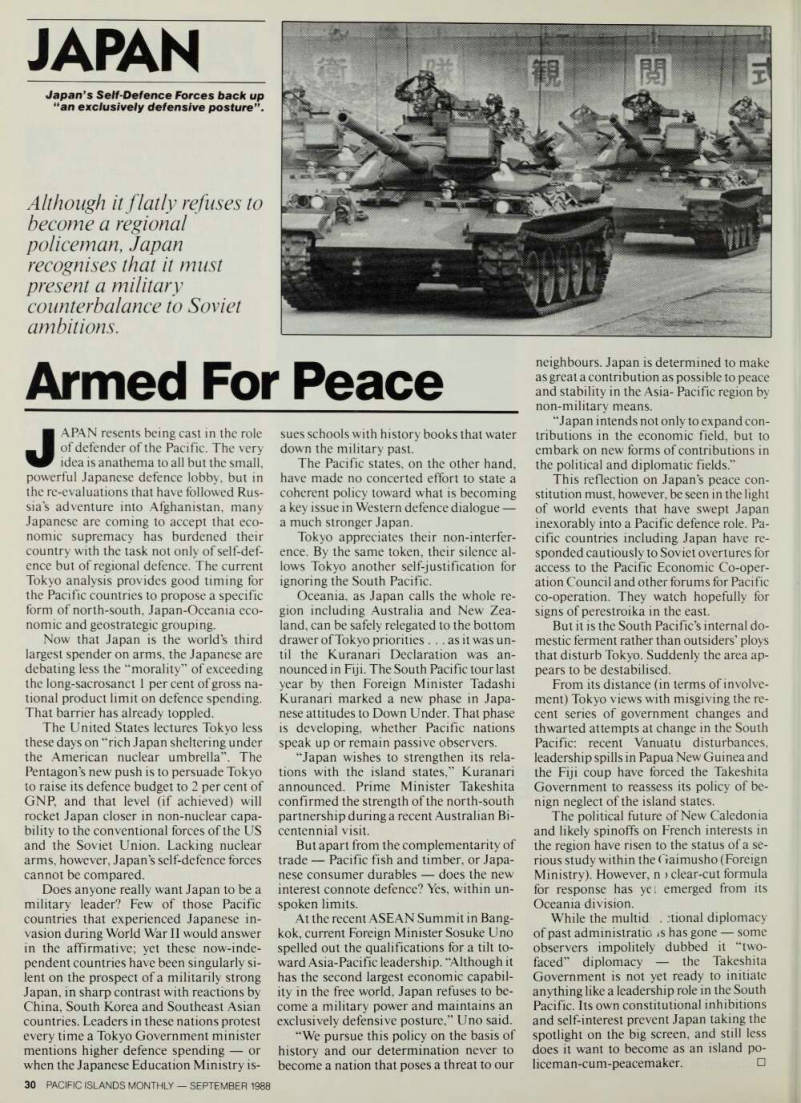
Although it flatly refuses to become a regional policeman, Japan recognises that it must present a military counterbalance to Soviet ambitions.
JAPAN resents being cast in the role of defender of the Pacific. The very idea is anathema to all but the small, powerful Japanese defence lobby, but in the re-evaluations that have followed Rus sia’s adventure into Afghanistan, many Japanese are coming to accept that eco nomic supremacy has burdened their country with the task not only of self-def ence but of regional defence. The current Tokyo analysis provides good timing for the Pacific countries to propose a specific form of north-south, Japan-Oceania eco nomic and geostrategic grouping.
Now that Japan is the world’s third largest spender on arms, the Japanese are debating less the “morality” of exceeding the long-sacrosanct 1 per cent of gross na tional product limit on defence spending.
That barrier has already toppled.
The United States lectures Tokyo less these days on “rich Japan sheltering under the American nuclear umbrella”. The Pentagon’s new push is to persuade Tokyo to raise its defence budget to 2 per cent of GNP, and that level (if achieved) will rocket Japan closer in non-nuclear capa bility to the conventional forces of the US and the Soviet Union. Lacking nuclear arms, however, Japan’s self-defence forces cannot be compared.
Does anyone really want Japan to be a military leader? Few of those Pacific countries that experienced Japanese in vasion during World War II would answer in the affirmative; yet these now-inde pendent countries have been singularly si lent on the prospect of a militarily strong Japan, in sharp contrast with reactions by China, South Korea and Southeast Asian countries. Leaders in these nations protest every time a Tokyo Government minister mentions higher defence spending or when the Japanese Education Ministry is
sues schools with history books that water down the military past.
The Pacific states, on the other hand, have made no concerted effort to state a coherent policy toward what is becoming a key issue in Western defence dialogue a much stronger Japan.
Tokyo appreciates their non-interfer ence. By the same token, their silence al lows Tokyo another self-justification for ignoring the South Pacific.
Oceania, as Japan calls the whole re gion including Australia and New Zea land, can be safely relegated to the bottom drawer of Tokyo priorities ... as it was un til the Kuranari Declaration was an nounced in Fiji. The South Pacific tour last year by then Foreign Minister Tadashi Kuranari marked a new phase in Japa nese attitudes to Down Under. That phase is developing, whether Pacific nations speak up or remain passive observers.
“Japan wishes to strengthen its rela tions with the island states,” Kuranari announced. Prime Minister Takeshita confirmed the strength of the north-south partnership during a recent Australian Bi centennial visit.
But apart from the complementarity of trade Pacific fish and timber, or Japa nese consumer durables does the new interest connote defence? Yes, within un spoken limits.
At the recent ASEAN Summit in Bang kok, current Foreign Minister Sosuke Uno spelled out the qualifications for a tilt to ward Asia-Pacific leadership. “Although it has the second largest economic capabil ity in the free world, Japan refuses to be come a military power and maintains an exclusively defensive posture,” Uno said.
“We pursue this policy on the basis of history and our determination never to become a nation that poses a threat to our
neighbours. Japan is determined to make as great a contribution as possible to peace and stability in the Asia- Pacific region by non-military means.
“Japan intends not only to expand con tributions in the economic field, but to embark on new forms of contributions in the political and diplomatic fields.”
This reflection on Japan’s peace con stitution must, however, be seen in the light of world events that have swept Japan inexorably into a Pacific defence role. Pa cific countries including Japan have re sponded cautiously to Soviet overtures for access to the Pacific Economic Co-oper ation Council and other forums for Pacific co-operation. They watch hopefully for signs of perestroika in the east.
But it is the South Pacific’s internal do mestic ferment rather than outsiders’ ploys that disturb Tokyo. Suddenly the area ap pears to be destabilised.
From its distance (in terms of involve ment) Tokyo views with misgiving the re cent series of government changes and thwarted attempts at change in the South Pacific: recent Vanuatu disturbances, leadership spills in Papua New Guinea and the Fiji coup have forced the Takeshita Government to reassess its policy of be nign neglect of the island states.
The political future of New Caledonia and likely spinoffs on French interests in the region have risen to the status of a se rious study within the Gaimusho (Foreign Ministry). However, n ) clear-cut formula for response has yet emerged from its Oceania division.
While the multid . :tional diplomacy of past administratio is has gone some observers impolitely dubbed it “two faced” diplomacy the Takeshita Government is not yet ready to initiate anything like a leadership role in the South Pacific. Its own constitutional inhibitions and self-interest prevent Japan taking the spotlight on the big screen, and still less does it want to become as an island po liceman-cum-peacemaker. □
Japan’s Self-Defence Forces back up “an exclusively defensive posture”.