Namaliu Faces Tough Decisions
p. 16 · Read in the full issue
Papua New Guniea
PNG's new leader targets law and order, youth and investment.
By Frank Senge
FACED with a fluid political system and a prevailing law and order prob lem of crisis proportions, Papua New Guinea’s new Namaliu Government has naturally targeted constitutional re forms and public security as its most ur gent priotities.
Releasing his Government’s policy in itiatives to an increasingly fidgety popu lace five weeks after taking government.
Prime Minister Namaliu vowed to deliver solutions. “I knew before assuming power that our country faced many problems,” he said. “I now know we face a crisis, and that unless tough decisions are taken and implemented the situation may deterio rate to such an extent that recovery be come impossible.”
The Prime Minister said there are towns and cities in PNG “where it is not safe to walk at night: where women live in constant fear of rape: the people have lost faith in the justice system; youth is frus trated; and foreign investment has come to a standstill.”
Mr Namaliu’s own solution to the law and order problem is the death sentence for major crimes. “In our traditional cul ture, the punishment matched the crime.
This system worked for our ancestors; it will work for us today,” he said.
He does admit, though, that such measures would have to be approved by Parliament: the death penalty is a conten tious problem, and one that has been brought to Parliament again and again over the life of independent PNG (early this year it was again brought to Parliament in the form of a private member’s bill).
The Government has already set up an
eight member ministerial committee to review the law and order situation, and plans to extend the jurisdiction of District Courts so they can handle a number of mi nor crime cases currently clogging the Na tional Court: to establish an anti corruption squad similar to those existing in Hong Kong and Singapore: to amend existing corruption legislation so it covers corruption in the private sector; and to prohibit the imprisonment of juveniles and segregate all minor or first offenders from hardened criminals.
On constitutional reforms, Mr Na maliu took up predecessor Paias Wingti’s moves to amend the section of the consti
tution that provides for votes of no con fidence and electoral laws. Mr Namaliu wants the power to be vested in the Prime Minister to dissolve Parliament and call fresh elections after each successful vote of no confidence.
Alternatively, he suggests that the period after the election of the Prime Min ister during which a vote can be put should be moved from the current six months to 12, 24 or even 30 months.
The government is considering rein troducing a system of optional preferen tial voting to replace the current first-past the-post system, under which any person scoring 1 per cent of the total number of votes in an electorate can enter Parliament.
Opposition leader Paias Wingti has vowed total support for the constitutional reforms, which Mr Namaliu promised to have before Parliament in November. The PM has also decided to retain the previous Government’s emphasis on economic growth and job creation as his third major objective, and education and training as his fourth and final strategy.
Mr Namaliu has promised to intro duce PNG’s first stock exchange and to streamline the National Investment and Development Authority, which oversees applications for new business ventures.
The private sector came out in support of the new Government, if for nothing more than the change in policy.
The public and political sectors remain uncertain, however. Several departmen tal heads admit waiting for directions, and Opposition leader Wingti has said he will give the Government nine months before deciding if it is really performing. □
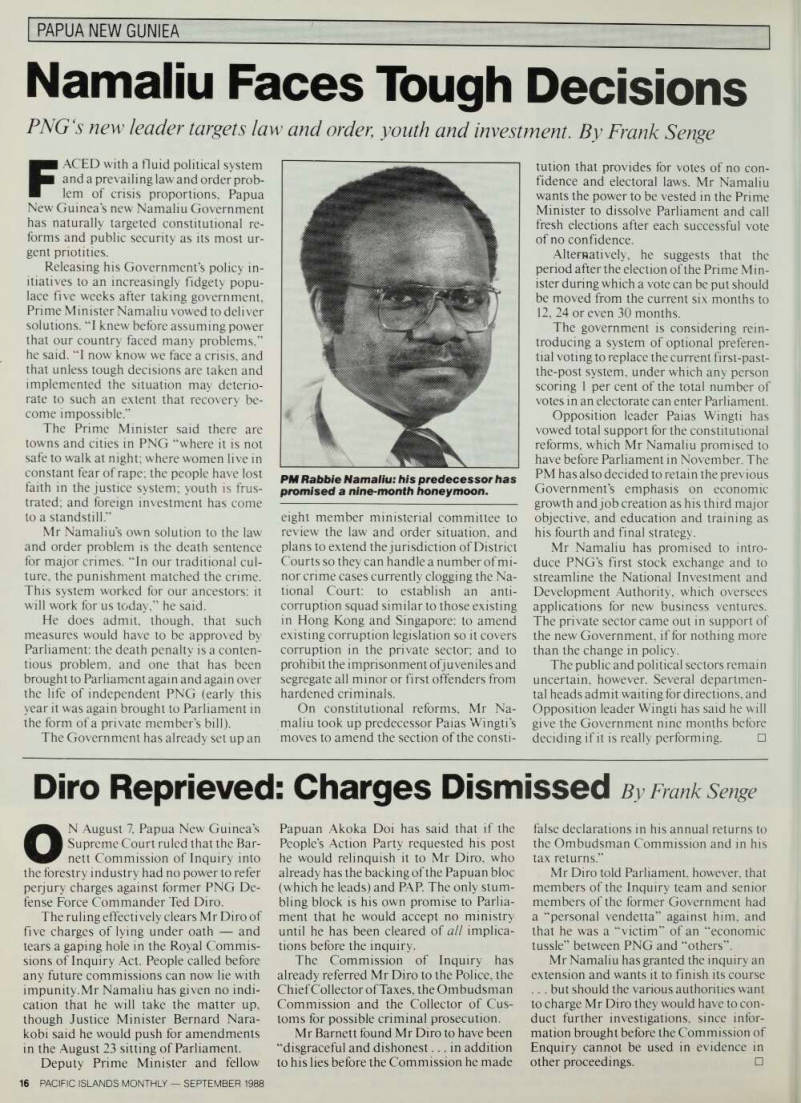
PM Rabbie Namaliu: his predecessor has promised a nine-month honeymoon.