Peace Breaks
p. 15 · Read in the full issue
New Caledonia
Peace Breaks Out In Noumea
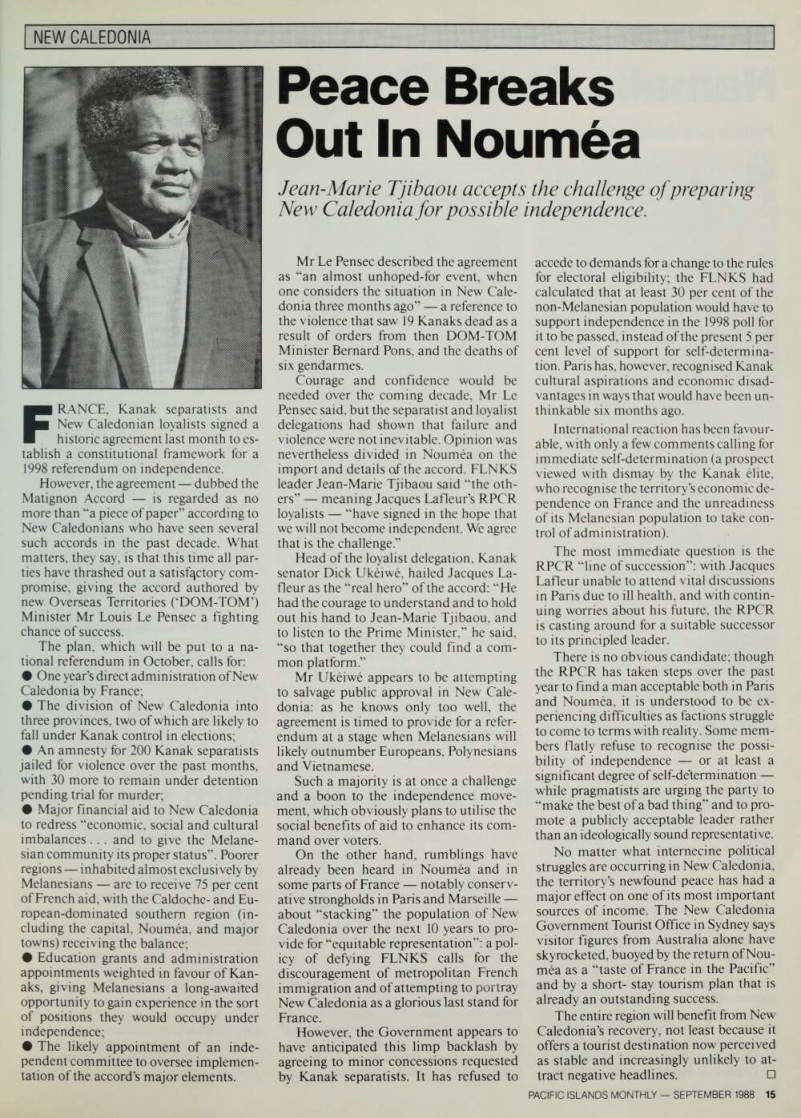
Jean-Marie Tjibaou accepts the challenge of preparing New Caledonia for possible independence.
FRANCE, Kanak separatists and New Caledonian loyalists signed a historic agreement last month to es tablish a constitutional framework for a 1998 referendum on independence.
However, the agreement dubbed the Matignon Accord is regarded as no more than “a piece of paper” according to New Caledonians who have seen several such accords in the past decade. What matters, they say, is that this time all par ties have thrashed out a satisfactory com promise, giving the accord authored by new Overseas Territories (‘DOM-TOM’) Minister Mr Louis Le Pensec a fighting chance of success.
The plan, which will be put to a na tional referendum in October, calls for: • One year’s direct administration of New Caledonia by France; • The division of New Caledonia into three provinces, two of which are likely to fall under Kanak control in elections; • An amnesty for 200 Kanak separatists jailed for violence over the past months, with 30 more to remain under detention pending trial for murder; • Major financial aid to New Caledonia to redress “economic, social and cultural imbalances. .. and to give the Melane sian community its proper status”. Poorer regions inhabited almost exclusively by Melanesians are to receive 75 per cent of French aid, with the Caldoche- and Eu ropean-dominated southern region (in cluding the capital, Noumea, and major towns) receiving the balance; • Education grants and administration appointments weighted in favour of Kan aks, giving Melanesians a long-awaited opportunity to gain experience in the sort of positions they would occupy under independence; • The likely appointment of an inde pendent committee to oversee implemen tation of the accord’s major elements.
Mr Le Pensec described the agreement as “an almost unhoped-for event, when one considers the situation in New Cale donia three months ago” a reference to the violence that saw 19 Kanaks dead as a result of orders from then DOM-TOM Minister Bernard Pons, and the deaths of six gendarmes.
Courage and confidence would be needed over the coming decade, Mr Le Pensec said, but the separatist and loyalist delegations had shown that failure and violence were not inevitable. Opinion was nevertheless divided in Noumea on the import and details of the accord. FLNKS leader Jean-Marie Tjibaou said “the oth ers” meaning Jacques Lafleur’s RPCR loyalists “have signed in the hope that we will not become independent. We agree that is the challenge.”
Plead of the loyalist delegation, Kanak senator Dick Ukeiwe, hailed Jacques La fleur as the “real hero” of the accord: “He had the courage to understand and to hold out his hand to Jean-Marie Tjibaou, and to listen to the Prime Minister,” he said, “so that together they could find a com mon platform.”
Mr Ukeiwe appears to be attempting to salvage public approval in New Cale donia: as he knows only too well, the agreement is timed to provide for a refer endum at a stage when Melanesians will likely outnumber Europeans, Polynesians and Vietnamese.
Such a majority is at once a challenge and a boon to the independence move ment, which obviously plans to utilise the social benefits of aid to enhance its com mand over voters.
On the other hand, rumblings have already been heard in Noumea and in some parts of France notably conserv ative strongholds in Paris and Marseille about “stacking” the population of New Caledonia over the next 10 years to pro vide for “equitable representation”: a pol icy of defying FLNKS calls for the discouragement of metropolitan French immigration and of attempting to portray New Caledonia as a glorious last stand for France.
However, the Government appears to have anticipated this limp backlash by agreeing to minor concessions requested by Kanak separatists. It has refused to
accede to demands for a change to the rules for electoral eligibility; the FLNKS had calculated that at least 30 per cent of the non-Melanesian population would have to support independence in the 1998 poll for it to be passed, instead of the present 5 per cent level of support for self-determina tion. Paris has, however, recognised Kanak cultural aspirations and economic disad vantages in ways that would have been un thinkable six months ago.
International reaction has been favour able, with only a few comments calling for immediate self-determination (a prospect viewed with dismay by the Kanak elite, who recognise the territory’s economic de pendence on France and the unreadiness of its Melanesian population to take con trol of administration).
The most immediate question is the RPCR “line of succession”: with Jacques Lafleur unable to attend vital discussions in Paris due to ill health, and with contin uing worries about his future, the RPCR is casting around for a suitable successor to its principled leader.
There is no obvious candidate; though the RPCR has taken steps over the past year to find a man acceptable both in Paris and Noumea, it is understood to be ex periencing difficulties as factions struggle to come to terms with reality. Some mem bers flatly refuse to recognise the possi bility of independence or at least a significant degree of self-determination while pragmatists are urging the party to “make the best of a bad thing” and to pro mote a publicly acceptable leader rather than an ideologically sound representative.
No matter what internecine political struggles are occurring in New Caledonia, the territory’s newfound peace has had a major effect on one of its most important sources of income. The New Caledonia Government Tourist Office in Sydney says visitor figures from Australia alone have skyrocketed, buoyed by the return of Nou mea as a “taste of France in the Pacific” and by a short- stay tourism plan that is already an outstanding success.
The entire region will benefit from New Caledonia’s recovery, not least because it offers a tourist destination now perceived as stable and increasingly unlikely to at tract negative headlines. □