Aggie Grey: A Tribute
p. 52 · Read in the full issue
Transition
A great South Pacific identity passes into legend.
AGGIE GREY will be remembered as the best-known hotel keeper in the South Pacific .. . and I don’t think she’d object to that epitaph.
To impress your personal mark on a pub for 40 years is a rare achievement in itself to be the name behind a pub that has had, over that span of years, the reputa tion for Islands hospitality and friendli ness is the stuff of South Seas history.
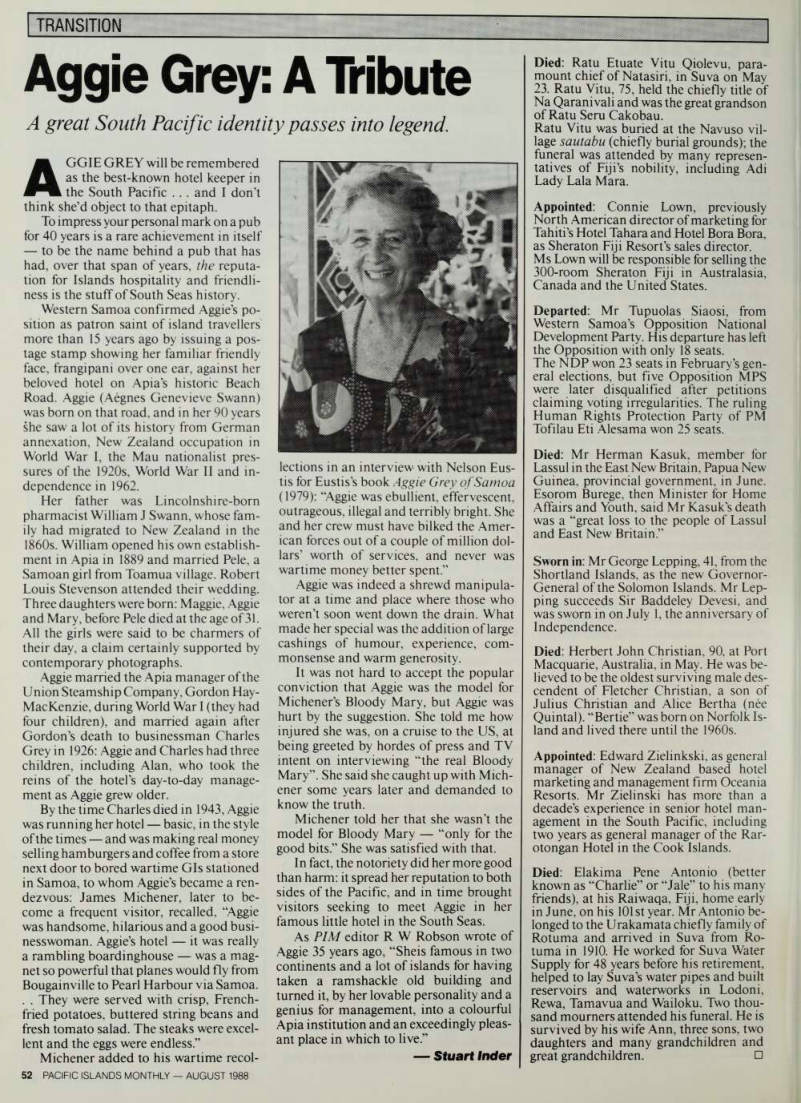
Western Samoa confirmed Aggie’s po sition as patron saint of island travellers more than 15 years ago by issuing a pos tage stamp showing her familiar friendly face, frangipani over one ear, against her beloved hotel on Apia’s historic Beach Road. Aggie (Aegnes Genevieve Swann) was born on that road, and in her 90 years she saw a lot of its history from German annexation, New Zealand occupation in World War I, the Mau nationalist pres sures of the 19205, World War II and in dependence in 1962.
Her father was Lincolnshire-born pharmacist William J Swann, whose fam ily had migrated to New Zealand in the 1860 s. William opened his own establish ment in Apia in 1889 and married Pele, a Samoan girl from Toamua village. Robert Louis Stevenson attended their wedding.
Three daughters were born: Maggie, Aggie and Mary, before Pele died at the age of 31.
All the girls were said to be charmers of their day, a claim certainly supported by contemporary photographs.
Aggie married the Apia manager of the Union Steamship Company, Gordon Hay- MacKenzie, during World War I (they had four children), and married again after Gordon’s death to businessman Charles Grey in 1926: Aggie and Charles had three children, including Alan, who took the reins of the hotel’s day-to-day manage ment as Aggie grew older.
By the time Charles died in 1943, Aggie was running her hotel basic, in the style of the times and was making real money selling hamburgers and coffee from a store next door to bored wartime Gls stationed in Samoa, to whom Aggie’s became a ren dezvous: James Michener, later to be come a frequent visitor, recalled, “Aggie was handsome, hilarious and a good busi nesswoman. Aggie’s hotel it was really a rambling boardinghouse was a mag net so powerful that planes would fly from Bougainville to Pearl Harbour via Samoa. . . They were served with crisp, French fried potatoes, buttered string beans and fresh tomato salad. The steaks were excel lent and the eggs were endless.”
Michener added to his wartime recol-
lections in an interview with Nelson Eus tis for Eustis’s book Aggie Grey of Samoa (1979): “Aggie was ebullient, effervescent, outrageous, illegal and terribly bright. She and her crew must have bilked the Amer ican forces out of a couple of million dol lars’ worth of services, and never was wartime money better spent.”
Aggie was indeed a shrewd manipula tor at a time and place where those who weren’t soon went down the drain. What made her special was the addition of large cashings of humour, experience, com monsense and warm generosity.
It was not hard to accept the popular conviction that Aggie was the model for Michener’s Bloody Mary, but Aggie was hurt by the suggestion. She told me how injured she was, on a cruise to the US, at being greeted by hordes of press and TV intent on interviewing “the real Bloody Mary”. She said she caught up with Mich ener some years later and demanded to know the truth.
Michener told her that she wasn’t the model for Bloody Mary “only for the good bits.” She was satisfied with that.
In fact, the notoriety did her more good than harm: it spread her reputation to both sides of the Pacific, and in time brought visitors seeking to meet Aggie in her famous little hotel in the South Seas.
As PIM editor R W Robson wrote of Aggie 35 years ago, “Sheis famous in two continents and a lot of islands for having taken a ramshackle old building and turned it, by her lovable personality and a genius for management, into a colourful Apia institution and an exceedingly pleas ant place in which to live.”
Stuart Inder
Died: Ratu Etuate Vitu Qiolevu, para mount chief of Natasiri, in Suva on May 23. Ratu Vitu, 75, held the chiefly title of Na Qaranivali and was the great grandson of Ratu Seru Cakobau.
Ratu Vitu was buried at the Navuso vil lage sautabu (chiefly burial grounds); the funeral was attended by many represen tatives of Fiji’s nobility, including Adi Lady Lala Mara.
Appointed: Connie Lown, previously North American director of marketing for Tahiti’s Hotel Tahara and Hotel Bora Bora, as Sheraton Fiji Resort’s sales director.
Ms Lown will be responsible for selling the 300-room Sheraton Fiji in Australasia, Canada and the United States.
Departed: Mr Tupuolas Siaosi, from Western Samoa’s Opposition National Development Party. His departure has left the Opposition with only 18 seats.
The NDP won 23 seats in February’s gen eral elections, but five Opposition MPS were later disqualified after petitions claiming voting irregularities. The ruling Human Rights Protection Party of PM Tofilau Eti Alesama won 25 seats.
Died: Mr Herman Kasuk, member for Lassul in the East New Britain, Papua New Guinea, provincial government, in June.
Esorom Burege, then Minister for Home Affairs and Youth, said Mr Kasuk’s death was a “great loss to the people of Lassul and East New Britain.”
Sworn in; Mr George Lepping, 41, from the Shortland Islands, as the new Governor- General of the Solomon Islands. Mr Lep ping succeeds Sir Baddeley Devesi, and was sworn in on July 1, the anniversary of Independence.
Died: Herbert John Christian, 90, at Port Macquarie, Australia, in May. He was be lieved to be the oldest surviving male des cendent of Fletcher Christian, a son of Julius Christian and Alice Bertha (nee Quintal). “Bertie” was born on Norfolk Is land and lived there until the 19605.
Appointed: Edward Zielinkski, as general manager of New Zealand based hotel marketing and management firm Oceania Resorts. Mr Zielinski has more than a decade’s experience in senior hotel man agement in the South Pacific, including two years as general manager of the Rar otongan Hotel in the Cook Islands.
Died: Elakima Pene Antonio (better known as “Charlie” or “Jale” to his many friends), at his Raiwaqa, Fiji, home early in June, on his 101 st year. Mr Antonio be longed to the Urakamata chiefly family of Rotuma and arrived in Suva from Ro tuma in 1910. He worked for Suva Water Supply for 48 years before his retirement, helped to lay Suva’s water pipes and built reservoirs and waterworks in Lodoni, Rewa, Tamavua and Wailoku. Two thou sand mourners attended his funeral. He is survived by his wife Ann, three sons, two daughters and many grandchildren and great grandchildren. □