Tropicalities
pp. 46-47 · Read in the full issue
“Brave And Humble” Leader
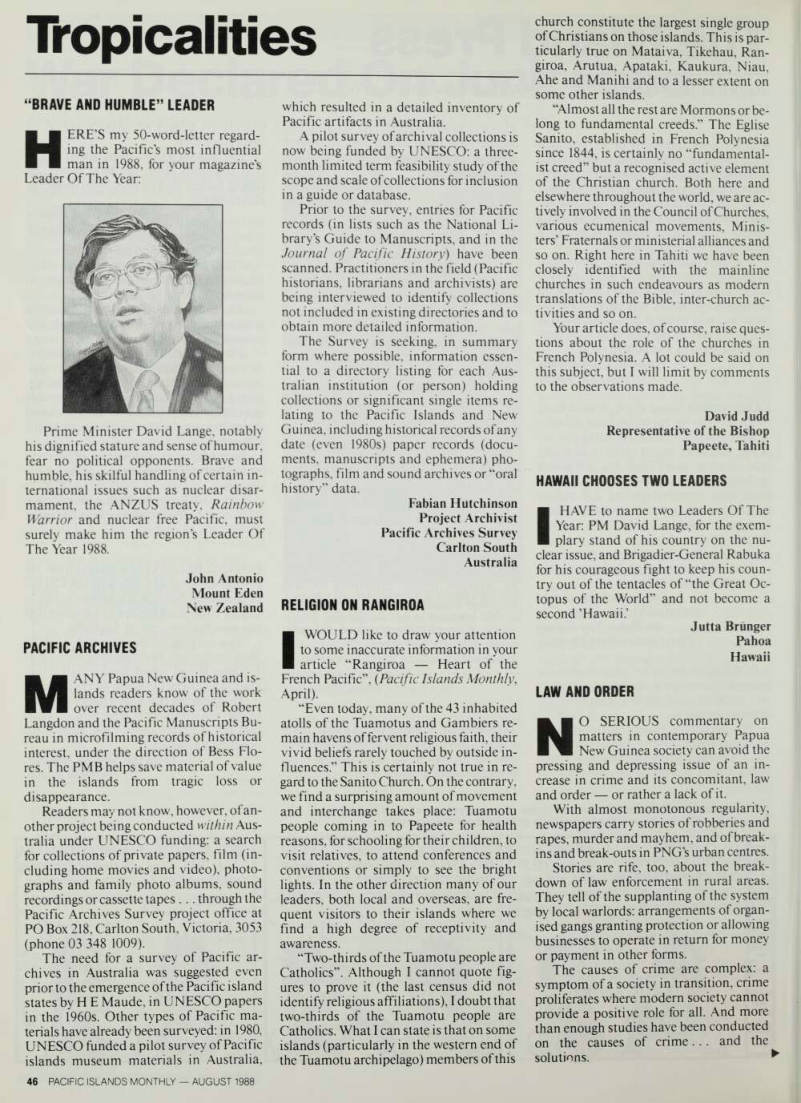
HERE’S my 50-word-letter regard ing the Pacific’s most influential man in 1988, for your magazine’s Leader Of The Year:
Prime Minister David Lange, notably his dignified stature and sense of humour, fear no political opponents. Brave and humble, his skilful handling of certain in ternational issues such as nuclear disar mament, the ANZUS treaty. Rainbow Warrior and nuclear free Pacific, must surely make him the region’s Leader Of The Year 1988.
John Antonio
Mount Eden New Zealand
Pacific Archives
MANY Papua New Guinea and is lands readers know of the work over recent decades of Robert Langdon and the Pacific Manuscripts Bu reau in microfilming records of historical interest, under the direction of Bess Flo res. The PMB helps save material of value in the islands from tragic loss or disappearance.
Readers may not know, however, of an other project being conducted within Aus tralia under UNESCO funding: a search for collections of private papers, film (in cluding home movies and video), photo graphs and family photo albums, sound recordings or cassette tapes .. .through the Pacific Archives Survey project office at PO Box 218, Carlton South, Victoria, 3053 (phone 03 348 1009).
The need for a survey of Pacific ar chives in Australia was suggested even prior to the emergence of the Pacific island states by H E Maude, in UNESCO papers in the 19605. Other types of Pacific ma terials have already been surveyed: in 1980, UNESCO funded a pilot survey of Pacific islands museum materials in Australia,
which resulted in a detailed inventory of Pacific artifacts in Australia.
A pilot survey of archival collections is now being funded by UNESCO: a three month limited term feasibility study of the scope and scale of collections for inclusion in a guide or database.
Prior to the survey, entries for Pacific records (in lists such as the National Li brary’s Guide to Manuscripts, and in the Journal of Pacific History) have been scanned. Practitioners in the field (Pacific historians, librarians and archivists) are being interviewed to identify collections not included in existing directories and to obtain more detailed information.
The Survey is seeking, in summary form where possible, information essen tial to a directory listing for each Aus tralian institution (or person) holding collections or significant single items re lating to the Pacific Islands and New Guinea, including historical records of any date (even 1980 s) paper records (docu ments, manuscripts and ephemera) pho tographs, film and sound archives or “oral history” data.
Fabian Hutchinson
Project Archivist Pacific Archives Survey Carlton South Australia
Religion On Rangiroa
I WOULD like to draw your attention to some inaccurate information in your article “Rangiroa Heart of the French Pacific”, ( Pacific Islands Monthly, April).
“Even today, many of the 43 inhabited atolls of the Tuamotus and Gamblers re main havens of fervent religious faith, their vivid beliefs rarely touched by outside in fluences.” This is certainly not true in re gard to the Sanito Church. On the contrary, we find a surprising amount of movement and interchange takes place: Tuamotu people coming in to Papeete for health reasons, for schooling for their children, to visit relatives, to attend conferences and conventions or simply to see the bright lights. In the other direction many of our leaders, both local and overseas, are fre quent visitors to their islands where we find a high degree of receptivity and awareness.
“Two-thirds of the Tuamotu people are Catholics”. Although I cannot quote fig ures to prove it (the last census did not identify religious affiliations), I doubt that two-thirds of the Tuamotu people are Catholics. What I can state is that on some islands (particularly in the western end of the Tuamotu archipelago) members of this
church constitute the largest single group of Christians on those islands. This is par ticularly true on Mataiva, Tikehau, Ran giroa, Arutua, Apataki, Kaukura, Niau, Ahe and Manihi and to a lesser extent on some other islands.
“Almost all the rest are Mormons or be long to fundamental creeds.” The Eglise Sanito, established in French Polynesia since 1844, is certainly no “fundamental ist creed” but a recognised active element of the Christian church. Both here and elsewhere throughout the world, we are ac tively involved in the Council of Churches, various ecumenical movements, Minis ters’ Fratemals or ministerial alliances and so on. Right here in Tahiti we have been closely identified with the mainline churches in such endeavours as modern translations of the Bible, inter-church ac tivities and so on.
Your article does, of course, raise ques tions about the role of the churches in French Polynesia. A lot could be said on this subject, but I will limit by comments to the observations made.
David Judd
Representative of the Bishop Papeete, Tahiti
Hawaii Chooses Two Leaders
IH AVE to name two Leaders Of The Year: PM David Lange, for the exem plary stand of his country on the nu clear issue, and Brigadier-General Rabuka for his courageous fight to keep his coun try out of the tentacles of “the Great Oc topus of the World” and not become a second ’Hawaii.’
Jutta Brünger
Pahoa Hawaii
Law And Order
NO SERIOUS commentary on matters in contemporary Papua New Guinea society can avoid the pressing and depressing issue of an in crease in crime and its concomitant, law and order or rather a lack of it.
With almost monotonous regularity, newspapers carry stories of robberies and rapes, murder and mayhem, and of break ins and break-outs in PNG’s urban centres.
Stories are rife, too, about the break down of law enforcement in rural areas.
They tell of the supplanting of the system by local warlords: arrangements of organ ised gangs granting protection or allowing businesses to operate in return for money or payment in other forms.
The causes of crime are complex: a symptom of a society in transition, crime proliferates where modern society cannot provide a positive role for all. And more than enough studies have been conducted on the causes of crime... and the solutions.
< In 1984 we had the K 100,000 Clifford Report. Before that there was the Morgan Report. We have heard of the “49 Steps” and the Minimum Penalties Laws. We saw the appointment of the Kerepia Task Force, witnessed the Lucas Awareness Cam paign and experienced a curfew in the National Capital.
To what purpose, we might all ask. The cynics would see their views confirmed by the official reaction to the latest of these studies, the Harris Report released, withdrawn and re-released all in a space of six weeks.
Whether the content of the Harris re port is palatable or not, the truth is that a succession of governments heeded a fun damental reality; that regardless of the measures adopted, for there to be any chance of success there must be a deter mination on the part of political leader ship hitherto unseen in Papua New Guinea.
The 1984 Parliamentary Committee on the State of Emergency put the same basic problem in these words: “It became glar ingly obvious during our investigations that the poor relationship, lack of consul tation and co-ordination between govern ment departments is as much a problem as the problem of law and order itself’.
The Clifford Report, after highlighting some of the problems and canvassing ideas on how they might be tackled, makes it clear there is little hope for success unless
the structure of public decision-making is altered to provide close co-operation be tween the various justice agencies in im plementation and priority setting.
Despite recommendations by all these reports, the basic problem remains one of apathy by the Government until hell breaks loose and society becomes con cerned enough to organise mass protests as happened in 1984, when a particu larly horrendous rape galvanised large sections of the Moresby citizenry into action.
The apparent indifference on the part of Government is manifested in several ways. The most recent is its reaction to the Harris report. Perhaps the author unwit tingly blurred the picture of a well-organ ised crime machine; he may also have used outdated police figures and crime statis tics but Government reaction was so negative that the Institute which itself commissioned the report attempted to withdraw it from circulation.
Is this lack of a positive, co-ordinated attitude reflective of a lack of a balanced approach to development by the Government?
We certainly hope not; though we won der when we see constant Government emphasis on economic activities at the ex pense of social sectors such as education and health.
It needs to be pointed out again (and we don’t need another major report, cost
ing thousands of kina, to do this) that the ultimate causes of crime in our country are economic and social, The economic causes seem to be ade quately cared for by Government’s prior ities. As for the social. . . well, it remains to be seen. The fundamental fact remains that our political leadership must realise that any concerted campaign to settle the law and order problem requires involve ment from the highest level, Maybe the Prime Minister and Cabi net have their hands full trying to workout ways to govern our nation more effec lively. Maybe that’s why they have been unable to address this major issue. But whatever their reasons, we hope they are not so preoccupied with their own sur vival that they risk compromising the safety of our society, After all, their preoccupation with political survival is as legitimate as soci ety’s preoccupation with its own survival, a key element of which is the law and order issue. All societies are (or at least should be) as privileged as their leaders. Law and order must not be regarded as a luxury for the privileged, but as a right for the masses: not patrician; not plebeian. A birthright bestowed on all of us.
A M Siaguru
Boroko Papua New Guinea