War Declared On Junk Food
p. 44 · Read in the full issue
Marshall Islands
UN specialists fight to wean islanders off imported foods
S WEEPING Westernisation cou pled with a booming population has dramatically altered the once self reliant Marshall Islands.
A profoundly disturbing feature of this change is malnutrition unknown just a decade ago and rejection of local foods in favour of costly imported goods.
The United Nations Children’s Fund is supporting a special agricultural program aimed at boosting self-sufficiency and en couraging increased consumption of local foods to counteract the dependence on the US these islands have acquired during 40 years of American control.
On remote coral atolls, coconut, pa paya and banana trees heavy with fruit sway with the afternoon trade winds; but kitchens are dominated by canned meats and rice, doughnuts and pancakes heavy with sugar. Local foods are valued less than imported goods.
A few hundred kilometres away are Majuro and Ebeye, the urban centres where the bulk of the 43,000 Marshall Is landers live. Here the way of life is strik ingly Western: nine-to-five government jobs, cars, televisions, discos and bars.
The Marshall Islands (formerly a UN Trust Territory administered by the US) are now self-governing in “free associ ation” with the United States. The low lying atolls are scattered across 800,000 square kilometres of ocean area 3500 kil ometres southwest of Hawaii. In exchange for use of a key missile testing range in the Marshalls, the US provides more than SUSSO million each year in direct subsi dies to the islands.
“The self-reliance message of Marshall Islands President Amata Kubua is a real challenge because of the dependence on the US,” says UNICEF consultant Paul Som mers, who is overseeing agriculture pro grams in the Marshall Islands and six other Pacific nations.
The home gardening project, funded by UNICEF, was launched in 1985, focusing on the remote outer atolls.
It began with families on a couple of small communities: project co-ordinator Stephen Lepton, a Marshall Islander trained by UNICEF, says its goal is to in crease the availability of local foods at the household level in an effort to discourage dependence on imported and costly processed foods.
Lepton provides advice on plants and developing fertiliser from compost mate rial. He promotes fruits and vegetables with which islanders are familiar because only certain crops can survive the nu-
trient-poor soil of a coral atoll and the ef fects of constant salt spray. Islanders are also hesitant to try new foods.
Breadfruit, bananas, taro, papaya and sweet potato are the prime crops planted on the islands. “There have been tremen dous achievements in a short time,” says Paul Sommers. Gardening “clubs” with membership ranging from 35 to 50 people have been established on four atolls since the project started.
Now, so many atolls are asking for the project’s assistance to set up garden clubs that Stephen Lepton says it is impossible to meet the demand.
While the project is making headway in stimulating farming and availability of local foods, malnutrition is on the rise. The number of malnourished children from outer atolls admitted to the main hospital in Majuro is increasing, says Health Sec retary Marie Maddison, but the majority of malnourished children are from the two urban centres.
On any given day, a visit to the chil dren’s ward in the hospital will find three or four severely malnourished children.
Dozens die each year from illnesses re
lated to malnutrition, such as pneumonia or measles, say hospital physicians. “If we compare the Marshalls to other [Third World] countries, the malnutrition prob lem is more negligence than poverty,” says Marie Maddison.
The nutritional problems of a Western diet high in sugar, preservatives and canned meats have been compounded by a 3.5 per cent annual birth increase, one of the highest in the world. In the urban centres people rely almost exclusively on imported food bought in stores.
Large families a family with five children is considered “small” put a se vere financial strain on the one or two people bringing home a paycheck. Food for the family, such as infant formula for ba bies, is stretched thinly.
In the urban centres, a steady diet of doughnuts, white bread, colas and ramen (a local noodle dish) is not unusual.
Reversing the impact of modernisa tion is slow, but the UNICEF project and health officials see change. “It is not as common now to see a child repeatedly readmitted for malnutrition,” says Mad dison. “Our follow-up system and health education is better, and there has been an improvement in public awareness.”
Although the Health Department’s preventive health work and UNICEF’s garden project are not administratively linked, both are promoting a self-reliance message that is beginning to be heard in the community. “I see more people con cerned today about eating sweets and ‘junk food’,” says Ms Maddison.
Both Stephen Lepton and health offi cials are using the media to promote local foods and improved nutrition. The garden project’s weekly radio show keeps the gar dening clubs up to date on new develop ments, and has sparked other communities to launch their own gardening projects.
Lepton has also used the local newspaper to stimulate community interest in grow ing and eating local foods.
“It’s hard to measure diet changes so early in the project,” says Paul Somers. The main thing is that more nutrition-packed local foods are being consumed on the is lands with garden projects.
At a later stage in the garden project, both Somers and Lepton hope it will be possible to expand the outer islands gar dens to the two urban centres. The success so far suggests that availability of nutri tious local foods is more than half the bat tle. If island fruits and vegetables are promoted and readily accessible, people will choose them over imports. □
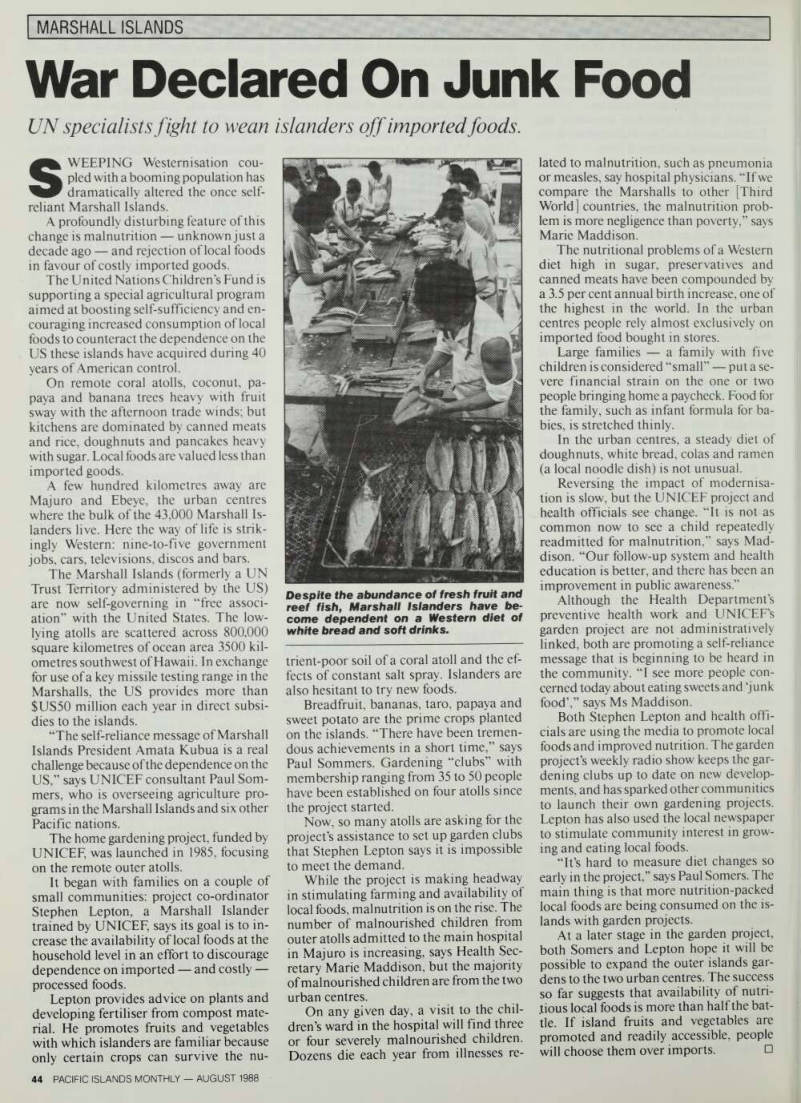
Despite the abundance of fresh fruit and reef fish, Marshall Islanders have be come dependent on a Western diet of white bread and soft drinks.