How Wingti Was Toppled
pp. 10-13 · Read in the full issue
Papua New Guinea
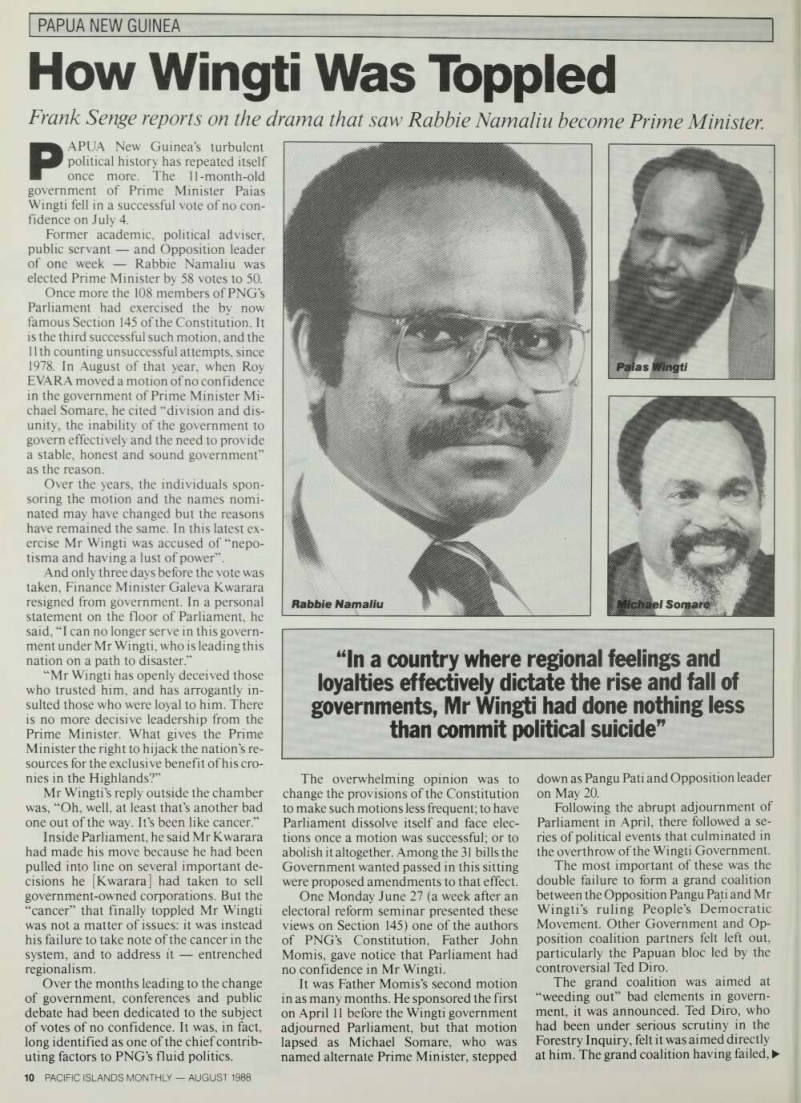
Frank Senge reports on the drama that saw Rabbie Namaliu become Prime Minister.
PAPUA New Guinea’s turbulent political history has repeated itself once more. The 11-month-old government of Prime Minister Paias Wingti fell in a successful vote of no con fidence on July 4.
Former academic, political adviser, public servant and Opposition leader of one week Rabbie Namaliu was elected Prime Minister by 58 votes to 50.
Once more the 108 members of PNG’s Parliament had exercised the by now famous Section 145 of the Constitution. It is the third successful such motion, and the 11th counting unsuccessful attempts, since 1978. In August of that year, when Roy EVARA moved a motion of no confidence in the government of Prime Minister Mi chael Somare, he cited “division and dis unity, the inability of the government to govern effectively and the need to provide a stable, honest and sound government” as the reason.
Over the years, the individuals spon soring the motion and the names nomi nated may have changed but the reasons have remained the same. In this latest ex ercise Mr Wingti was accused of “nepo tisma and having a lust of power”.
And only three days before the vote was taken, Finance Minister Galeva Kwarara resigned from government. In a personal statement on the floor of Parliament, he said, “I can no longer serve in this govern ment under Mr Wingti, who is leading this nation on a path to disaster.”
“Mr Wingti has openly deceived those who trusted him, and has arrogantly in sulted those who were loyal to him. There is no more decisive leadership from the Prime Minister. What gives the Prime Minister the right to hijack the nation’s re sources for the exclusive benefit of his cro nies in the Highlands?”
Mr Wingti’s reply outside the chamber was, “Oh, well, at least that’s another bad one out of the way. It’s been like cancer.”
Inside Parliament, he said Mr Kwarara had made his move because he had been pulled into line on several important de cisions he [Kwarara] had taken to sell government-owned corporations. But the “cancer” that finally toppled Mr Wingti was not a matter of issues: it was instead his failure to take note of the cancer in the system, and to address it entrenched regionalism.
Over the months leading to the change of government, conferences and public debate had been dedicated to the subject of votes of no confidence. It was, in fact, long identified as one of the chief contrib uting factors to PNG’s fluid politics.
“In a country where regional feelings and loyalties effectively dictate the rise and fall of governments, Mr Wingti had done nothing less than commit political suicide”
The overwhelming opinion was to change the provisions of the Constitution to make such motions less frequent; to have Parliament dissolve itself and face elections once a motion was successful; or to abolish it altogether. Among the 31 bills the Government wanted passed in this sitting were proposed amendments to that effect, One Monday June 27 (a week after an electoral reform seminar presented these views on Section 145) one of the authors of PNG’s Constitution, Father John Momis, gave notice that Parliament had no confidence in Mr Wingti.
It was Father Momis’s second motion in as many months. He sponsored the first on April 11 before the Wingti government adjourned Parliament, but that motion lapsed as Michael Somare, who was named alternate Prime Minister, stepped
down as Pangu Pati and Opposition leader on May 20.
Following the abrupt adjournment of Parliament in April, there followed a se ries of political events that culminated in the overthrow of the Wingti Government.
The most important of these was the double failure to form a grand coalition between the Opposition Pangu Pati and Mr Wingti’s ruling People’s Democratic Movement. Other Government and Op position coalition partners felt left out, particularly the Papuan bloc led by the controversial Ted Diro.
The grand coalition was aimed at “weeding out” bad elements in govern ment, it was announced. Ted Diro, who had been under serious scrutiny in the Forestry Inquiry, felt it was aimed directly at him. The grand coalition having failed, ►
Michael Somare
Paias Wingti
Rabbie Namaliu
“Mr Namaliu has brushed off accusations of‘inexperience’, saying he has the education, the qualifications and the drive to make a successful Prime Minister”
Mr Wingti dumped Pangu and opted for the smaller Opposition partner, the National Party led by fellow Western Highlander Michael Mel.
That invitation, and the ministerial reshuffle that followed, almost certainly sealed the fate ofMrWingti’s government.
Not only were Papuans given a very raw deal, but most of the important economic portfolios went to the Highlands.
By prior arrangement two Papuans, Albert Karo and Allan Ebu, were allocated ministries while with Mr Diro’s People’s Action Party; they then signed on with Mr Wingti’s party. However, Mr Ebu had his Fisheries and Marine Resources ministry taken away and given to Highlander Thomas Negints. Mr Ebu was given Corrective Institutions Service instead, but pressure from his maritime Kikori electorate in the Gulf of Papua led to his resignation from PDM and the government one week later.
Minority Papua Party leader Galeva Kwarara had his Finance and Planning Ministry halved and the all-important policy aspect given to National Party leader Michael Mel in a new Treasury Ministry.
Papuan Akoka Doi had his Foreign Affairs portfolio taken away and kept by the Prime Minister. At the height of the lobying prior to the no-confidence vote it was offered back, but Mr Doi refused.
Mr Wingti also held on to the Deputy Prime Ministership after Sir Julius Chan was suspended to face a leadership tribunal over the Placer Pacific shares affair.
The Papuan bloc, as the second largest group in government, had always demanded that post.
In the reshuffle Mr Wingti also stripped Rabaul MP John Kaputin (from Mr Namaliu’s New Guinea Islands region) of the Minerals and Energy portfolio and gave it to Highlander Wiwa Korowi. Thus the Prime Ministership, Deputy Prime Ministership (for two crucial weeks), Treasury, Minerals and Energy, Foreign Affairs, Fisheries and Marine Resources, Police, Health and Lands among the nation’s most important ministries were all in the hands of Highlanders.
The other regions Papua, Mamose and New Guinea Islands controlled the lesser ministries. So in a country where regional feelings and loyalties effectively dictate the rise and fall of governments, Mr Wingti had done nothing less than commit political suicide.
Two other incidents also had a significant bearing: the PNG Defence Force takeover of Lae Airport, and the grounding of third level airline Talair. The two events were quite unrelated, but both involved central figures Civil Aviation Minister Hugo Berghuser and Talair owner Denis Buchanan.
On June 1, two Defence Force DC3s took off from Port Moresby in the early hours of the morning with armed soldiers, obstensibly headed for Nadzab. They flew over Nadzab but landed at Lae airport, where they proceeded to take over the facilities and stood guard.
The government, it emerged, had or-
dered the airport closed as from June 1 and over the following week soldiers physically harrassed civilian Civil Aviation workers, saying they had orders to guard Defence Force facilities.
Talair, which has hangars and other maintenance facilities at Nadzab, sup ported the Defence Force much to the anger of the Government, which regard the action for what it was: a direct disobedi ence of Government orders. The Prime Minister severely reprimanded the Def ence Force commander, and Mr Berghu ser accused Talair of flying over 200 unapproved routes, threatening to ground the airline unless it stopped immediately.
Mr Buchanan, however, had beaten him to the draw. On June 30 he grounded his entire airline, saying he could not op erate under the Wingti Government and that he would resume operations only if the government changed.
The Government was outraged. It ac cused Mr Buchanan of trying to “black mail” the country and taking part in the politics of PNG. The Opposition claimed Mr Buchanan had been pushed into grounding the airline. Pressure was brought to bear on members to rescue the largest third-level airline in the southern hemisphere, and an essential link with all rural areas of the country. (As soon as Mr Namaliu gained Government, Mr Buch anan lifted the groundings.) But even at the last moment, Mr Wingti still had the numbers to stay in Govern ment. What sealed his fate was a split in the National Party.
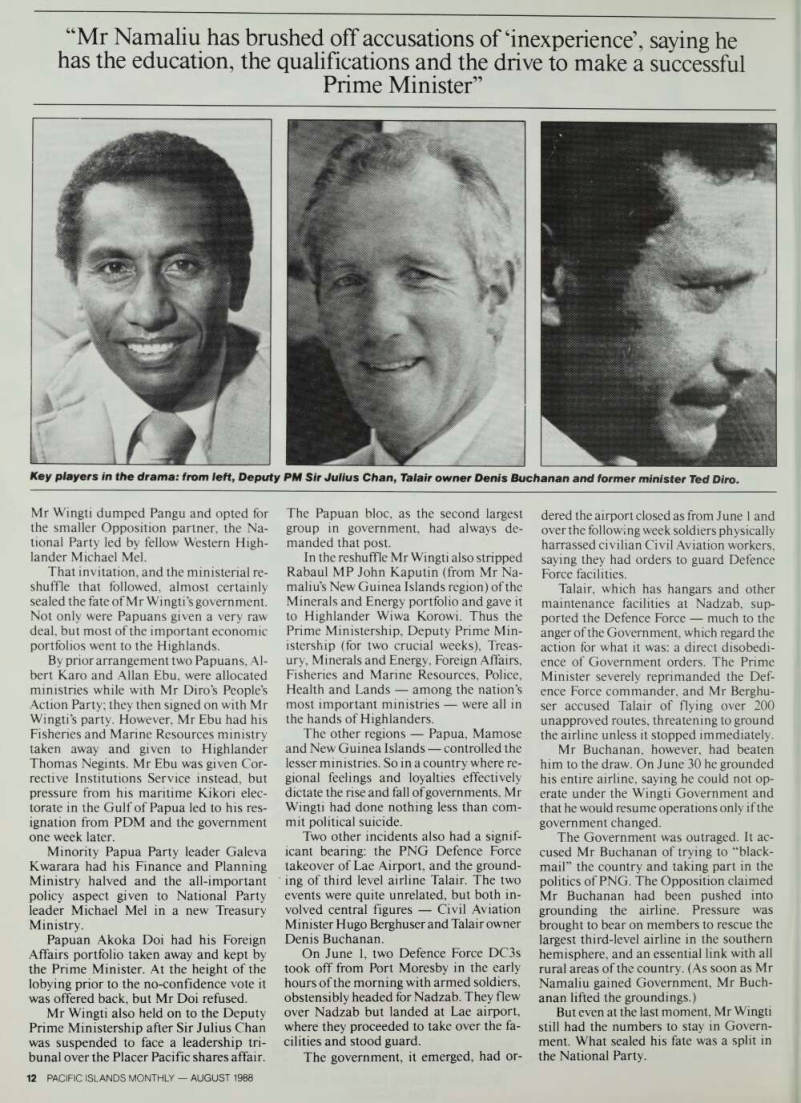
Key players in the drama: from left, Deputy PM Sir Julius Chan, Talair owner Denis Buchanan and former minister Ted Diro.
A splinter group of five members led by an old political rival. Mount Hagen busi nessman Paul Pora, joined the Opposi tion. In a last-ditch stand to stem the tide of resignations, Mr Wingti tabled the For estry Inquiry’s second interim report rec ommending criminal prosecution against Mr Diro and other persons concerned. . . but his timing was awry. With three days to the vote, nobody bothered to read the two voluminous reports.
When defeat finally came, Mr Wingti took it calmly. He was first across the floor to congratulate the new Prime Minister.
“It has been very difficult governing the country given the different factions in government,” he said. “It has been very tiring and I faced a lot of problems.” Pri vately, he has said he is much relieved.
His Deputy, Sir Julius Chan, had words of thanks, praise and prediction. “I think the greatest victory today is that the people, through this parliament, have chosen the change in Government,” Mr Julius said.
“From time to time your Mr Wingti’s leadership will be called on to test again the need to make change if change is necessary, and we should not be afraid to do so when the time comes.”
Mr Namaliu, while promising a review of government activity, is supportive of Mr Wingti’s emphasis on economic development.
At 41 he is not only three years older than Mr Wingti, but has been close to PNG politics longer. He graduated from the University of PNG with a Bachelor of Arts, majoring in History and English, in 1970.
He was awarded a Canadian scholarship to do a Master’s degree at the University of Victoria in British Columbia, and on his return to PNG he tutored at UPNG before becoming principal private secretary to Chief Minister Michael Smoare in 1974.
Not only after he became one of the first Papua New Guineans to be appointed a District Commissioner, and in 1976 he was made chairman of the Public Services Commission.
Mr Namaliu entered politics in 1982 as member for Kokopo, and served under both Somare and Wingti (when he was deputy Pangu Pati leader): he held the For eign Affairs and Primary Industry port folios in the Somare government.
He has brushed off accusations of “inex perience”, saying he has the education, the qualifications and the drive to make a suc cessful Prime Minister. “I am not afraid to lead, nor am I so naive as to swerve from responsibilities of firm and decisive lead ership. I believe in democratic participa tory government and that is exactly what the people of PNG will get,” he said.
At time of going to press, the new Govern ment comprised Pangu, Melanesian Alli ance, the Papuan bloc, the League for National Advancement and the National Party splinter group. The Opposition comprises the the People’s Progress Party, the Melanesian United Front and the rest of the National Party. □