New Guinea Goes To Air
p. 58 · Read in the full issue
Out Of The Past
Bert Weston recalls the early days of radio in Salamaua and Edie Creek.
THE ARTICLE in the May issue of Pacific Islands Monthly dealing with the communications revolu tion in the Pacific and the comprehensive and sophisticated internal and external systems now in operation are a far cry from those existing in what was the Mandated Territory of New Guinea when I arrived there 60 years ago.
Rabaul alone then possessed a tele phone service, manually operated, and there were a few private lines strung up in other places such as between Edie Creek and Wau and from Holden’s Air Service office in Salamaua to the airfield three kil ometres away; these were single-wire earth return systems. In 1937, Salamaua re ceived a telephone service to about 40 subscribers.
When the telephone service was even tually installed each subscriber was given a number, but these were usually dis carded in favour of asking the operator for a person or firm by name. The operator’s shed had an open shutter providing a full view of the one and only street in Sala maua and this made him a mine of information.
Radio was operated by Amalgamated Wireless Australia (AWA) with the main station, capable of reaching Sydney, lo cated at Kopoko near Rabaul. Several small coastal stations able to reach Ra baul and ships in local waters were estab lished in a few outports from which messages to Australia were relayed by Ra baul radio, all by morse keying.
One such station was on the Edie Creek goldfield, high in the mountains behind Wau. Operator Ted Bishton installed it in 1927 after it had been reduced to its com ponent parts down on the coast and car ried in along the Buang track over some weeks. “Bish” remained as operator for some years. He also acquired a gold min ing claim, which he worked profitably each day when not attending to morning and afternoon schedules. Some of the long time staff at the Kokopo station also took up tracts of land nearby and spent time off duty setting up coconut plantations.
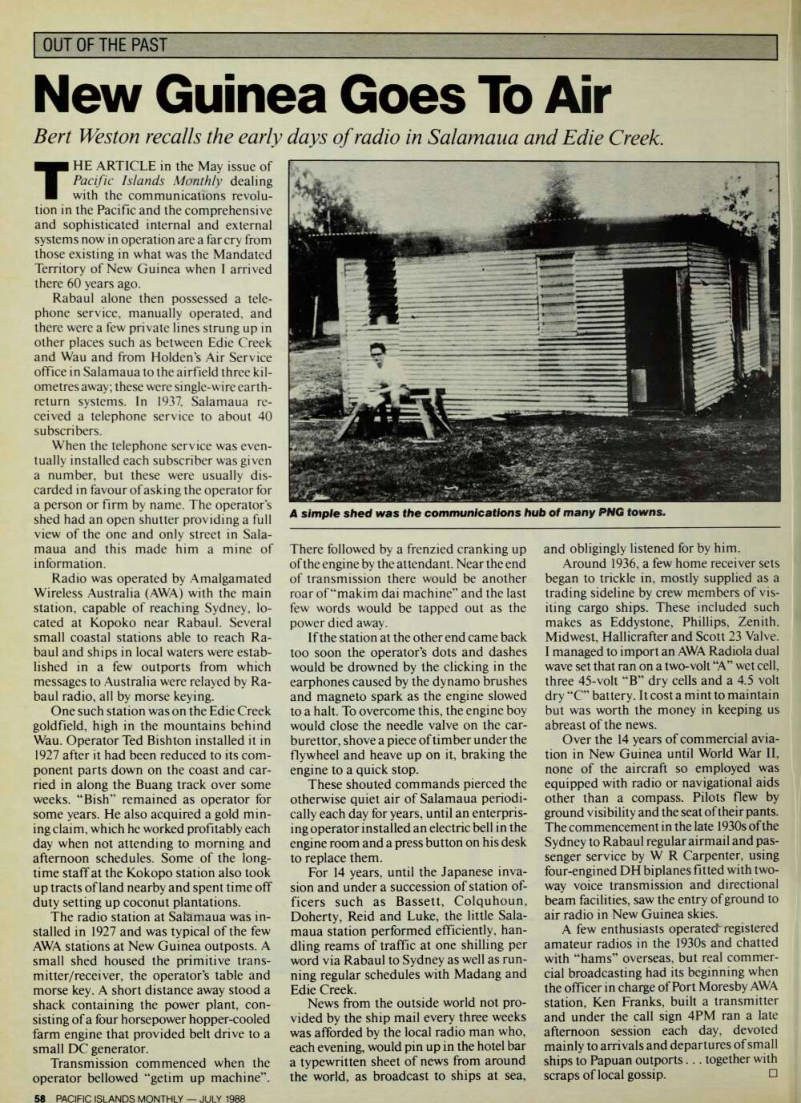
The radio station at Salamaua was in stalled in 1927 and was typical of the few AWA stations at New Guinea outposts. A small shed housed the primitive trans mitter/receiver, the operator’s table and morse key. A short distance away stood a shack containing the power plant, con sisting of a four horsepower hopper-cooled farm engine that provided belt drive to a small DC generator.
Transmission commenced when the operator bellowed “getim up machine”.
There followed by a frenzied cranking up of the engine by the attendant. Near the end of transmission there would be another roar of “makim dai machine” and the last few words would be tapped out as the power died away.
If the station at the other end came back too soon the operator’s dots and dashes would be drowned by the clicking in the earphones caused by the dynamo brushes and magneto spark as the engine slowed to a halt. To overcome this, the engine boy would close the needle valve on the car burettor, shove a piece of timber under the flywheel and heave up on it, braking the engine to a quick stop.
These shouted commands pierced the otherwise quiet air of Salamaua periodi cally each day for years, until an enterpris ing operator installed an electric bell in the engine room and a press button on his desk to replace them.
For 14 years, until the Japanese inva sion and under a succession of station of ficers such as Bassett, Colquhoun, Doherty, Reid and Luke, the little Sala maua station performed efficiently, han dling reams of traffic at one shilling per word via Rabaul to Sydney as well as run ning regular schedules with Madang and Edie Creek.
News from the outside world not pro vided by the ship mail every three weeks was afforded by the local radio man who, each evening, would pin up in the hotel bar a typewritten sheet of news from around the world, as broadcast to ships at sea,
and obligingly listened for by him.
Around 1936, a few home receiver sets began to trickle in, mostly supplied as a trading sideline by crew members of vis iting cargo ships. These included such makes as Eddystone, Phillips, Zenith, Midwest, Hallicrafter and Scott 23 Valve.
I managed to import an AWA Radiola dual wave set that ran on a two-volt “A” wet cell, three 45-volt “B” dry cells and a 4.5 volt dry “C” battery. It cost a mint to maintain but was worth the money in keeping us abreast of the news.
Over the 14 years of commercial avia tion in New Guinea until World War 11, none of the aircraft so employed was equipped with radio or navigational aids other than a compass. Pilots flew by ground visibility and the seat of their pants.
The commencement in the late 1930 s of the Sydney to Rabaul regular airmail and pas senger service by W R Carpenter, using four-engined DH biplanes fitted with two way voice transmission and directional beam facilities, saw the entry of ground to air radio in New Guinea skies.
A few enthusiasts operated registered amateur radios in the 1930 s and chatted with “hams” overseas, but real commer cial broadcasting had its beginning when the officer in charge of Port Moresby AWA station, Ken Franks, built a transmitter and under the call sign 4PM ran a late afternoon session each day, devoted mainly to arrivals and departures of small ships to Papuan outports... together with scraps of local gossip. □
A simple shed was the communications hub of many PNG towns.