Back To The Islands
p. 18 · Read in the full issue
New Zealand
Sir Paul Reeves revives his ties with the region.
By Jack Kelleher
IT HAD been an emotional experience and one that still enveloped him. Sir Paul Reeves used his hands to indicate the sense of family that was part of the Maori life, his heritage, and the effect of offering that relationship back to the world from which it came.
“I see it as something that binds us, and doesn’t divide us,” he said. Partnership in the region had taken on a new meaning for him; the experience of meeting so many people in their own countries had con firmed his hopes for the region and for the significance of New Zealand as a part of the South Pacific.
New Zealand was not the major power of the region, he said, but it did have re sources to make available on terms set by the islanders: “We seem to have a sensi tivity about this, which they welcome and appreciate.”
Sir Paul was conscious of the pathfind ing nature of the tour. In the Tokelaus His Excellency was constitutionally in a part of New Zealand and the territory in which he is the Queen’s representative, but on most of the islands he was not. A quite dif ferent protocol was involved.
Was the extent of the tour evidence of new thinking from the Ministry of For eign Affairs, testing the possibilities when the Queen’s representative in New Zea land is Maori? Whatever its origin, the tour through Tonga, Western Samoa, the Cook Islands, Vanuatu, the Solomon Islands and Papua New Guinea had been an outstand
ing success, he acknowledged.
Sir Paul and Lady Reeves had taken with them a small party of Maoris, two from his home province of Taranaki to en sure a contribution
from the visitors of appropriate custom and protocol in the arrival ceremonies.
Their presence endorsed the Maori aspect of the visits.
While earlier Governors-General had travelled to the islands, Sir Paul was aware that he was the first to do so in such an extensive way. In some cases he was per sonalising contacts he had made earlier in life, some of them when he was Arch bishop of New Zealand.
In earlier years he had been given hon ours in Western Samoa, also in a village in Tonga; the prime minister of Vanuatu had been his pupil at St John’s College, Auck land. This time, in his new role, he was able to announce the NZ Government’s insti tution of the Sir Paul Reeves Scholarship for each country: a student from each of six island countries will have the oppor tunity each year to study in New Zealand at undergraduate or postgraduate level.
Because church missionary societies have been involved in education in New Zealand and the islands for so long Sol omons and Vanuatu students at Maori and
other schools since 1850 a former arch bishop could not miss the significance of being associated with such scholarships.
Sir Paul said he was impressed by the continuing impact of religion in the is lands; the understanding that life and re ligion are one rather than the secular world’s impression that religion is for spare time. Principles could be misapplied, but the islands lifestyle was a good one.
Churches in the islands, with backing from societies in places such as New Zealand, were still able to run schools and hospi tals. Church societies should continue to be encouraged, Sir Paul said; the Melane-
sian Brotherhood was a fine example in which young men went out to isolated places and spread the faith by example, not by words alone.
On his first day back in the Wellington office, Sir Paul had formally received a huge report on New Zealand’s social serv ices that included criticisms of the status of women. One of his lasting memories of the tour was the size of the congregation for a cathedral service in Honiara and the separation of the men on one side of St Barnabas’s, the women on the other.
Port Moresby gave the Queen’s New Zealand representative a particular wel come, with street signs for a cavalcade and children everywhere. There were expres sions of gratitude for aid projects de scribed as “modest, flexible and close to the grass roots of society”.
Those aid projects had impressed, whether they were offered by church mis sionaries or by New Zealand engineers.
They showed this country was finding a true role for itself among its island neighbours. D
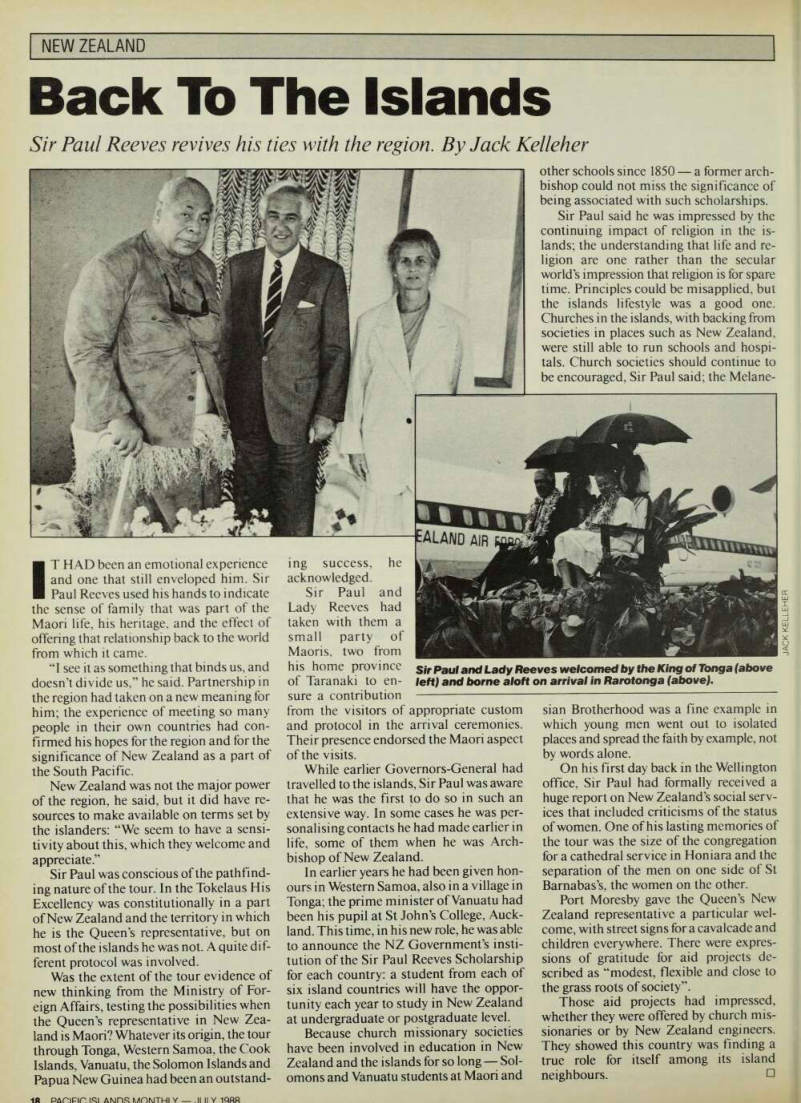
Sir Paul and Lady Reeves welcomed by the King of Tonga (above left) and borne aloft on arrival in Rarotonga (above).