Islands 88: A Meeting Of
p. 16 · Read in the full issue
Australia
Islands 88: A Meeting Of Pacific Minds By Vivian Carroll
By Vivian Carroll
POLITICAL and economic prob lems stemming from geographical isolation, cultural insularity and resource dependence are common to is lands and rural communities throughout the world.
This May, two international meetings addressed the large-scale political, eco nomic, cultural and energy resource issues facing small island states and remote lan dlocked regions. Both were held in the southern hemisphere for the first time and simultaneously at the University of Tasmania in Hobart.
Islands 88, the second Conference of the Islands of the World, and ERIC V, the fifth Energy for Rural and Island Communities Conference, drew 170 delegates from 25 countries; chiefly Pacific rim and oceanic nations but also from France, West Ger many, Israel, India, Sri Lanka, Mauritius, the Maldives and Jamaica. Opened by Sir Ninian Stephen, Australia’s Governor- General, Islands 88 took an interdiscipli nary problem-oriented approach devel oped further by the concurrent ERIC V meeting. Diplomats met with field devel opment workers, technologists sat with economists, environmental scientists lunched with administrators and academ ics heard the tales of island fishermen.
Issues on the agenda included pros pects for self-reliance; islands as sovereign states; women and human resources in is land development; appropriate economic
development through innovation and a critical examination of tourism.
Mr Arthur Boyd, an economist and resident of the US-administered San Juan Islands, said tourism should not be seen as an “economic panacea” for the problems of small island states. There were consid erable risks for the continuity of island so cieties when tourist numbers rose to upset the level of local resources and infrastruc ture such as medical care, roads, food and water supplies and local policing. The sought-after economic multiplier effect of tourism could often run into the negative in vulnerable communities. Dangers also existed in abandoning traditional activi ties in favour of modern development op tions; small inns, for example, are better suited to island economies than five-star hotel complexes that divert money from the local community.
Dr David Lowenthal, a geographer at University College, London, believes is landers have “justified misgivings” about change and could do well to exchange per ceived rewards for stability. Even at Is lands 88, outsiders offering “solutions” were often part of the problem. According to Dr Lowenthal, outsiders find a power vacuum in islands and become over-zeal ous on their inhabitants’ behalf. Even the suggestion that an International Associ ation of Islands of the World be estab lished met with the steely response: “Whose initiative; what motive?”
Lowenthal says islanders need to be generalists flexible enough to move be tween occupations and developments as they change unlike, for example, Brit ish coalminers who are now unable to shift location or occupation.
Possibilities for more rational air trans port systems (both for passengers and freight) were examined, as were shipping services often difficult to maintain at economic and efficient levels.
Throughout discussions in workshops and plenary sessions, it was agreed that a major condition allowing island dwellers the opportunity to maintain and improve their social and economic wellbeing was a degree of administrative autonomy; which includes an element of local control over the use of natural resources so the pro ceeds of short-term production are rein vested in the local area.
In the field of human resources, prob lems include the formulation of appropri ate education policies in countries from which a high proportion of young adults will emigrate, and migration as a partial solution to unemployment or other local difficulties.
Although a formal association of is lands did not emerge this year, delegates and individuals can now work together through a secretariat at the Small Islands Centre at (believe it or not) the University of Calgary, Canada. □
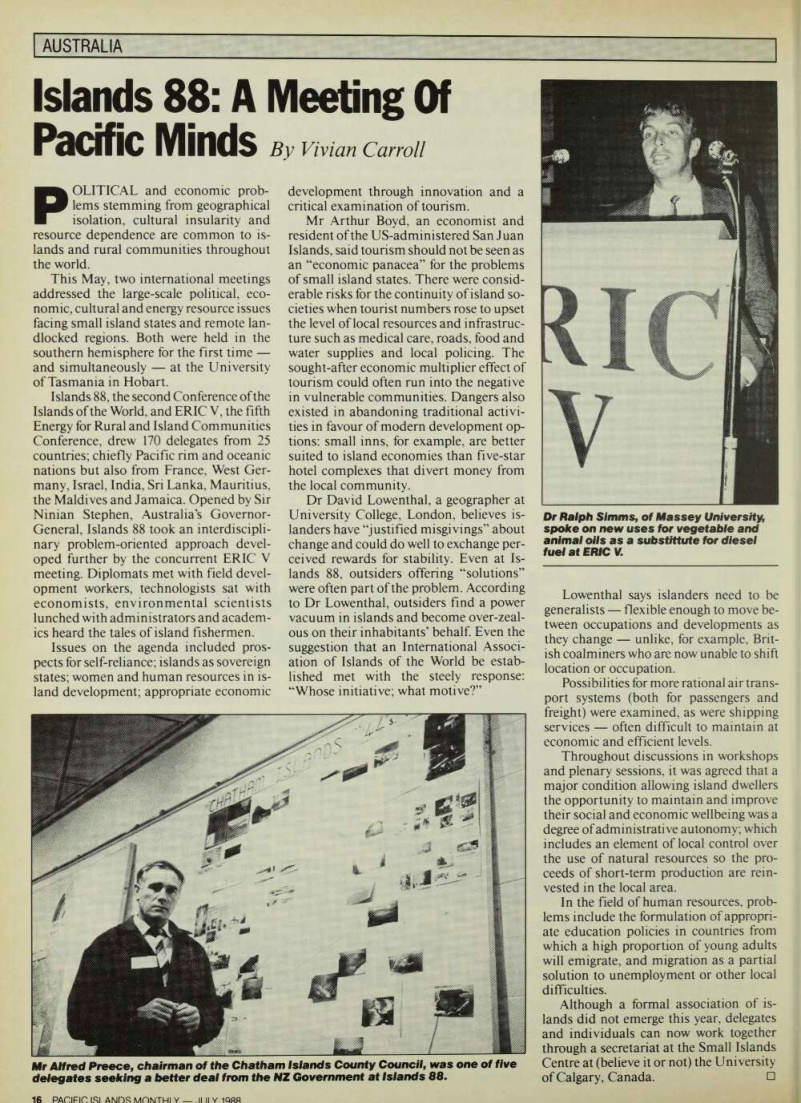
Mr Alfred Preece, chairman of the Chatham Islands County Council, was one of five delegates seeking a better deal from the NZ Government at Islands 88.
Dr Ralph Simms, of Massey University, spoke on new uses for vegetable and animal oils as a substitute for diesel fuel at ERIC V.