Ratu Sukuna’s Crowning Moment
p. 58 · Read in the full issue
Out Of The Past
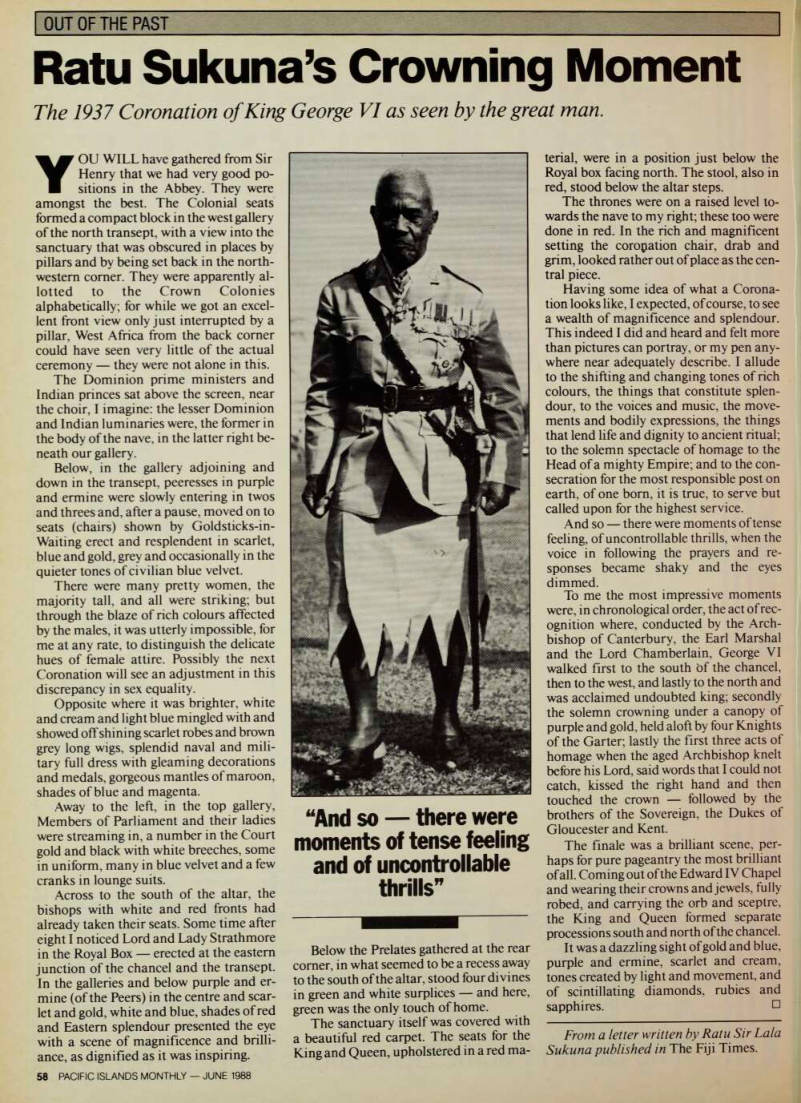
The 1937 Coronation of King George VI as seen by the great man.
YOU WILL have gathered from Sir Henry that we had very good po sitions in the Abbey. They were amongst the best. The Colonial seats formed a compact block in the west gallery of the north transept, with a view into the sanctuary that was obscured in places by pillars and by being set back in the north western corner. They were apparently al lotted to the Crown Colonies alphabetically; for while we got an excel lent front view only just interrupted by a pillar, West Africa from the back comer could have seen very little of the actual ceremony they were not alone in this.
The Dominion prime ministers and Indian princes sat above the screen, near the choir, I imagine: the lesser Dominion and Indian luminaries were, the former in the body of the nave, in the latter right be neath our gallery.
Below, in the gallery adjoining and down in the transept, peeresses in purple and ermine were slowly entering in twos and threes and, after a pause, moved on to seals (chairs) shown by Goldsticks-in- Waiting erect and resplendent in scarlet, blue and gold, grey and occasionally in the quieter tones of civilian blue velvet.
There were many pretty women, the majority tall, and all were striking; but through the blaze of rich colours affected by the males, it was utterly impossible, for me at any rate, to distinguish the delicate hues of female attire. Possibly the next Coronation will see an adjustment in this discrepancy in sex equality.
Opposite where it was brighter, white and cream and light blue mingled with and showed off shining scarlet robes and brown grey long wigs, splendid naval and mili tary full dress with gleaming decorations and medals, gorgeous mantles of maroon, shades of blue and magenta.
Away to the left, in the top gallery, Members of Parliament and their ladies were streaming in, a number in the Court gold and black with white breeches, some in uniform, many in blue velvet and a few cranks in lounge suits.
Across to the south of the altar, the bishops with white and red fronts had already taken their seats. Some time after eight I noticed Lord and Lady Strathmore in the Royal Box erected at the eastern junction of the chancel and the transept.
In the galleries and below purple and er mine (of the Peers) in the centre and scar let and gold, white and blue, shades of red and Eastern splendour presented the eye with a scene of magnificence and brilli ance, as dignified as it was inspiring.
Below the Prelates gathered at the rear comer, in what seemed to be a recess away to the south of the altar, stood four divines in green and white surplices and here, green was the only touch of home.
The sanctuary itself was covered with a beautiful red carpet. The seats for the King and Queen, upholstered in a red ma
terial, were in a position just below the Royal box facing north. The stool, also in red, stood below the altar steps.
The thrones were on a raised level to wards the nave to my right; these too were done in red. In the rich and magnificent setting the coronation chair, drab and grim, looked rather out of place as the cen tral piece.
Having some idea of what a Corona tion looks like, I expected, of course, to see a wealth of magnificence and splendour.
This indeed I did and heard and felt more than pictures can portray, or my pen any where near adequately describe. I allude to the shifting and changing tones of rich colours, the things that constitute splen dour, to the voices and music, the move ments and bodily expressions, the things that lend life and dignity to ancient ritual; to the solemn spectacle of homage to the Head of a mighty Empire; and to the con secration for the most responsible post on earth, of one bom, it is true, to serve but called upon for the highest service.
And so there were moments of tense feeling, of uncontrollable thrills, when the voice in following the prayers and re sponses became shaky and the eyes dimmed.
To me the most impressive moments were, in chronological order, the act of rec ognition where, conducted by the Arch bishop of Canterbury, the Earl Marshal and the Lord Chamberlain, George VI walked first to the south of the chancel, then to the west, and lastly to the north and was acclaimed undoubted king; secondly the solemn crowning under a canopy of purple and gold, held aloft by four Knights of the Garter; lastly the first three acts of homage when the aged Archbishop knelt before his Lord, said words that I could not catch, kissed the right hand and then touched the crown followed by the brothers of the Sovereign, the Dukes of Gloucester and Kent.
The finale was a brilliant scene, per haps for pure pageantry the most brilliant of all. Coming out of the Edward IV Chapel and wearing their crowns and jewels, fully robed, and carrying the orb and sceptre, the King and Queen formed separate processions south and north of the chancel.
It was a dazzling sight of gold and blue, purple and ermine, scarlet and cream, tones created by light and movement, and of scintillating diamonds, rubies and sapphires. D
From a letter written by Ratu Sir Lala Sukuna published in The Fiji Times.
“And so - there were moments of tense feeling and of uncontrollable thrills”