Here’s To A New Islands Brew
p. 38 · Read in the full issue
Western Samoa’s Vailima beer is a foaming success.
By Laurie Strachan
WHEN a country’s balance of pay ments gets out of kilter, it has to start doing two things in creasing exports and cutting imports.
The most effective way of trimming the imports bill is to give consumers locally made products at a better price than those they can import. Import substitution is a concept that is working brilliantly in one particular industry in Western Samoa.
Ten years ago the Government entered into a joint venture with the West German company Brauhaase to build a brewery able to handle the island’s beer needs and to earn some much-needed foreign ex change by way of exports.
Now Western Samoa Breweries Lim ited is the single largest revenue earner in the country, with a turnover of 12 million tala (SAB.S million) and a workforce of 130.
It brews its own Vailima beer in three dif ferent styles and San Miguel beer on lic ence from the Philippines; unusually for a brewery, it also bottles the Coca-Cola range of soft drinks.
With a tax of 45 per cent on its prod ucts, it’s a good earner for the Government and also brings in some export income from neighbouring American Samoa, New Zealand, the Tokelau Islands and the Cook Islands.
However, the drive for exports is se verely hindered by the fact that the brew ery has to import all its raw materials other than the water; the malt comes from Aus tralia and the hops from the famous hop fields of Bavaria in southern Germany.
The yeast is also German.
As a result, the landed price in what should have been the ideal nearby market of Hawaii is higher than competitors such as New Zealand’s Steinlager and even beers such as Holsten, shipped all the way from Hamburg, making Hawaii a hard market to crack. However, internal demand con
tinues to grow, says man ager Horst Hoffmann.
“Samoans are not heavy beer consumers,” he says.
“Their per capita consump tion is about 27 litres a year compared with Germans, who drink around 135 litres.
However, consumption is increasing and I project a rise of about 10 per cent a year for the next few years.”
The brewery’s output last year was 55,000 hectolitres, which puts it in the class of a large mini-brewery. (By comparison, a major Aus tralian operation such as the
Carlton Brewery in Sydney has an annual output of around four million hectolitres.) The beer itself is a high quality product designed to a German recipe that complies with the Bavarian purity law, the Reinheitsgebot.
It uses no chemical additives but does, unlike the German beers, occasionally incorporate some cane sugar. The reason,
says master brewer Manfred Graaf, is sim ply that “sometimes we have a surplus of sugar left over from the soft-drink manu facturing side of the business, so we add that to the beer wort.”
Graaf points out that the small amounts added have little effect on the flavour of the final product. Pacific Islands Month ly's own taste test confirmed that Vailima is a beer that for purity and complexity of flavour, leaves many of its mass-market competitors in the shade.
The San Miguel beer is, naturally, brewed to a Filipino recipe aimed at get ting as close as possible to the taste of the highly successful original.
Graaf trained in Germany and he, in turn, is training a team of young Samoans to take over when he leaves.
Incidentally, the name Vailima comes from the place in Western Samoa where the writer Robert Louis Stevenson spent his last five years. It means “water out of the hand” and it derives from an old local leg end about the discovery of a spring.
Thanks to Westen Samoa Breweries, it has a whole new meaning now. □
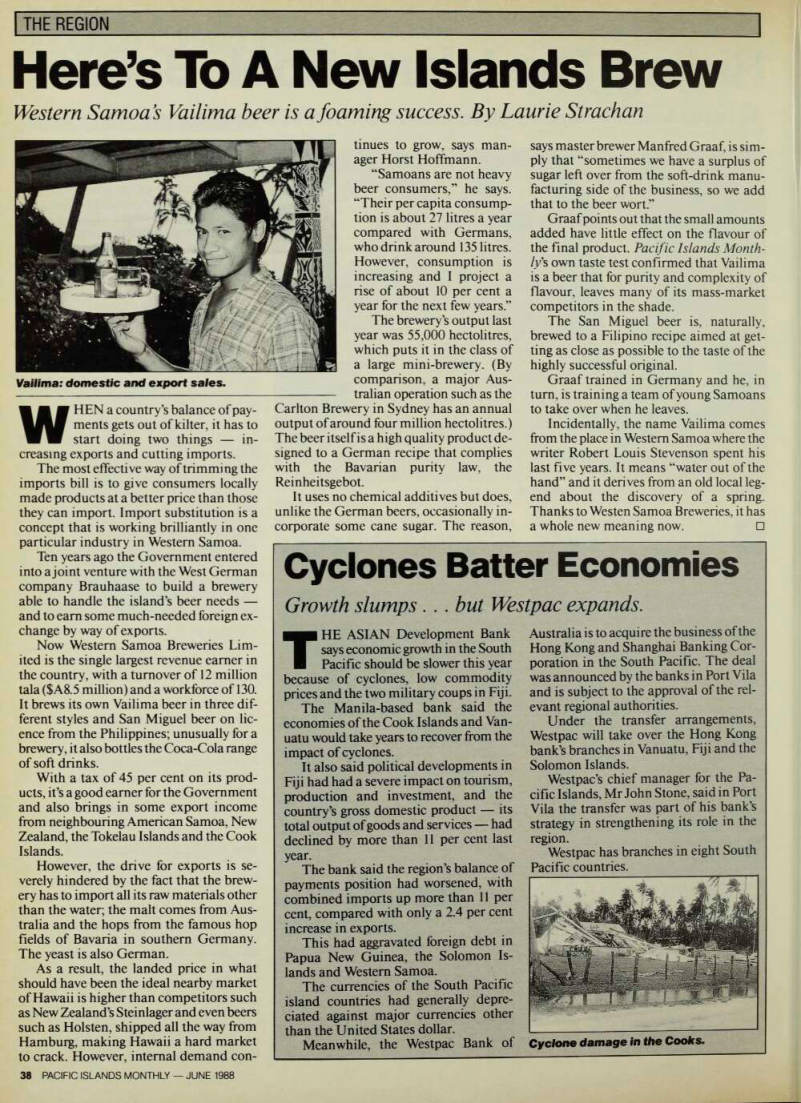
Vailima: domestic and export sales.