PNG Law
pp. 34-36 · Read in the full issue
PARTS of Papua New Guinea are slipping into anarchy. In the West ern Highlands, the Government’s rule of law is yielding to the gun.
The elders and fight leaders of clans that fought one another with bow and arrow until pacification in the 1940 s and ’sos know it.
So do gangs of delinquent youths, the casualties of a misconceived educational system. So do the coastal Papua New Gui neans and expatriates employed in government and commerce. So does the majority of law-abiding Highlanders.
The rule of law and the sanctions it em ploys the police, the courts and the prospect of jail, which establish its au thority are in retreat.
These were my impressions from a re cent month-long visit to PNG, including several days in the Highlands. I talked with
national police officers and journalists, with expatriate plantation managers, businessmen and academics and read the national newspapers.. What I saw in the Western Highlands saddened and shocked me. I don’t see myself as a blow-in jour nalist from “South” looking for a beat-up story on lawlessness at PNG’s expense.
I have lived off and on in PNG over 27 years. It was a crucible of my formative years: working for the late Jim Leahy on coffee plantations in the Highlands in the early 19605; as a freelance journalist for four years in Port Moresby, reporting on the transition from Australian rule to in dependence; making a television docu mentary on the role of aircraft in opening up the country.
PNG was where I cut my teeth as a for eign correspondent, and I enjoyed going back there for old friendships renewed, for the excitement of an impending gold boom and to see the energy of the capital. But not what I saw in the Western Highlands.
In Mount Hagen I was shown home made shotguns at police headquarters. A two-centimetre pipe is fixed to a carved
wooden stock. The firing pin is a 7cm nail; a strip of inner tube pulled taught by a clothes peg is the spring and firing mechanism.
I met Mrs Norma Burgess, cashier of the large local trading company, who had been robbed at gunpoint by three men while taking the weekend’s earning of K 200.000 from the strongroom to the bank a one-minute journey at 8.30 one morning.
I was told of one plantation manage ment company that has withdrawn from the Baiyer River Valley, where it had man aged cattle and coffee interests belonging to local government councils. The coun cils could not guarantee the safety of staff and property.
I was told of a management group with nine plantations, owned by a Western Highlands business group led by Parlia mentary Opposition member Michael Mel, which charters helicopters to fly in plantation payrolls because the roads are no longer safe. Insurance is now refused for bulk cash movements through the Highlands.
The hysteria generated by the recent general election has contributed to the growing anarchy. The Highland warrior’s obsession with martial prowess now fo cusses on being elected: election means the chance to reward supporters with the lar gesse that comes with holding office.
Fourteen hundred candidates con tested 109 seats in the July elections. In one Highland seat 45 hopefuls nominated, and supporters of defeated candidates vented their rage by pillage and arson on millions of kina worth of government property hospitals, schools, district offices, corn
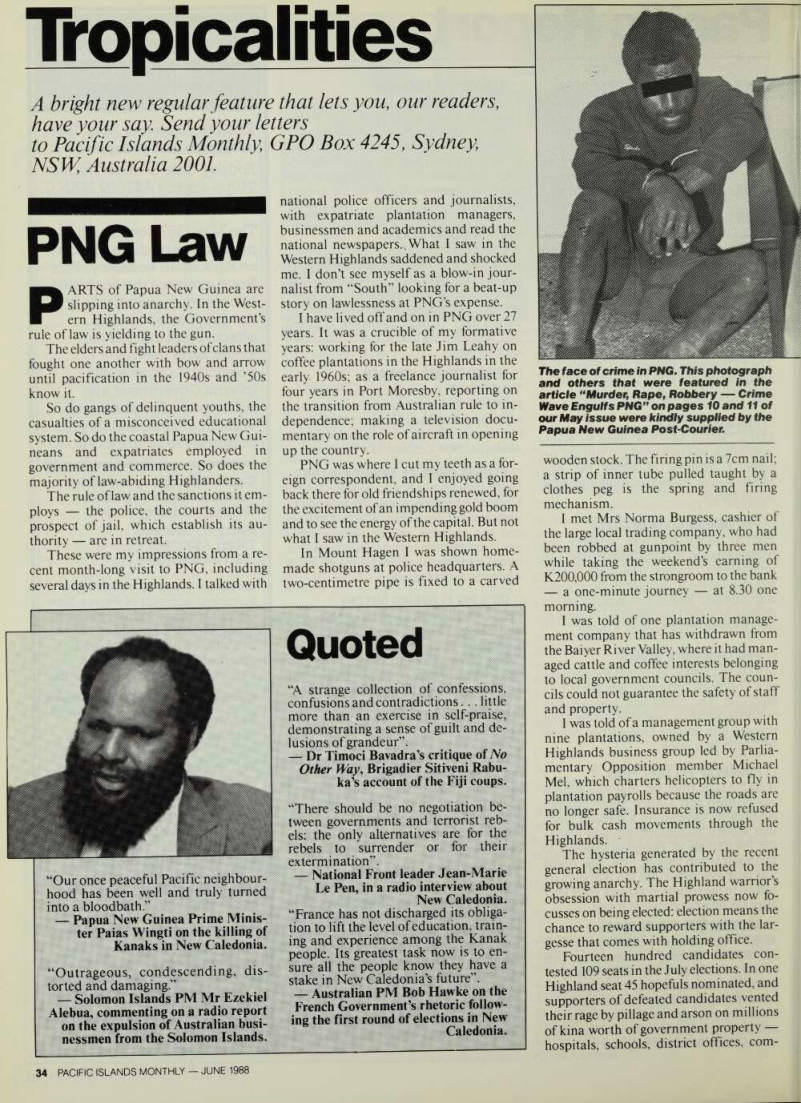
The face of crime in PNG. This photograph and others that were featured in the article “Murder, Rape, Robbery - Crime Wave Engulfs PNG” on pages 10 and 11 of our May issue were kindly supplied by the Papua New Guinea Post-Courier.
munity centres; by beating electoral offi cials and teachers, and by the rape of wives, nurses and female teachers.
And the Government response? Prime Minister Paias Wingti won’t accept that PNG has a problem with lawlessness. He prefers to talk of “the growing pains of a young country”. His remedy is to develop PNG’s agricultural and fishing resources for the twofold purpose of generating wealth, and to dissipate antisocial behav iour through expanded opportunities for employment.
As a long-term solution, no one could quarrel with that. As a solution to the cur rent crisis, it’s like draining the pool while ignoring someone drowning.
I’ve known Dick Hagon since the early 19605. He’s lived in the Western High lands since 1954, when he turned a tract of uninhabited swamp into the largest and one of the best coffee plantations in the country.
He sold out after 20 years, but retains other commercial interests. Five years ago the PNG Government invited him to res cue the Wahgi-Mek group of plantations, owned by two local government councils.
Debts of K 5.7 million had taken it to the wall; Hagon is now turning it round, re paying creditors at K 1.5 million a year with a commitment to clear all debts by 1990.
“I’m like a lot of Australians who’ve lived the best years of their lives in this country,” he told me. “I want to see it through its difficulties.”
He agrees with PM Wingti on the need for massive rural development, but he also wants radical action to combat lawless ness now: rewards to police informers leading to convictions; surrender to police of all firearms and ammunition, regard less of licences; a maximum security prison, preferably on an offshore island, to isolate and contain hard-core criminals; and expanded recruitment and better pay, training and equipment for PNG’s de moralised police force.
Hagon should be judged by his deeds as much as by his words. He was instru mental in establishing a Law and Order Committee in Mount Hagen to liaise with police; in setting up rewards for police in formants. It has helped, he says... but it’s not by itself enough.
Lawlessness is probably worst in the
Western Highlands, but it’s also a problem in major urban centres such as Port Mo resby and Lae. There it surfaces through the so-called “raskol” gangs of delinquent youths, casualties from a school system that discards all but a handful before high school, and that does nothing to prepare the balance for the workforce.
They come to the cities in search of work or job training, are rebuffed, and gravitate to gangs that burgle and rape.
Bonds of camaraderie are forged in def ence against a society that rejects them.
That’s the judgment of Dr Bruce Har ris, of the University of California, San Diego, a social anthropologist who speci alises in urban outcast gangs and who for 18 months has been studying Port Mores by’s “raskol” gangs through the Institute of Applied Social and Economic Research for the PNG Government.
Media reports in Australia and New Zealand have stamped Lae and Port Mo resby as cities where no woman, especially a white woman, is safe. While Harris de plores rape, he insists it is motivated not by the need for sexual release but as an outlet for pent-up rage, frustration and the sense of failure in a society that relegates its unemployed and unemployable to the scrapheap. The victim may be singled out for a real or imagined slight, he says. The rapist may believe the woman or the wom an’s husband must be punished; or it may be Melanesian male pride humiliated at taking orders from a woman.
Former chief-of-staff Tim Sinclair made the point in the PNG Post Courier in September. Rape, he said, “is commit ted by people who feel the need to prove they are not just third-rate dropouts. The unconscious thinking goes: ‘You might have the brains, money and good life, but I’ll show you I’ve got manhood.’ It is pay back by those who feel cheated by life.”
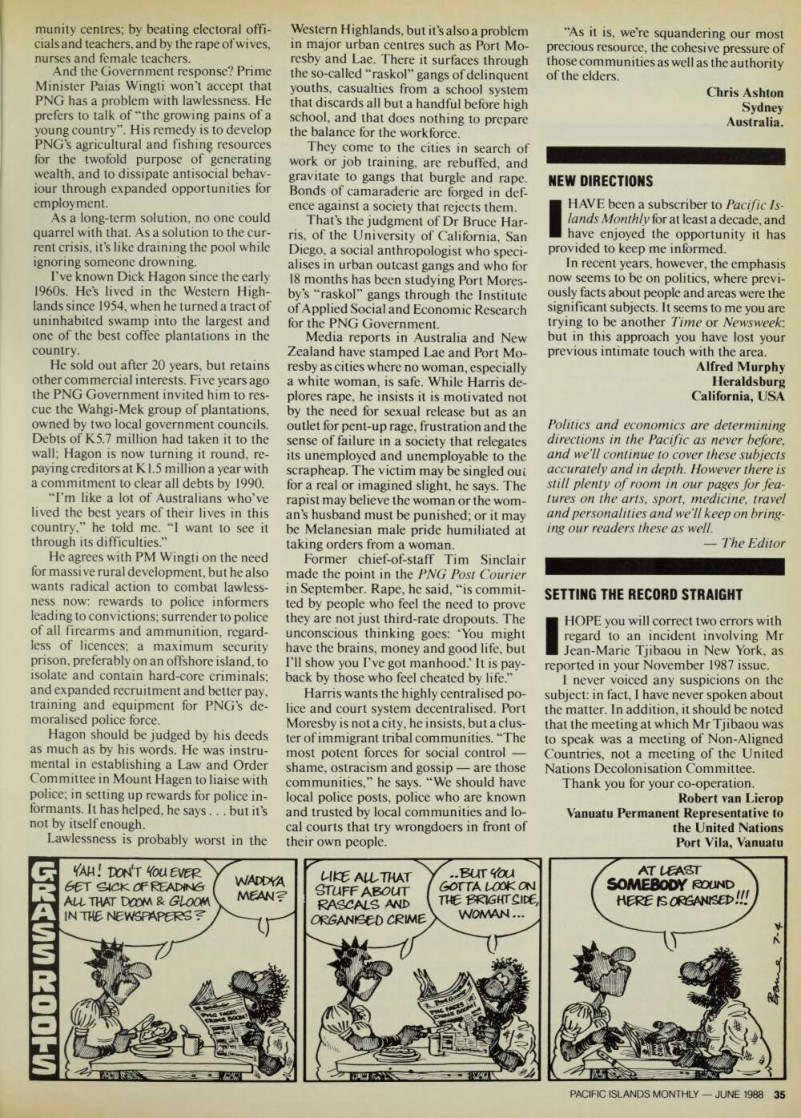
Harris wants the highly centralised po lice and court system decentralised. Port Moresby is not a city, he insists, but a clus ter of immigrant tribal communities. “The most potent forces for social control shame, ostracism and gossip are those communities,” he says. “We should have local police posts, police who are known and trusted by local communities and lo cal courts that try wrongdoers in front of their own people.
“As it is, we’re squandering our most precious resource, the cohesive pressure of those communities as well as the authority of the elders.
Chris Ashton
Sydney Australia.
New Directions
I HAVE been a subscriber to Pacific Is lands Monthly for at least a decade, and have enjoyed the opportunity it has provided to keep me informed.
In recent years, however, the emphasis now seems to be on politics, where previ ously facts about people and areas were the significant subjects. It seems to me you are trying to be another Time or Newsweek : but in this approach you have lost your previous intimate touch with the area.
Alfred Murphy
Heraldsburg California, USA Politics and economics are determining directions in the Pacific as never before, and well continue to cover these subjects accurately and in depth. However there is still plenty of room in our pages for fea tures on the arts, sport, medicine, travel and personalities and well keep on bring ing our readers these as well.
The Editor
Setting The Record Straight
I HOPE you will correct two errors with regard to an incident involving Mr Jean-Marie Tjibaou in New York, as reported in your November 1987 issue.
I never voiced any suspicions on the subject: in fact, I have never spoken about the matter. In addition, it should be noted that the meeting at which Mr Tjibaou was to speak was a meeting of Non-Aligned Countries, not a meeting of the United Nations Decolonisation Committee.
Thank you for your co-operation.
Robert van Lierop
Vanuatu Permanent Representative to the United Nations Port Vila, Vanuatu
The Role Of The Church
I READ with interest James S Murray’s “The Church Today” in your January issue, but would like to correct the impression he gives of the role of the An glican Church in relation to other mission ary bodies in the evangelisation of the Pacific.
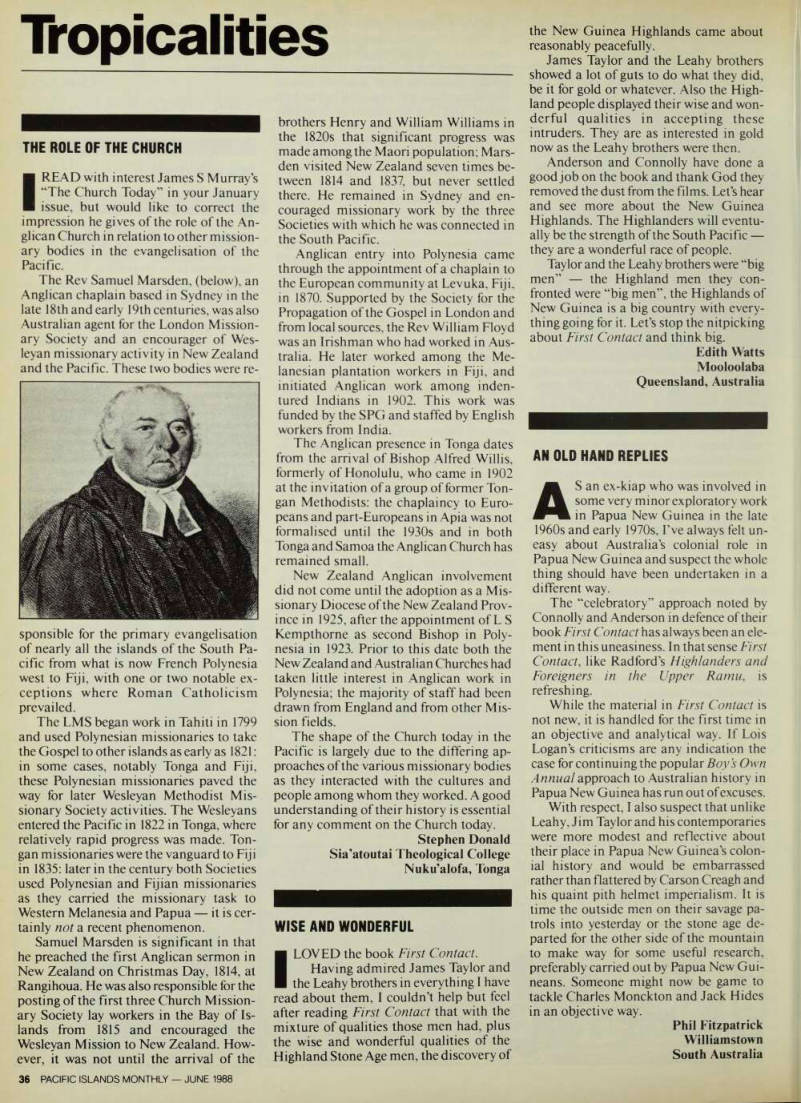
The Rev Samuel Marsden, (below), an Anglican chaplain based in Sydney in the late 18th and early 19th centuries, was also Australian agent for the London Mission ary Society and an encourager of Wes leyan missionary activity in New Zealand and the Pacific. These two bodies were re-
sponsible for the primary evangelisation of nearly all the islands of the South Pa cific from what is now French Polynesia west to Fiji, with one or two notable ex ceptions where Roman Catholicism prevailed.
The LMS began work in Tahiti in 1799 and used Polynesian missionaries to take the Gospel to other islands as early as 1821: in some cases, notably Tonga and Fiji, these Polynesian missionaries paved the way for later Wesleyan Methodist Mis sionary Society activities. The Wesleyans entered the Pacific in 1822 in Tonga, where relatively rapid progress was made. Ton gan missionaries were the vanguard to Fiji in 1835; later in the century both Societies used Polynesian and Fijian missionaries as they carried the missionary task to Western Melanesia and Papua it is cer tainly not a recent phenomenon.
Samuel Marsden is significant in that he preached the first Anglican sermon in New Zealand on Christmas Day, 1814, at Rangihoua. He was also responsible for the posting of the first three Church Mission ary Society lay workers in the Bay of Is lands from 1815 and encouraged the Wesleyan Mission to New Zealand. How ever, it was not until the arrival of the
brothers Henry and William Williams in the 1820 s that significant progress was made among the Maori population; Mars den visited New Zealand seven times be tween 1814 and 1837, but never settled there. He remained in Sydney and en couraged missionary work by the three Societies with which he was connected in the South Pacific.
Anglican entry into Polynesia came through the appointment of a chaplain to the European community at Levuka, Fiji, in 1870. Supported by the Society for the Propagation of the Gospel in London and from local sources, the Rev William Floyd was an Irishman who had worked in Aus tralia. He later worked among the Me lanesian plantation workers in Fiji, and initiated Anglican work among inden tured Indians in 1902. This work was funded by the SPG and staffed by English workers from India.
The Anglican presence in Tonga dates from the arrival of Bishop Alfred Willis, formerly of Honolulu, who came in 1902 at the invitation of a group of former Ton gan Methodists: the chaplaincy to Euro peans and part-Europeans in Apia was not formalised until the 1930 s and in both Tonga and Samoa the Anglican Church has remained small.
New Zealand Anglican involvement did not come until the adoption as a Mis sionary Diocese of the New Zealand Prov ince in 1925, after the appointment of L S Kempthorne as second Bishop in Poly nesia in 1923. Prior to this date both the New Zealand and Australian Churches had taken little interest in Anglican work in Polynesia; the majority of staff had been drawn from England and from other Mis sion fields.
The shape of the Church today in the Pacific is largely due to the differing ap proaches of the various missionary bodies as they interacted with the cultures and people among whom they worked. A good understanding of their history is essential for any comment on the Church today.
Stephen Donald
Sia’atoutai Theological College Nukualofa, Tonga
Wise And Wonderful
I LOVED the book First Contact .
Having admired James Taylor and the Leahy brothers in everything I have read about them, I couldn’t help but feel after reading First Contact that with the mixture of qualities those men had, plus the wise and wonderful qualities of the Highland Stone Age men, the discovery of
the New Guinea Highlands came about reasonably peacefully.
James Taylor and the Leahy brothers showed a lot of guts to do what they did, be it for gold or whatever. Also the High land people displayed their wise and won derful qualities in accepting these intruders. They are as interested in gold now as the Leahy brothers were then.
Anderson and Connolly have done a good job on the book and thank God they removed the dust from the films. Let’s hear and see more about the New Guinea Highlands. The Highlanders will eventu ally be the strength of the South Pacific they are a wonderful race of people.
Taylor and the Leahy brothers were “big men” the Highland men they con fronted were “big men”, the Highlands of New Guinea is a big country with every thing going for it. Let’s stop the nitpicking about First Contact and think big.
Edith Watts
Mooloolaba Queensland, Australia
An Old Hand Replies
AS an ex-kiap who was involved in some very minor exploratory work in Papua New Guinea in the late 1960 s and early 19705, I’ve always felt un easy about Australia’s colonial role in Papua New Guinea and suspect the whole thing should have been undertaken in a different way.
The “celebratory” approach noted by Connolly and Anderson in defence of their book First Contact has always been an ele ment in this uneasiness. In that sense First Contact , like Radford’s Flighlanders and Foreigners in the Upper Ramu, is refreshing.
While the material in First Contact is not new, it is handled for the first time in an objective and analytical way. If Lois Logan’s criticisms are any indication the case for continuing the popular Boy s Own Annual approach to Australian history in Papua New Guinea has run out of excuses.
With respect, I also suspect that unlike Leahy, Jim Taylor and his contemporaries were more modest and reflective about their place in Papua New Guinea’s colon ial history and would be embarrassed rather than flattered by Carson Creagh and his quaint pith helmet imperialism. It is time the outside men on their savage pa trols into yesterday or the stone age de parted for the other side of the mountain to make way for some useful research, preferably carried out by Papua New Gui neans. Someone might now be game to tackle Charles Monckton and Jack Hides in an objective way.
Phil Fitzpatrick
Williamstown South Australia