Rabuka
pp. 27-32 · Read in the full issue
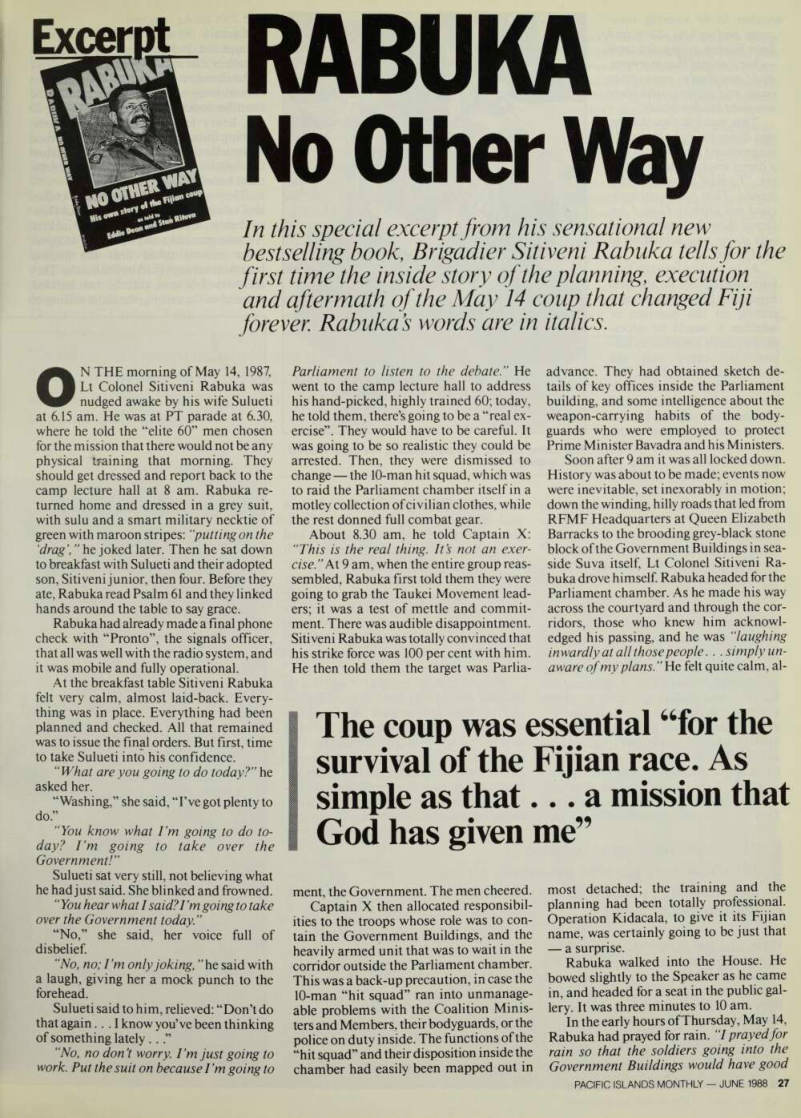

No Other Way
In this special excerpt from his sensational new bestselling book, Brigadier SRabuka tells for the first time the inside story of the planning, execution and aftermath of the May 14 coup that changed Fiji forever. Rabuka s words are in italics.
ON THE morning of May 14, 1987, Lt Colonel Sitiveni Rabuka was nudged awake by his wife Sulueti at 6.15 am. He was at PT parade at 6.30, where he told the “elite 60” men chosen for the mission that there would not be any physical training that morning. They should get dressed and report back to the camp lecture hall at 8 am. Rabuka re turned home and dressed in a grey suit, with sulu and a smart military necktie of green with maroon stripes: “putting on the ‘drag’, ” he joked later. Then he sat down to breakfast with Sulueti and their adopted son, Sitiveni junior, then four. Before they ate, Rabuka read Psalm 61 and they linked hands around the table to say grace.
Rabuka had already made a final phone check with “Pronto”, the signals officer, that all was well with the radio system, and it was mobile and fully operational.
At the breakfast table Sitiveni Rabuka felt very calm, almost laid-back. Every thing was in place. Everything had been planned and checked. All that remained was to issue the final orders. But first, time to take Sulueti into his confidence.
“What are you going to do today?” he asked her.
“Washing,” she said, “Pve got plenty to do.”
“You know what I’m going to do to day? I’m going to take over the Government!”
Sulueti sat very still, not believing what he had just said. She blinked and frowned.
“You hear what I said? I’m going to take over the Government today.”
“No,” she said, her voice full of disbelief.
“No, no; I’m only joking, ”he said with a laugh, giving her a mock punch to the forehead.
Sulueti said to him, relieved: “Don’t do that again... I know you’ve been thinking of something lately ...”
“No, no don’t worry. I’m just going to work. Put the suit on because I’m going to
Parliament to listen to the debate.” He went to the camp lecture hall to address his hand-picked, highly trained 60; today, he told them, there’s going to be a “real exercise”. They would have to be careful. It was going to be so realistic they could be arrested. Then, they were dismissed to change the 10-man hit squad, which was to raid the Parliament chamber itself in a motley collection of civilian clothes, while the rest donned full combat gear.
About 8.30 am, he told Captain X: “This is the real thing. It’s not an exercise.” At 9 am, when the entire group reassembled, Rabuka first told them they were going to grab the Taukei Movement leaders; it was a test of mettle and commitment. There was audible disappointment, Sitiveni Rabuka was totally convinced that his strike force was 100 per cent with him.
He then told them the target was Parlia-
The coup was essential "Tor the survival of the Fijian race. As simple as that... a mission that God has given me”
ment, the Government. The men cheered.
Captain X then allocated responsibil ities to the troops whose role was to con tain the Government Buildings, and the heavily armed unit that was to wait in the corridor outside the Parliament chamber.
This was a back-up precaution, in case the 10-man “hit squad” ran into unmanage able problems with the Coalition Minis ters and Members, their bodyguards, or the police on duty inside. The functions of the “hit squad” and their disposition inside the chamber had easily been mapped out in
advance. They had obtained sketch de tails of key offices inside the Parliament building, and some intelligence about the weapon-carrying habits of the body guards who were employed to protect Prime Minister Bavadra and his Ministers, Soon after 9 am it was all locked down, History was about to be made; events now were inevitable, set inexorably in motion; down the winding, hilly roads that led from RFMF Headquarters at Queen Elizabeth Barracks to the brooding grey-black stone block ofthe Government Buildings in sea side Suva itself, Lt Colonel Sitiveni Ra buka drove himself. Rabuka headed for the Parliament chamber. As he made his way across the courtyard and through the cor ridors, those who knew him acknowl edged his passing, and he was “ laughing inwardly at all those people . . . simply un aware of my plans.” He felt quite calm, al
most detached; the training and the planning had been totally professional.
Operation Kidacala, to give it its Fijian name, was certainly going to be just that a surprise.
Rabuka walked into the House. He bowed slightly to the Speaker as he came in, and headed for a seat in the public gal lery. It was three minutes to 10 am.
In the early hours of Thursday, May 14, Rabuka had prayed for rain. “I prayed for rain so that the soldiers going into the Government Buildings would have good
treason to be wearing rain coats and jackets. Suva had been having a long dry spell but it rained that morning, and everybody wore rain coats and jackets, with their weapons hidden inside”
This was his sign that he was doing the right thing. He is convinced that the rain was a direct response to his pray ers. “I asked for rain, and it rained. That really strength ened my faith in God. I be lieved then that everything I was doing was according to God’s plan.”
As he walked into the Par liament chamber for the first time in his life he was concen trating on the question of whether it would be neces sary to shoot someone to suc cessfully carry out the military takeover of Fiji. Ra buka himself was unarmed.
The RFMF did not know whether there was any kind of metal detector in use in the Parliament as a security measure. ‘7 was trying to work out the ‘worst case’ sit uation, when we would have
tofire a shot in the air that was the worst case as far as I was concerned. . . (but) the surprise element was the very thing that would prevent our having to fire a shot. ”
Surprise was seen as their key weapon, “ But if we had to shoot to kill, we would have.”
He sat down next to Police Inspector Jahir Khan, who was on duty and sitting in the first row of seats, just outside the public entrance. As he sat, he tapped the inspector on the right thigh. The police man thought it was a friendly greeting, but Rabuka was endeavouring to establish whether the Inspector was armed. He stood up and moved past Khan, checking visually whether he was carrying anything in his left uniform pocket or in the waist band of his sulu. Satisfied he could see no weapons, Rabuka moved to another seat, The Honourable Mr Taniela (“Big Dan”) Veitata, of the Opposition Alliance
“Everyone involved in my coup of 14th May were people I personally picked and trained ... no foreigners came into the country to help”
Party, and the Taukei Movement chair man at the time, was in full flight in his maiden speech. “Big Dan”, a colourful and flamboyant man, was delivering a care fully prepared speech that was astonish ingly appropriate given what was just about to happen.
Veitata was referring to the efforts of Ratu Mara whilst he was Prime Minister
to create a multi-racial Fiji. This, Veitata said, had been attempted against a back ground of peace and harmony that had been “the governing principle upon which the Fijian people have been living their lives ever since the arrival of Christianity in Fiji 150 years ago...” He sharply made the point that the Fijians, under the Mara Government, had “extended our hands of friendship to the other races ... Regrett ably, Mr Speaker, Sir,... all we have re ceived from them is a kick in our faces...”
Rabuka calmly checked his watch as he listened, trying very hard to look relaxed and interested only in what “Big Dan” was saying. It was one minute to 10. He tried to visualise where his men should be. The trucks bringing the soldiers to Parliament House had to be passing the nearby tennis courts, about to turn toward the main en trance to Parliament House. Other troops would be about to disembark and run into
Fiji’s main Post Office. Another group was about to take over the premises ofFintel, Fiji International Telecommunica tions Limited, and
impose a blackout on all messages leaving the country; another unit was about to take charge of the Fintel satellite station on the outskirts of Suva.
The big old clock on the tower atop the Government Buildings had begun to strike 10. Dan Veitata had been diverted by an interjection from a Coalition Government Minister, and was responding spiritedly.
The 10th stroke rang out.
Captain X and his 10 men burst through the doors opening on to the pub lic gallery, facing the Speaker at the far end of the chamber. The Government benches curved away around the left side of the chamber looking from the gallery. The 10 ran, heavy feet thumping on the floor, echoing from the high ceiling. They turned sharp left and spread out in a line against the wall, immediately behind the Govern ment benches.
They were clothed in a motley collec tion of civvies, including colourful flow ered shirts and somewhat “tatty” jackets.
All wore gasmasks and when they stopped, those nearest could hear the audible breathiness magnified by the masks. They all carried 9 mm pistols, two-handed, pointed to the ceiling, the butts resting on
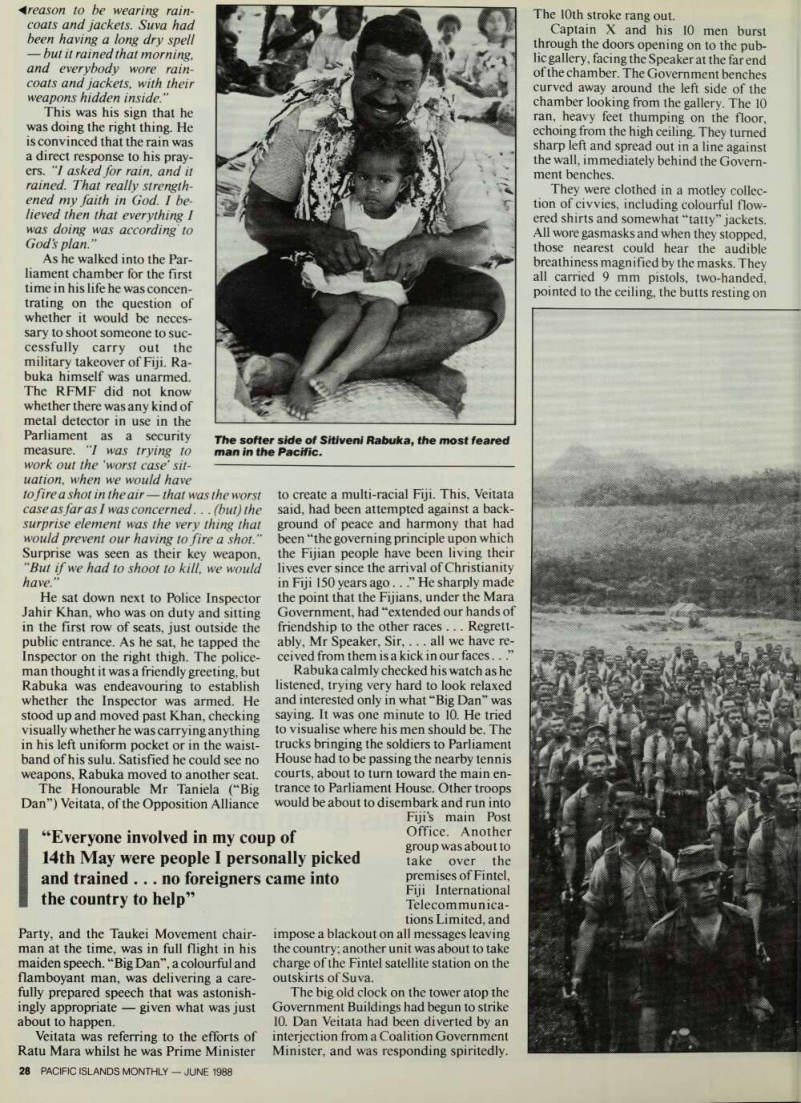
The softer side of Sitiveni Rabuka, the most feared man in the Pacific.
their right shoulders. Captain X, his pistol similarly poised, stopped at the entrance to the steps that led down to the central floor of the chamber, the area separating the Government and Opposition benches.
He wore a balaclava so what he had to say could be understood.
Both Rabuka and Captain X say that in order to reduce the risk of someone in the hit squad getting “trigger-happy”, all the pistols had loaded magazines, but none had a bullet in the breech; they were not cocked, ready to fire. According to Cap tain X, his instructions were to move the Government team from the chamber how was entirely up to him and his team; if physical manhandling had become nec essary to move people, it would have been done. “Shooting anyone was a last resort.
That is why,” Captain X says, “I had the
back-up team just outside lining the cor ridor, more than a dozen men in full com bat gear, armed with Ml 6 assault rifles in case we couldn’t handle the situation in the Parliament.”
“As they burst in the doors, I said ‘that’s it ’. Precise timing, everything is working well. All I’ve got to do is walk up and tell them it’s all over.”
“Sit down everybody, sit down,” Cap tain X called out loudly, his eyes roving in search of any sign of resistance or retal iation. There was none. “This is a military takeover. Ladies and gentlemen, we apol ogise for any inconvenience caused. You are requested to stay cool, stay down, and listen to what we are going to tell you.” The loudest sound was a collective intake of breaths. “Kidacala” surprise had worked. There had been one lone splutter
of “What’s this, what’s this?”, from Government Minister Tupeni Baba. His only answer was the command from Cap tain X and the sight of Lt Colonel Rabuka striding briskly down the chamber toward the Speaker’s chair.
“Please stay calm, ladies and gentle men, stay calm,” he said, loudly and firmly. He recalls: “I felt cool and confi dent. God was with me, and I had re hearsed the scene in my mind many times over the past four weeks. I saw that my un cle, the Speaker, wasn’t believing what he was seeing and hearing. The look on his face suggested he wasn’t totally taking the situation seriously as though he be lieved, or hoped, that it was just an exer cise. I thought to myself'God is telling me to do this, and if God tells me, nothing will go wrong’.” *
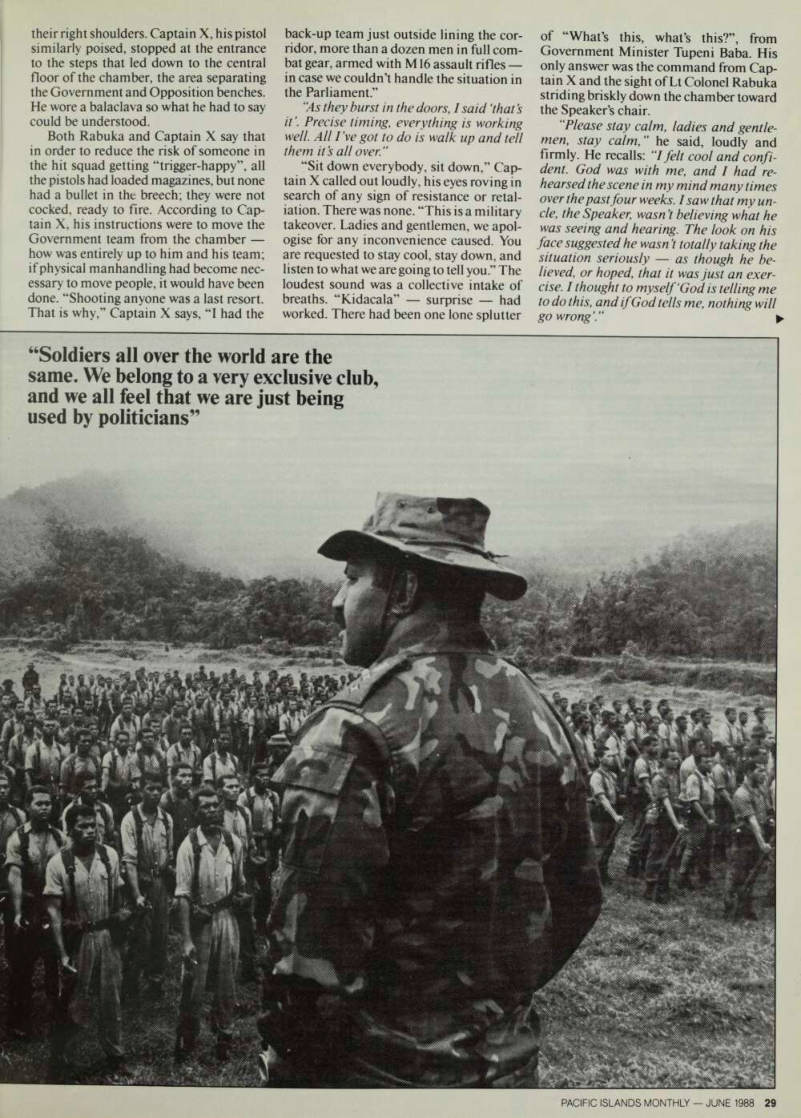
“Soldiers all over the world are the same. We belong to a very exclusive club, and we all feel that we are just being used by politicians”
◄ Rabuka mounted the steps to where the Speaker sat, stopped beside his elaborate chair, turned and faced the Parliament chamber. An element of farce entered the proceedings here; Rabuka didn’t find out until much later that the rest of the take over proceeded with him standing on the Speaker’s foot but he was totally obli vious to the fact. Apparently, when he reached the Speaker’s dais, his uncle went to stand up but couldn’t because Rabuka had planted his heavy right foot on that of his uncle. Rabuka says he was concentrat ing so hard on what he was doing, he sim ply wasn’t aware the Speaker was effectively pinned to the spot.
“Mr Prime Minister, please lead your team down to the right... Policeman, keep the passage clear. Stay down, remain calm.” Dr Timoci Bavadrasat motionless, disbelief written all over his face. “Mr Prime Minister, Sir, will you lead your team now.” There was emphasis on the “now”, and hands were thrust into hip pockets with deliberation, in a gesture de signed to further emphasise the instruc tion. Bavadra stood, and began leading his team out of the Parliament. The earlier lone voice, Tupeni Baba, declined to leave.
Rabuka gave him a specific, personal di rective: “Go.” Baba went.
When the chamber had cleared, it was four minutes past 10. “I had taken over the Government, not for power or personal gain, but to save my people from blood shed.” Rabuka prayed briefly, thanking God for the achievement.
Sitiveni Rabuka is emphatic that he has no real regrets for his actions. ‘7 do not think that I have any regrets at all. Per-
haps the only regret I have is that there was no other way we could have done it.”
Outside the Parliament, where Rabuka had followed his men, the Government Ministers and members were about to be loaded on to trucks to be taken to Queen Elizabeth Barracks and locked in the guardroom on a temporary basis. Once again, Tupeni Baba objected. “No, no,” he shouted, “we are not getting into the trucks.” Rabuka took a loaded Ml 6 from the nearest soldier, cocked it and pointed at Baba’s head. "Move, ” he said.
By the end of the day there had been no contact with Ratu Sir Kamisese Mara, who was a phone call away. An Alliance Party member had phoned Mara at the Fijian
Resort from the Parliament tea-room soon after the coup, to tell him what Rabuka had done. The former Prime Minister was vis ibly, and strongly, affected by the news. He went pale, and appeared very weak.
For Rabuka, whether Ratu Mara would co-operate by joining his Council of Min isters was his biggest worry. Without Ratu Mara, he believed there would be a major credibility gap. He agonised about ring ing, trying to pluck up courage because he was not sure about how the nation’s most respected politician would react to the coup, and its implications. “I needed Ratu Mara. The Fijians needed him. So did the nation.”
It was in the early hours of Friday, May 15, when the call reached Ratu Mara’s wife, Adi Lady Lala, to whom he apologised for the lateness of the call, Ratu Mara came on line, and Rabuka paused again how would he react, given that the coup had ef fectively brought to a halt all that Ratu Mara had worked for over 17 years?
He asked had Ratu Mara heard about the coup?
“Yes”. Rabuka invited him to join his Council of Ministers, taking the Foreign Affairs and Civil Aviation portfolios, “I accept”.
“What about your reputation, sir?”
Ratu Mara replied that his reputation was of no use if the nation was in ruins, Ra buka thanked him for his co-operation and rang off, elated.
“I nearly hit the roof as I jumped and cheered.” □
An extract /romßabuka: No Other Way by Eddie Dean and Stan Ritova. Copyright text® The Marketing Team International Ltd, 1988. Photographs ® Stan Ritova, 1988. Published by Doubleday at $12.95 in Australia and $17.95 in New Zealand (incl GST). Published in Fiji by The Mar keting Team International at $9.95. All rights reserved. □
Rabuka returns to the Parliament chamber, scene of his dramatic coup.