Mantis Wildlife
p. 23 · Read in the full issue
Curse Of The Cane Toad
How the rapacious pest is threatening Pacific flora and fauna.
By James Murray
HAWAII, Papua New Guinea, Van uatu, Tonga and Australia all Pacific nations, and all victims of one especially worrying island-hopping pest. A pest that is part clown, part storm trooper: Bufo marinus, the cane toad.
But simply because of its spread, and its varying social and ecological impact, no joint program for its control has yet been formulated by Pacific nations. “I don’t think there is any real potential for collab oration at this stage,” says Dr Hal Cogger, curator of reptiles and amphibians at the Australian Museum, Sydney. “The prob lem is at its worst here in Australia. If there’s a breakthrough to a control perhaps a virus with a similar effect on cane toads as the myxomatosis virus had on rabbits then Pacific island nations would bene fit in due course.”
While research continues, it is possible that a new documentary, Cane Toads: An Unnatural History, produced by Film Australia for film and video distribution in Australasia and in the Pacific, may fo cus sufficient attention on Bufo marinus to speed up research into its control.
Written and produced by Mark Lewis, the documentary is no sombre treatise: in deed, if it errs it does so on the side of lev ity. Nonetheless, it highlights the diversity of opinion about the cane toad that forms a major obstacle to deal with it.
There are those who find the cane toad lovable. . and there are those who will do anything to kill it. Typical of the first is Marie Roth of Gordonvale, Queensland, who says in the film: “When we first came north I had friends with little girls who ac tually kept cane toads as pets... They used to put little frocks on them and put them in little beds.”
Typical of the second is Tip Byrne, a cane grower from Tully, also in Queens land, who says: “They pose a bigger men ace than the German army in World War
II. I appeal to everyone that whenever you see a toad, have no hesitation in running over and killing the monster.”
Other opinions are just as vivid — and as varied. Animal ecologist Dr Rob Floyd says: “Gut content analysis shows the toad will eat virtually any living thing that’s small enough to get into its mouth. One researcher showed that it will try to eat ping-pong balls.”
Dr Michael Archer, associate professor ofZoology at the University of New South Wales, fears that “What we’re going to see is a single introduced species replacing many natural species: an ecosystem under threat, being chopped away at the base.”
With colleague Dr Jeanette Covacecich, Archer has written a key paper on the dis tribution of the cane toad and its effect on local vertebrates. Bufo Marinus occurs naturally in North and South America be tween southern Texas and central Argen tina, and its numbers appear to be limited throughout its natural range solely by pop ulation pressures and competition for re sources of food and mates.
It hr*s been used as a biological control of insects, snails and rats and was intro duced into southern Florida and Louisi ana, most islands of the Caribbean, Hawaii and the Pacific islands.
In fact, it was from Hawaii that the first batch of cane toads was introduced into Australia in 1935. The move followed an international conference in Puerto Rico in 1932, when the cane toad was promoted as a cure for “white grubs” and “French bee tle” infesting the sugarcane districts of Queensland.
American entomologist Raquel Dexter told the conference: “1 strongly advocate the effective use of the cane toad, which is doing its full share of benefit to our sugar industry and to which this international congress should pay a tribute of gratitude.”
Her eloquence persuaded the Aus tralian Government that the cane toad was the cure for insect infestation. Unfortu nately, in the tests that followed two cru cial facts were overlooked: the insects that infested the cane fields could fly, and the cane toad could not; and where a variety of food was offered the cane toad es chewed the insects it was supposed to eat.
Further, the cane toad was keener on reproducing itself than destroying insects.
The male rides on the female’s back in a non-penetrating sexual embrace known as amplexus until fertilisation takes place.
And since the female can produce 24,000 eggs a month, the rate of production is awesome.
The cane toad is certainly an adaptable
creature. It shelters in shallow depres sions, logs, drainpipes, hollows at the ends of well-constructed burrows more than 25 centimetres deep in soft, stony and clayey soil, beneath cement slabs, rocks and sheets of corrugated iron.
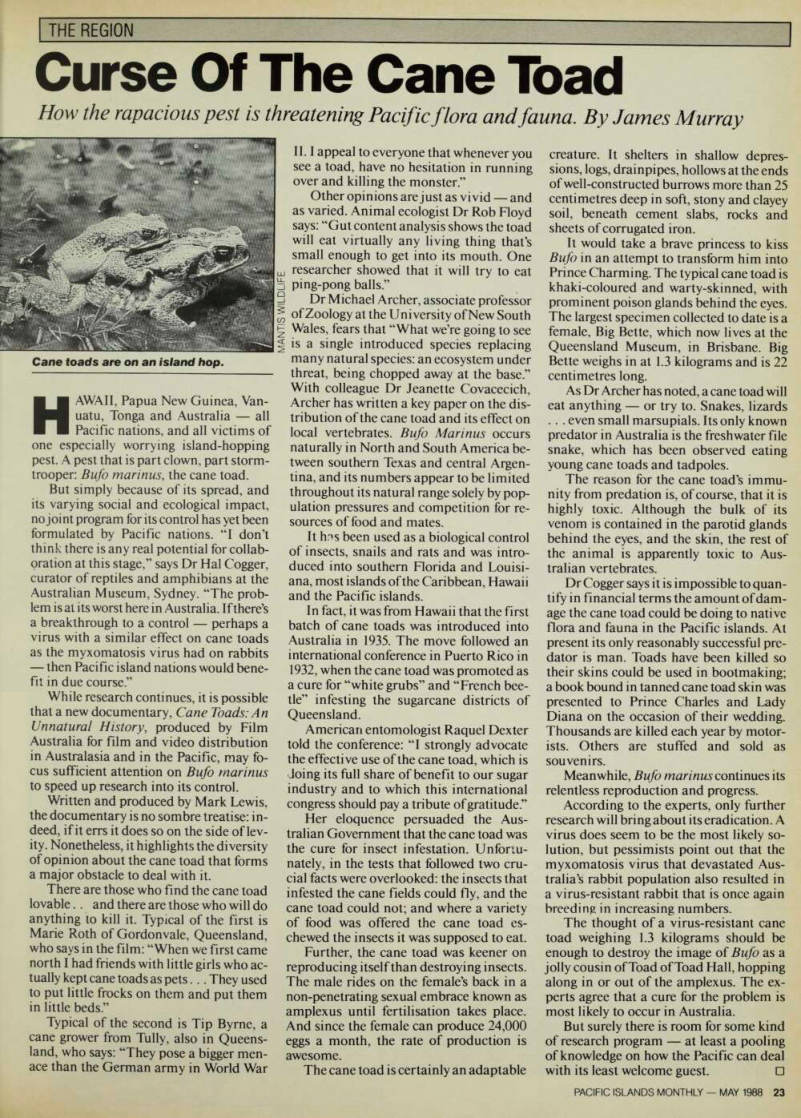
It would take a brave princess to kiss Bufo in an attempt to transform him into Prince Charming. The typical cane toad is khaki-coloured and warty-skinned, with prominent poison glands behind the eyes.
The largest specimen collected to date is a female. Big Bette, which now lives at the Queensland Museum, in Brisbane. Big Bette weighs in at 1.3 kilograms and is 22 centimetres long.
As Dr Archer has noted, a cane toad will eat anything or try to. Snakes, lizards . . . even small marsupials. Its only known predator in Australia is the freshwater file snake, which has been observed eating young cane toads and tadpoles.
The reason for the cane toad’s immu nity from predation is, of course, that it is highly toxic. Although the bulk of its venom is contained in the parotid glands behind the eyes, and the skin, the rest of the animal is apparently toxic to Aus tralian vertebrates.
Dr Cogger says it is impossible to quan tify in financial terms the amount of dam age the cane toad could be doing to native flora and fauna in the Pacific islands. At present its only reasonably successful pre dator is man. Toads have been killed so their skins could be used in bootmaking; a book bound in tanned cane toad skin was presented to Prince Charles and Lady Diana on the occasion of their wedding.
Thousands are killed each year by motor ists. Others are stuffed and sold as souvenirs.
Meanwhile, Bufo marinus continues its relentless reproduction and progress.
According to the experts, only further research will bring about its eradication. A virus does seem to be the most likely so lution, but pessimists point out that the myxomatosis virus that devastated Aus tralia’s rabbit population also resulted in a virus-resistant rabbit that is once again breeding in increasing numbers.
The thought of a virus-resistant cane toad weighing 1.3 kilograms should be enough to destroy the image of Bufo as a jolly cousin of Toad of Toad Hall, hopping along in or out of the amplexus. The ex perts agree that a cure for the problem is most likely to occur in Australia.
But surely there is room for some kind of research program at least a pooling of knowledge on how the Pacific can deal with its least welcome guest. □
Cane toads are on an island hop.