Another Blow To Compact
pp. 21-22 · Read in the full issue
Palau
A new round of legal point scoring.
By Ed Rampell
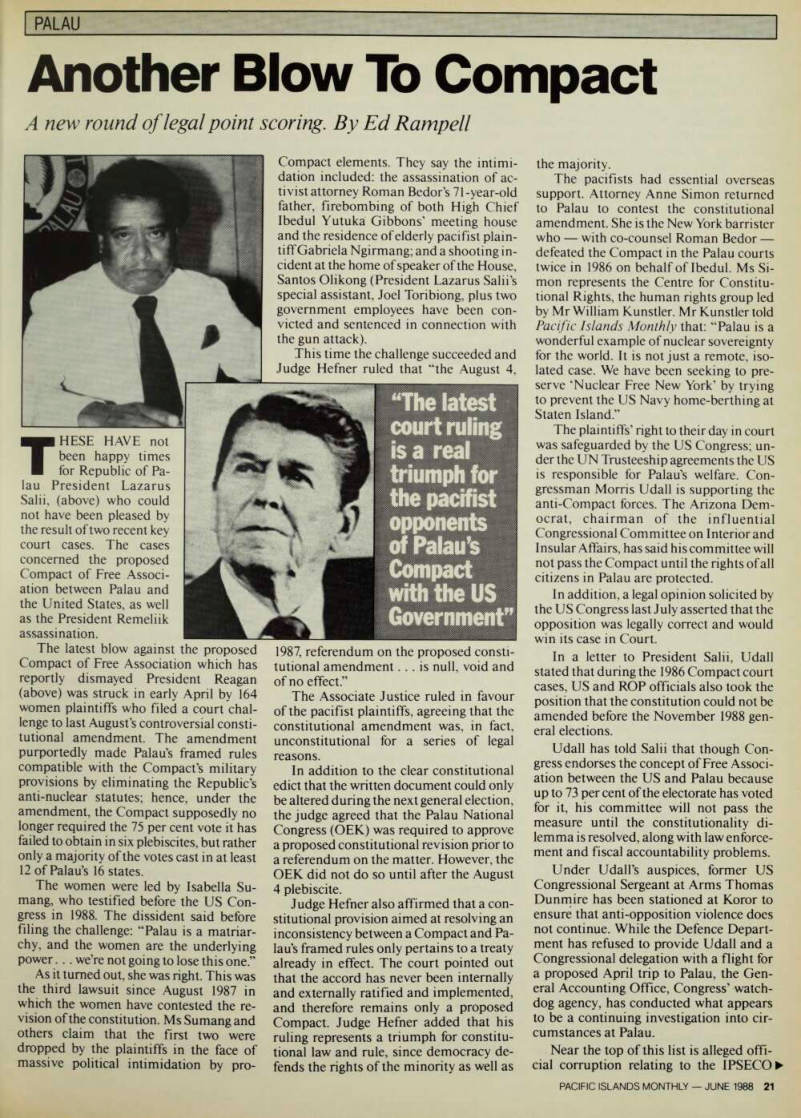
These have not been happy times for Republic of Pa lau President Lazarus Salii, (above) who could not have been pleased by the result of two recent key court cases. The cases concerned the proposed Compact of Free Associ ation between Palau and the United States, as well as the President Remeliik assassination.
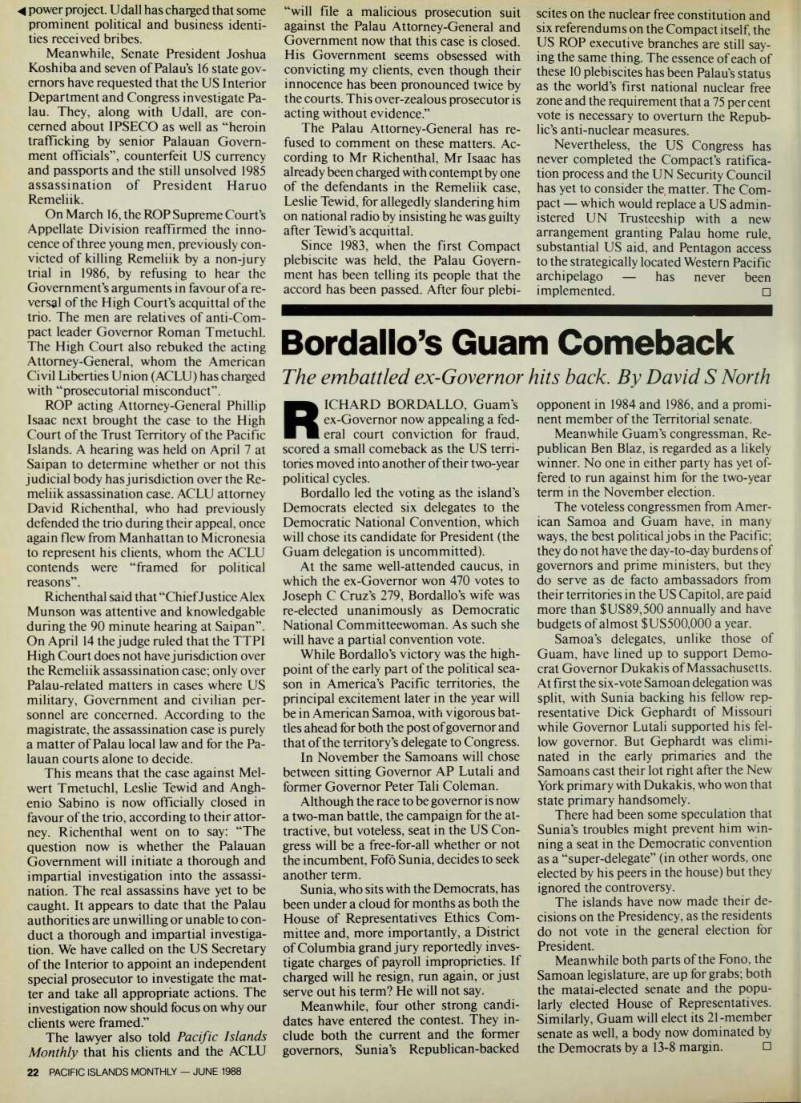
The latest blow against the proposed Compact of Free Association which has reportly dismayed President Reagan (above) was struck in early April by 164 women plaintiffs who filed a court challenge to last August’s controversial constitutional amendment. The amendment purportedly made Palau’s framed rules compatible with the Compact’s military provisions by eliminating the Republic’s anti-nuclear statutes; hence, under the amendment, the Compact supposedly no longer required the 75 per cent vote it has failed to obtain in six plebiscites, but rather only a majority of the votes cast in at least 12 of Palau’s 16 states.
The women were led by Isabella Sumang, who testified before the US Congress in 1988. The dissident said before filing the challenge: “Palau is a matriarchy, and the women are the underlying power .. . we’re not going to lose this one.”
As it turned out, she was right. This was the third lawsuit since August 1987 in which the women have contested the revision of the constitution. Ms Sumang and others claim that the first two were dropped by the plaintiffs in the face of massive political intimidation by pro-
Compact elements. They say the intimi dation included: the assassination of ac tivist attorney Roman Bedor’s 71-year-old father, firebombing of both High Chief Ibedul Yutuka Gibbons’ meeting house and the residence of elderly pacifist plain tiff Gabriela Ngirmang; and a shooting in cident at the home of speaker of the House, Santos Olikong (President Lazarus Salii’s special assistant, Joel Toribiong, plus two government employees have been con victed and sentenced in connection with the gun attack).
This time the challenge succeeded and Judge Hefner ruled that “the August 4,
1987, referendum on the proposed consti tutional amendment... is null, void and of no effect.”
The Associate Justice ruled in favour of the pacifist plaintiffs, agreeing that the constitutional amendment was, in fact, unconstitutional for a series of legal reasons. in addition to the clear constitutional edict that the written document could only be altered during the next general election, the judge agreed that the Palau National Congress (OEK) was required to approve a proposed constitutional revision prior to a referendum on the matter. However, the OEK did not do so until after the August 4 plebiscite, Judge Hefner also affirmed that a con stitutional provision aimed at resolving an inconsistency between a Compact and Pa lau’s framed rules only pertains to a treaty already in effect. The court pointed out that the accord has never been internally and externally ratified and implemented, and therefore remains only a proposed Compact. Judge Hefner added that his ruling represents a triumph for constitu tional law and rule, since democracy de fends the rights of the minority as well as
the majority.
The pacifists had essential overseas support. Attorney Anne Simon returned to Palau to contest the constitutional amendment. She is the New York barrister who with co-counsel Roman Bedor defeated the Compact in the Palau courts twice in 1986 on behalf of Ibedul. Ms Si mon represents the Centre for Constitu tional Rights, the human rights group led by Mr William Kunstler. Mr Kunstler told Pacific Islands Monthly that: “Palau is a wonderful example of nuclear sovereignty for the world. It is not just a remote, iso lated case. We have been seeking to pre serve ‘Nuclear Free New York’ by trying to prevent the US Navy home-berthing at Staten Island.”
The plaintiffs’ right to their day in court was safeguarded by the US Congress; un der the UN Trusteeship agreements the US is responsible for Palau’s welfare. Con gressman Morris Udall is supporting the anti-Compact forces. The Arizona Dem ocrat, chairman of the influential Congressional Committee on Interior and Insular Affairs, has said his committee will not pass the Compact until the rights of all citizens in Palau are protected.
In addition, a legal opinion solicited by the US Congress last July asserted that the opposition was legally correct and would win its case in Court.
In a letter to President Salii, Udall stated that during the 1986 Compact court cases, US and ROP officials also took the position that the constitution could not be amended before the November 1988 gen eral elections.
Udall has told Salii that though Con gress endorses the concept of Free Associ ation between the US and Palau because up to 73 per cent of the electorate has voted for it, his committee will not pass the measure until the constitutionality di lemma is resolved, along with law enforce ment and fiscal accountability problems.
Under Udall’s auspices, former US Congressional Sergeant at Arms Thomas Dun mire has been stationed at Koror to ensure that anti-opposition violence does not continue. While the Defence Depart ment has refused to provide Udall and a Congressional delegation with a flight for a proposed April trip to Palau, the Gen eral Accounting Office, Congress’ watch dog agency, has conducted what appears to be a continuing investigation into cir cumstances at Palau.
Near the top of this list is alleged offi cial corruption relating to the IPSECO^
“The latest court ruling is a real triumph for the pacifist opponents of Palau’s Compact with the US Government”
4 power project. Udall has chained that some prominent political and business identi ties received bribes.
Meanwhile, Senate President Joshua Koshiba and seven of Palau’s 16 state gov ernors have requested that the US Interior Department and Congress investigate Pa lau. They, along with Udall, are con cerned about IPSECO as well as “heroin trafficking by senior Palauan Govern ment officials”, counterfeit US currency and passports and the still unsolved 1985 assassination of President Haruo Remeliik.
On March 16, the ROP Supreme Court’s Appellate Division reaffirmed the inno cence of three young men, previously con victed of killing Remeliik by a non-jury trial in 1986, by refusing to hear the Government’s arguments in favour of a re versal of the High Court’s acquittal of the trio. The men are relatives of anti-Com pact leader Governor Roman Tmetuchl.
The High Court also rebuked the acting Attorney-General, whom the American Civil Liberties Union (ACLU) has charged with “prosecutorial misconduct”.
ROP acting Attorney-General Phillip Isaac next brought the case to the High Court of the Trust Territory of the Pacific Islands. A hearing was held on April 7 at Saipan to determine whether or not this judicial body has jurisdiction over the Re meliik assassination case. ACLU attorney David Richenthal, who had previously defended the trio during their appeal, once again flew from Manhattan to Micronesia to represent his clients, whom the ACLU contends were “framed for political reasons”.
Richenthal said that “Chief Justice Alex Munson was attentive and knowledgable during the 90 minute hearing at Saipan”.
On April 14 the judge ruled that the TTPI High Court does not have jurisdiction over the Remeliik assassination case; only over Palau-related matters in cases where US military. Government and civilian per sonnel are concerned. According to the magistrate, the assassination case is purely a matter of Palau local law and for the Pa lauan courts alone to decide.
This means that the case against Mel wert Tmetuchl, Leslie Tewid and Angh enio Sabino is now officially closed in favour of the trio, according to their attor ney. Richenthal went on to say: “The question now is whether the Palauan Government will initiate a thorough and impartial investigation into the assassi nation. The real assassins have yet to be caught. It appears to date that the Palau authorities are unwilling or unable to con duct a thorough and impartial investiga tion. We have called on the US Secretary of the Interior to appoint an independent special prosecutor to investigate the mat ter and take all appropriate actions. The investigation now should focus on why our clients were framed.”
The lawyer also told Pacific Islands Monthly that his clients and the ACLU
“will file a malicious prosecution suit against the Palau Attorney-General and Government now that this case is closed.
His Government seems obsessed with convicting my clients, even though their innocence has been pronounced twice by the courts. This over-zealous prosecutor is acting without evidence.”
The Palau Attorney-General has re fused to comment on these matters. Ac cording to Mr Richenthal, Mr Isaac has already been charged with contempt by one of the defendants in the Remeliik case, Leslie Tewid, for allegedly slandering him on national radio by insisting he was guilty after Tewid’s acquittal.
Since 1983, when the first Compact plebiscite was held, the Palau Govern ment has been telling its people that the accord has been passed. After four plebi
scites on the nuclear free constitution and six referendums on the Compact itself, the US ROP executive branches are still say ing the same thing. The essence of each of these 10 plebiscites has been Palau’s status as the world’s first national nuclear free zone and the requirement that a 75 per cent vote is necessary to overturn the Repub lic’s anti-nuclear measures.
Nevertheless, the US Congress has never completed the Compact’s ratifica tion process and the UN Security Council has yet to consider the, matter. The Com pact which would replace a US admin istered UN Trusteeship with a new arrangement granting Palau home rule, substantial US aid, and Pentagon access to the strategically located Western Pacific archipelago has never been implemented. □