Gaddafi’s Pacific Intrigues
p. 18 · Read in the full issue
The Region
In an exclusive interview, Nicolas Rothwell talks to Libya’s chief Oceania strategist
COLONEL GADDAFI’S shadowy international revolutionary organ isation Mathaba, established in the Libyan capital of Tripoli and dispensing funds to liberation movements around the world, is run by a most unlikely radical.
Tunku Mohammed Hassan di Tiro, a Sumatran prince, fervent Muslim and bit ter opponent of Indonesia, is the chair man of Mathaba’s political committee.
In an exclusive interview with Pacific Islands Monthly , at his headquarters in Tripoli, he outlined Mathaba’s organisa tion and aims for the Asia Pacific region.
The Mathaba Against Imperialism, Racism, Zionism and Fascism, to give the front its rather inclusive full title, is “the Libyan way of supporting liberation movements, either morally or financially, depending on the situation but not mili tarily,” Hassan di Tiro explained.
It was set up in 1985 and is headed by Colonel Gaddafi himself, who attended the Mathaba Asian Pacific Conference in Tripoli last year.
Mathaba appears to be a parallel struc ture, operating unofficially and independ ently of the Libyan foreign ministry and separate from the covert channels that may supply arms to radical causes supported by the Libyan regime, such as the IRA or Philippines separatists.
Hassan di Tiro himself makes the cru cial decisions, and runs a personal net work of contacts with the liberation movement leaders Libya supports, among them Jacob Prai of the OPM (Free Papua Movement) of West Papua and Yann Ce lene Uregei of New Caledonia’s Kanak radical faction, FULK (United Kanak Liberation Front).
Although he denies all knowledge of the controversial plans by an Australian Ab original delegation to visit Libya or of the attempted visit by Tahitian pro-inde pendence activists that was thwarted in Sydney in April, he expresses strong sup port for the Aboriginal cause.
But Hassan di Tiro’s chief message is one of unremitting hostility to Indonesia.
He makes clear that Mathaba’s efforts are focused on supporting the various inde pendence movements active across the In donesian Archipelago, including his own Aceh Sumatra Liberation Front.
“We are making advances against In donesia, both on the ground and diplo matically, with Fretilin (East Timor Liberation Front), the OPM, the Republic of the South Moluccas; we are all one.
“They come to Tripoli sometimes, but we are always in touch, above ground and underground, inside and outside, and I
shall see to it when Aceh wins so do OPM and the Moluccans.”
Hassan di Tiro’s alliance with Colo nel Gaddafi is based on Islamic solidar ity. His native king dom of Aceh, in the northern part of Su matra, was long known as the “Ver andah of Islam” be cause of the vigour of the Moslem faith there.
But the deep commitment of Li bya to the disman tling of Indonesia, which Libya sees as a Javanese colonial
power that has taken over the Dutch Em pire, suggests the future will see constant Libyan activity in the Asia-Pacific region.
Hassan di Tiro explains that it is in Australia’s interest to befriend the libera tion movements fighting against Indone sia. “We want eternal friendship with the people of Australia, who are our neigh bours. We know what Australia means to us, strategically and economically, so we want to co-operate but if the Aus tralians want the Javanese to colonise us, that’s another story.”
Although Hassan di Tiro is predictably coy about the details of Libyan support for radical movements, claiming Mathaba only provides money, reliable reports sug gest arms shipments have gone to groups such as the Philippines Muslim Moro reb els. More common are the “training courses” provided in past years to cadres from Pacific nations such as New Cale donia and Vanuatu.
Hassan di Tiro flatly claims, “The Ja vanese days of controlling Aceh are near an end. The Javanese have no right to rule any territory outside their own island, the main centre of Indonesia’s population.” In other words, his goal is the complete dis memberment of Indonesia.
Mathaba itself, he says, does not fund the Aceh Sumatra Liberation Front, be cause Aceh is a rich country that can sup port the Front’s European headquarters in Stockholm and other missions as well as its Tripoli embassy. The organisation’s chief concern is with “moral duties”.
He laments Australia’s closure of Li byan offices and stresses that Mathaba has no political or economic intent in the Pa-
cific or anywhere else outside Libya. “Very simply, Libya supports the principle of self determination,” he contends.
This means that in New Caledonia and French Polynesia, “We back the natives.
We take the UN position for self-deter mination: it’s not a matter of political in trigue; it’s just a question of justice. The French should talk things over.”
On Australia’s Aborigines, Hassan di Tiro admits that Mathaba has not studied this problem deeply or made it a high priority: “The question is justice. I am sure the Australians should not compromise about it, the Aborigines should get their due, as citizens, as human beings.
Hassen di Tiro’s way of operating the Mathaba Front seems to rely on close per sonal links between key leaders. Of radical Kanak leader Yann Celene Uregei, he says, “We are so close they make me their spokesman when they are not here.” Mr Uregei, in an interview with The Aus tralian in Noumea last year, confirmed his close link with Tripoli and said his FULK faction had been funded by Libya.
Hassan di Tiro’s personal support for the mission of OPM chief Jacob Prai is such that he offers expansively to send him to Australia on a diplomatic tour. Another figure with whom he is friendly is South Moluccan separatist Dr Manu Sama.
An independence fighter, heir to a line of rulers, a polished diplomat who yet ins ists he should be “on the battlefield where my ancestors died”, Hassan di Tiro neatly incarnates Libya’s determined support for liberation fronts: the means may be bloody, the Libyan philosophy runs, but the cause justifies the bloodshed. □
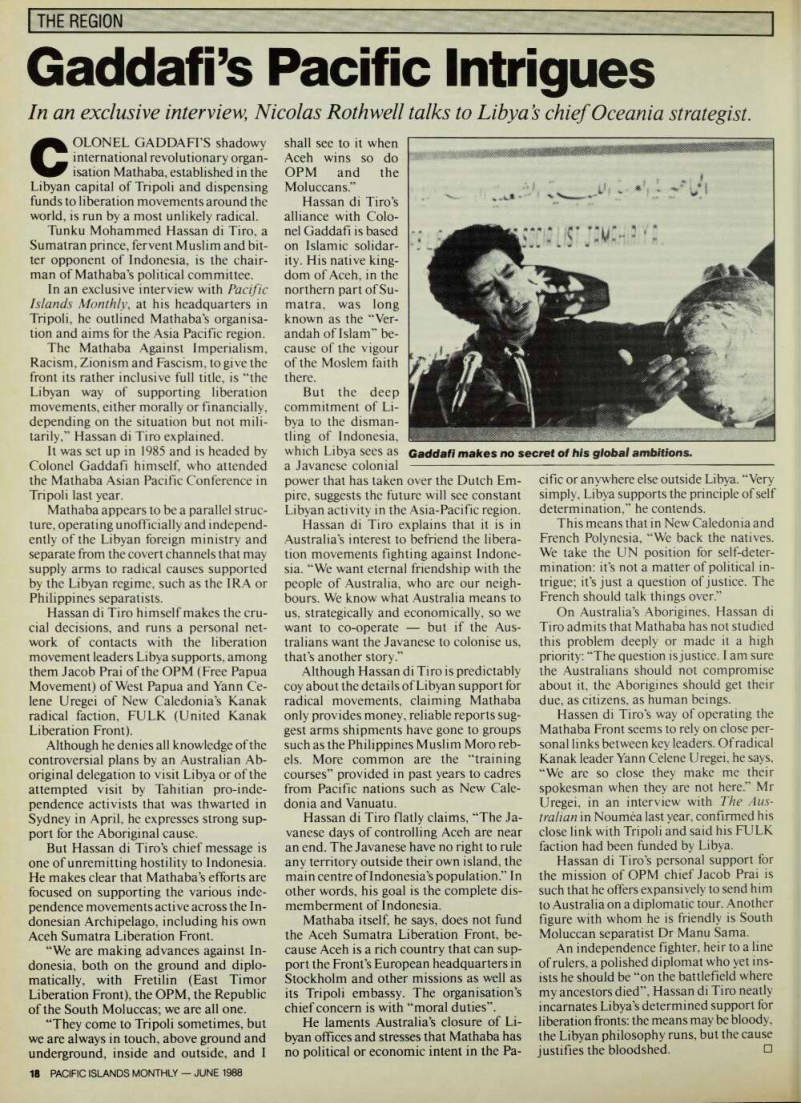
Gaddafi makes no secret of his global ambitions.