Custodian Of The Culture
p. 15 · Read in the full issue
French Polynesia
Manouche Lehartel is preserving Polynesian tradition.
By Nicolas Rothwell.
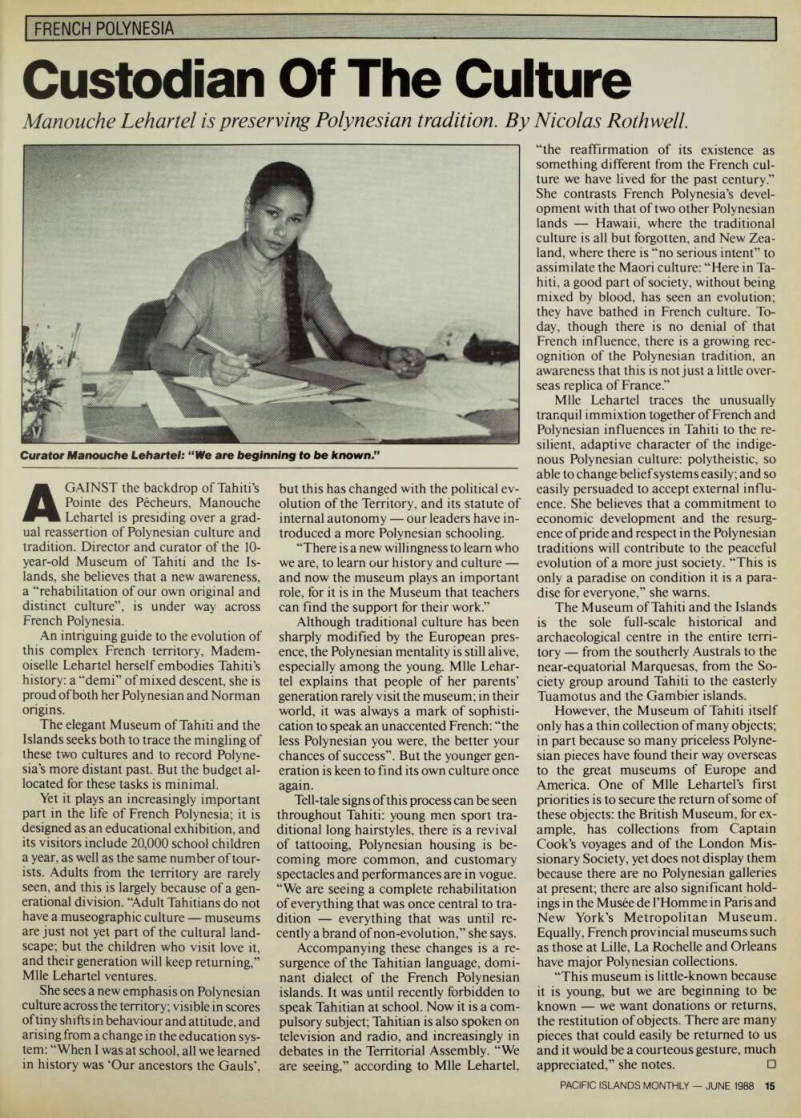
AGAINST the backdrop of Tahiti’s Pointe des Pecheurs, Manouche Lehartel is presiding over a gradual reassertion of Polynesian culture and tradition. Director and curator of the 10year-old Museum of Tahiti and the Islands, she believes that a new awareness, a “rehabilitation of our own original and distinct culture”, is under way across French Polynesia.
An intriguing guide to the evolution of this complex French territory, Mademoiselle Lehartel herself embodies Tahiti’s history: a “demi” of mixed descent, she is proud of both her Polynesian and Norman origins.
The elegant Museum of Tahiti and the Islands seeks both to trace the mingling of these two cultures and to record Polynesia’s more distant past. But the budget allocated for these tasks is minimal.
Yet it plays an increasingly important part in the life of French Polynesia; it is designed as an educational exhibition, and its visitors include 20,000 school children a year, as well as the same number of tourists. Adults from the territory are rarely seen, and this is largely because of a generational division. “Adult Tahitians do not have a museographic culture museums are just not yet part of the cultural landscape; but the children who visit love it, and their generation will keep returning,”
Mlle Lehartel ventures.
She sees a new emphasis on Polynesian culture across the territory; visible in scores of tiny shifts in behaviour and attitude, and arising from a change in the education systern: “When I was at school, all we learned in history was ‘Our ancestors the Gauls’,
but this has changed with the political ev olution of the Territory, and its statute of internal autonomy our leaders have in troduced a more Polynesian schooling, “There is a new willingness to leam who we are, to learn our history and culture and now the museum plays an important role, for it is in the Museum that teachers can find the support for their work.”
Although traditional culture has been sharply modified by the European pres ence, the Polynesian mentality is still alive, especially among the young. Mile Lehar tel explains that people of her parents’ generation rarely visit the museum; in their world, it was always a mark of sophisti cation to speak an unaccented French: “the less Polynesian you were, the better your chances of success”. But the younger gen eration is keen to find its own culture once again.
Tell-tale signs of this process can be seen throughout Tahiti: young men sport tra ditional long hairstyles, there is a revival of tattooing, Polynesian housing is be coming more common, and customary spectacles and performances are in vogue, “We are seeing a complete rehabilitation of everything that was once central to tra dition everything that was until re cently a brand of non-evolution,” she says, Accompanying these changes is a re surgence of the Tahitian language, domi nant dialect of the French Polynesian islands. It was until recently forbidden to speak Tahitian at school. Now it is a com pulsory subject; Tahitian is also spoken on television and radio, and increasingly in debates in the Territorial Assembly. “We are seeing,” according to Mile Lehartel,
“the reaffirmation of its existence as something different from the French cul ture we have lived for the past century.”
She contrasts French Polynesia’s devel opment with that of two other Polynesian lands Hawaii, where the traditional culture is all but forgotten, and New Zea land, where there is “no serious intent” to assimilate the Maori culture: “Here in Ta hiti, a good part of society, without being mixed by blood, has seen an evolution; they have bathed in French culture. To day, though there is no denial of that French influence, there is a growing rec ognition of the Polynesian tradition, an awareness that this is not just a little over seas replica of France.”
Mile Lehartel traces the unusually tranquil immixtion together of French and Polynesian influences in Tahiti to the re silient, adaptive character of the indige nous Polynesian culture: polytheistic, so able to change belief systems easily; and so easily persuaded to accept external influ ence. She believes that a commitment to economic development and the resurg ence of pride and respect in the Polynesian traditions will contribute to the peaceful evolution of a more just society. “This is only a paradise on condition it is a para dise for everyone,” she warns.
The Museum of Tahiti and the Islands is the sole full-scale historical and archaeological centre in the entire terri tory from the southerly Australs to the near-equatorial Marquesas, from the So ciety group around Tahiti to the easterly Tuamotus and the Gambier islands.
However, the Museum of Tahiti itself only has a thin collection of many objects; in part because so many priceless Polyne sian pieces have found their way overseas to the great museums of Europe and America. One of Mile Lehartel’s first priorities is to secure the return of some of these objects: the British Museum, for ex ample, has collections from Captain Cook’s voyages and of the London Mis sionary Society, yet does not display them because there are no Polynesian galleries at present; there are also significant hold ings in the Musee de I’Homme in Paris and New York’s Metropolitan Museum.
Equally, French provincial museums such as those at Lille, La Rochelle and Orleans have major Polynesian collections.
“This museum is little-known because it is young, but we are beginning to be known we want donations or returns, the restitution of objects. There are many pieces that could easily be returned to us and it would be a courteous gesture, much appreciated,” she notes. □
Curator Manouche Lehartel: “We are beginning to be known"