New Caledonia:
Opinion
New Caledonia: Blood On The Tricolor
After a violent and tragic month, France’s troubled Pacific territory must ponder new directions.
THE VIOLENCE that convulsed New Caledonia during last month’s Presidential and regional elec tions has changed forever the tenor of political life in that small and apparently fated territory. On one hand, events have dealt a crippling blow to those colons who would see Noumea forever an outlying suburb of Paris.
Despite their rhetoric and their unnerving willingness to open fire on anyone who threatens their hegemony of eco nomic and political authority, New Caledonia’s loyalists have been deeply shaken by the “muscular mobilisation” of separatist Kanaks.
The discipline and commitment demonstrated in such coups de foudre as the humiliating capture of Captain Philippe Legorjus, head of France’s elite anti-terrorist squad, seem to have amazed even the Kanaks themselves and though finally overwhelmed at Ouvea by Captain Legorjus and his vastly superior numbers and weaponry, the newfound confidence those partial successes have en gendered will doubtless continue to affect Kanak political bargaining.
Naturally, the Right has trotted out “proof’ that the militants were trained and armed by Libya: but the truth is that many of the FLNKS “terrorists” received their ed ucation not in Tripoli but in the Army of the Republic of France. Perhaps their familiarity with French strategy en abled them to anticipate the Army’s actions, and thus to effectively paralyse 9000 troops for almost a fortnight. . . albeit with the loss of at least 30 guerrillas.
But before the supporters of Kanaky congratulate themselves too heartily, they should take stock of just what they have accomplished. It seems certain President Fran cois Mitterrand and his Prime Minister, Michel Rocard, will win control of France’s Government. It seems certain, too, that the Pons statute will be repealed and elements of the Pisani plan introduced in its place. But that is all.
While Jean-Marie Le Pen’s New Caledonian support ers can express their own political philosophies, and while the leaders of the RPCR can continue to exert almost complete control over the territory’s economy, the com plexities of the real world will ensure progress in whatever direction to an independent Kanaky, to a Kanaky in dependent in association with France, or perhaps to New Caledonia’s election to the status of a metropolitan departement is slow and painful.
FLNKS President Tjibaou will have to move swiftly to consolidate and to assert his authority over his “troops”.
And he will have to begin dialogue with all sections of New Caledonian and French politics if he is to maintain his
primacy. The day of token Melanesian representation, ep itomised by Dick Ukeiwe, may have passed: in its place must be a more mature, more responsible and above all more politically sagacious Kanak presence.
If the gains (in regional sympathy, if not in tangible im provement) of last month are to remain meaningful, they must be followed by more than speeches. Now is the time for the FLNKS to demonstrate that its desires are worthy of attention; if it cannot do so, the organisation will have condemned the people and the land it claims to love to a bloody and tragic future. □
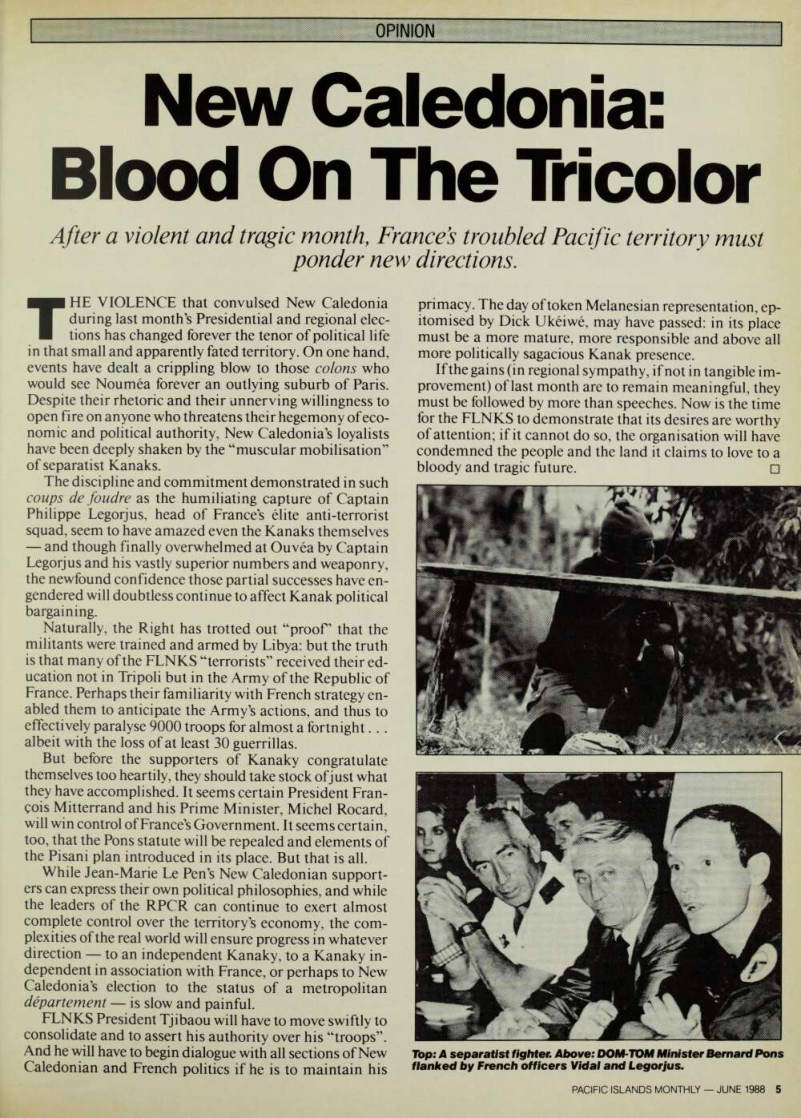
Top: A separatist fighter. Above: DOM-TOM Minister Bernard Pons flanked by French officers Vidal and Legorjus.