A “True Man” Remembered
p. 58 · Read in the full issue
Out Of The Past
Bill Gammage pays tribute to PNG explorer and administrator John Black
EARLY next month, a party of Papua New Guineans and Australians will set out from Mount Hagen to retrace the route of the longest and most arduous patrol in the history of Papua New Guinea’s explora tion the 1938/39 Taylor-Black patrol, which traversed some 3000 kilometres of the most mountainous and difficult ter rain in Papua New Guinea, and which was responsible for bringing many thousands of people within the mantle of PNG’s ad ministration and protection.
Led by Assistant District Officer James Lindsay Taylor and Patrol Officer John Russell Black, the 1938/39 patrol lasted al most 16 months and was remarkable, in those frontier days, for the virtual absence of bloodshed and the positive impression it made on Highlanders.
James Taylor’s daughters Meg and Daisy, Australian National University historian Bill Gammage and former kiap Barry Taverner have worked out for months to plan the 50th anniversary re enactment of Taylor’s and Black’s achieve ment. following Jim Taylor’s death in Go roka in June 1987.
Their task has been made easier and more stimulating by the enthusiastic par ticipation, encouragement and experience of John Black, who supported their en deavour from his home in Adelaide and was planning to welcome the 1988 Hagen- Sepik patrol’s return to Goroka in August.
Tragically. John Black died on April 6 on his way to work in Adelaide, only a month before he was to celebrate his 80th birthday. Bill Gammage pays tribute to one of the truly great men in the history of Papua New Guinea and its evolution into a leader of Southwest Pacific affairs.
JOHN BLACK is perhaps best known as second-in-command of the 1938/39 Hagen-Sepik patrol, which Jim Taylor led from Mt Hagen to Telefomin and back. Black played an epic part in that patrol, leading a section that set out northwest from Hoiyeva (near present-day Tari) past Koroba, across the fearsome Strickland Gorge to Sembati near Oksapmin, then on to Telefomin.
John stayed at Telefomin until Jim Tay lor returned, then followed the Om and Lagaip Rivers back to Wabag, on his way discovering the rich Porgera goldfields now being developed by Placer. John’s journey took him through some of the most mag nificent and the roughest country in New Guinea; when it is told, the story of the patrol will better Hollywood’s most imaginative adventures, but although John
considered the patrol his most momen tous work in PNG, he did not regard it as his most important work.
That was to come later. John had an instinctive eye for policy, whether or not he was involved in its formulation, and related events and issues to farsighted principles of government.
By 1945, John was convinced that the future of New Guinea should lie within its indigenous people and he joined the new Provisional Administration as Assistant Director of Planning, committed to fur thering indigenous interests. At the same time Papua New Guineans such as John Guise, Advent Torossi and Willie Gavera would gather at John’s home near Hanu abada to discuss their country’s political and economic future... and even inde pendence. Many of the Territory’s whites thought of John Black as a ratbag and a communist, and he encountered consid erable hostility from some senior admin istration officials.
When he resigned in 1948 he was still only a substantive patrol officer, but John was confident that in those early postwar years he and like-minded colleagues had achieved something of major importance for Papua New Guinea.
“Many of those prewar officials who came back after the' war wanted to turn the clock back to 1939,” he would say, “but we stopped them. By the time we left, they had no choice but to prepare the country for eventual independence.” This, thought John, was his greatest contribution to Papua New Guinea. It was indeed a sig nificant achievement.
John Black was born in North Ade laide on May 12, 1908, the eldest of five children. After leaving school, he worked and studied for a year under Sir Douglas Mawson at Adelaide University, then went
on to farm at Mount Compass until late in 1932, when he saw an advertisement for cadet patrol officers in New Guinea. He was one of more than 2000 applicants ... and one of only 10 selected.
On reaching Rabaul in July 1933, he asked to do bush work and there seems no doubt that his strength and intelligence made an instant impression on his supe riors. He was sent to Morobe and soon after was on exploratory patrol - something un heard-of for so new a cadet. The patrol, led by Keith McCarthy, found the site of pres ent-day Menyamya in the Morobe moun tains, and during a skirmish at Menyamya Black was hit in the forehead by an arrow.
This was bad publicity for a young ca det, so McCarthy radioed that he was sending Black out to have a boil treated.
Down on the coast, the doctor remarked drily that it was the first time he had treated a boil with pieces of wood in it, then sent Black back to Menyamya.
John Black was the natural choice as second-in-command to James Taylor on the Hagen-Sepik patrol. When the patrol ended it was he who urged military intel ligence in Australia to supress its records, in order to conceal from the Japanese pos sible airstrip sites in the Highlands. He also handed over to the AIF his beautifully drawn map of the patrol’s route, and did not see it again until he discovered it in Canberra six days before his death.
On the Hagen-Sepik patrol and during World War 11, John Black came to know New Guineans man-to-man, with the “cloak of colonialism”, as he called it, drawn aside.
There is much more to John Black and the life he lived. In 1944/45 he was one of Alf Conlon’s policy men in the influential Directorate of Research; in 1945/46 he was, in effect, military governor in turn of Bru nei, Labuan and Sarawak in British Bor neo. In 1946 John married Dawn Reid Smith, and it was her family’s land near Maitland in South Australia that the Blacks farmed after they left Papua New Guinea in 1953.
John Black spent the rest of his life in South Australia, and died leaving five children. He once said he could never have the courage Dawn had shown before she died of cancer in June 1986, but he was in every way an exceptional man brave, tough, humane, to the last ranging a lively and critical intelligence over the issues of the day. His ideal was the “intellectual in action”, and his life exemplified that ideal to the full. John Black was, as they say in Papua New Guinea, a “true man”. □
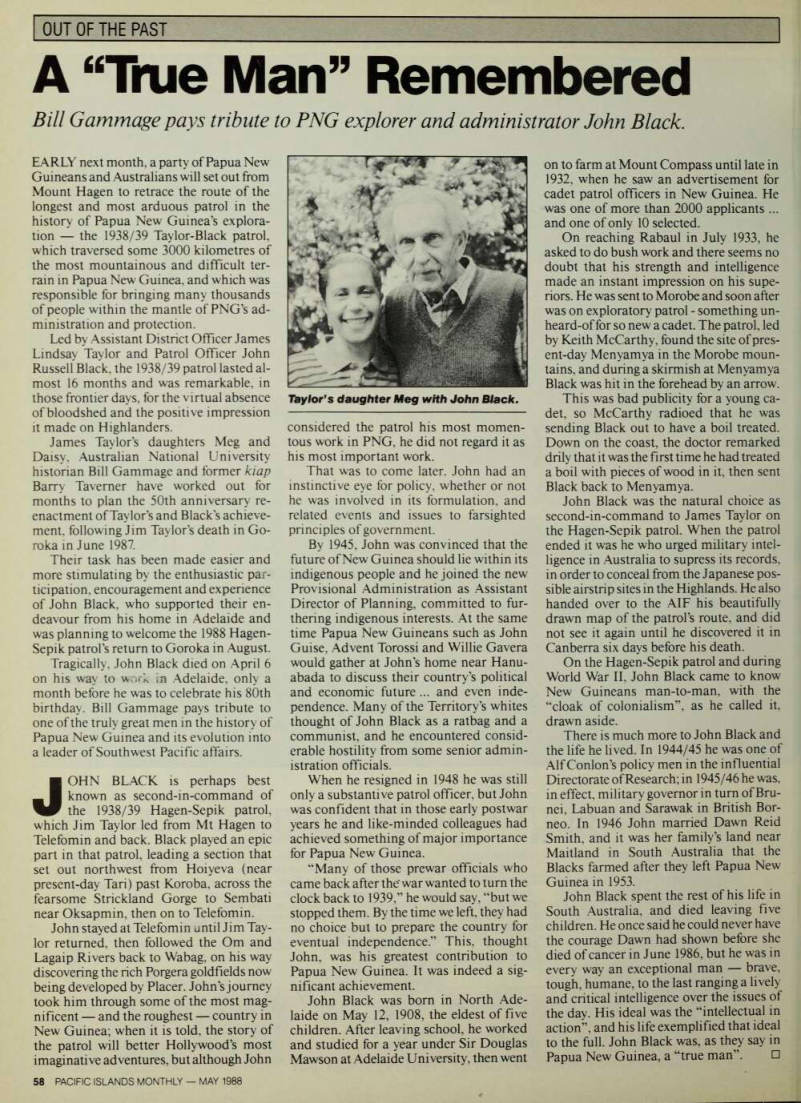
Taylor’s daughter Meg with John Black.