Book Reviews
p. 52 · Read in the full issue
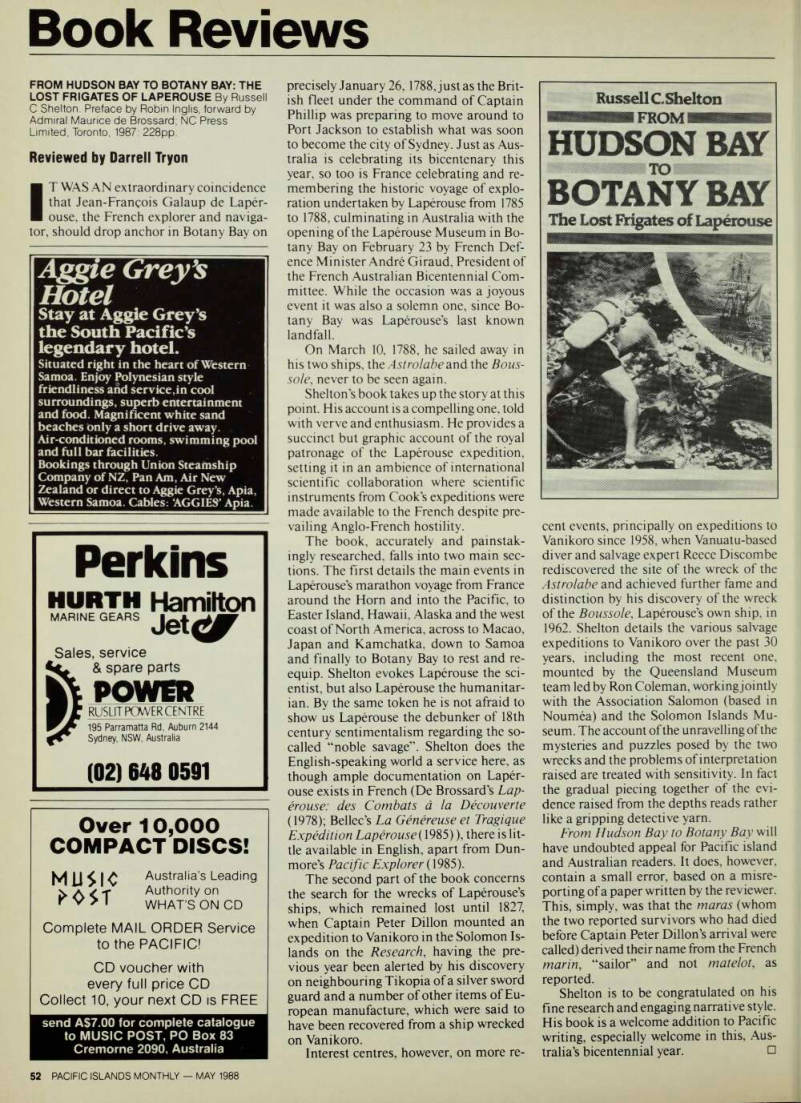
FROM HUDSON BAY TO BOTANY BAY: THE
Lost Frigates Of Laperouse By Russell
C Shelton. Preface by Robin Inglis, forward by Admiral Maurice de Brossard; NC Press Limited, Toronto, 1987: 228 pp.
Reviewed by Darrell Tryon
IT WAS AN extraordinary coincidence that Jean-Francois Galaup de Laper ouse, the French explorer and naviga tor, should drop anchor in Botany Bay on
precisely January 26,1788, just as the Brit ish fleet under the command of Captain Phillip was preparing to move around to Port Jackson to establish what was soon to become the city of Sydney. Just as Aus tralia is celebrating its bicentenary this year, so too is France celebrating and re membering the historic voyage of explo ration undertaken by Laperouse from 1785 to 1788, culminating in Australia with the opening of the Laperouse Museum in Bo tany Bay on February 23 by French Def ence Minister Andre Giraud, President of the French Australian Bicentennial Com mittee. While the occasion was a joyous event it was also a solemn one, since Bo tany Bay was Laperouse’s last known landfall.
On March 10, 1788, he sailed away in his two ships, the Astrolabe and the Bous sole,, never to be seen again.
Shelton’s book takes up the story at this point. His account is a compelling one, told with verve and enthusiasm. He provides a succinct but graphic account of the royal patronage of the Laperouse expedition, setting it in an ambience of international scientific collaboration where scientific instruments from Cook’s expeditions were made available to the French despite pre vailing Anglo-French hostility.
The book, accurately and painstak ingly researched, falls into two main sec tions. The first details the main events in Laperouse’s marathon voyage from France around the Horn and into the Pacific, to Easter Island, Hawaii, Alaska and the west coast of North America, across to Macao, Japan and Kamchatka, down to Samoa and finally to Botany Bay to rest and re equip. Shelton evokes Laperouse the sci entist, but also Laperouse the humanitar ian. By the same token he is not afraid to show us Laperouse the debunker of 18th century sentimentalism regarding the so called “noble savage”. Shelton does the English-speaking world a service here, as though ample documentation on Laper ouse exists in French (De Brossard’s Lap erouse: des Combats a la Decouverte (1978); Bellec’s La Genereuse et Tragique Expedition Laperouse{ l9Bs)), there is lit tle available in English, apart from Dun more’s Pacific Explorer ( 1985).
The second part of the book concerns the search for the wrecks of Laperouse’s ships, which remained lost until 1827, when Captain Peter Dillon mounted an expedition to Vanikoro in the Solomon Is lands on the Research , having the pre vious year been alerted by his discovery on neighbouring Tikopia of a silver sword guard and a number of other items of Eu ropean manufacture, which were said to have been recovered from a ship wrecked on Vanikoro.
Interest centres, however, on more re-
cent events, principally on expeditions to Vanikoro since 1958, when Vanuatu-based diver and salvage expert Reece Discombe rediscovered the site of the wreck of the Astrolabe and achieved further fame and distinction by his discovery of the wreck of the Boussole, Laperouse’s own ship, in 1962. Shelton details the various salvage expeditions to Vanikoro over the past 30 years, including the most recent one, mounted by the Queensland Museum team led by Ron Coleman, working jointly with the Association Salomon (based in Noumea) and the Solomon Islands Mu seum. The account of the unravelling of the mysteries and puzzles posed by the two wrecks and the problems of interpretation raised are treated with sensitivity. In fact the gradual piecing together of the evi dence raised from the depths reads rather like a gripping detective yarn.
From Hudson Bay to Botany Bay will have undoubted appeal for Pacific island and Australian readers. It does, however, contain a small error, based on a misre porting of a paper written by the reviewer.
This, simply, was that the maras (whom the two reported survivors who had died before Captain Peter Dillon’s arrival were called) derived their name from the French marin, “sailor” and not matelot, as reported.
Shelton is to be congratulated on his fine research and engaging narrative style.
His book is a welcome addition to Pacific writing, especially welcome in this, Aus tralia’s bicentennial year. □