New Island Satellite link
pp. 49-50 · Read in the full issue
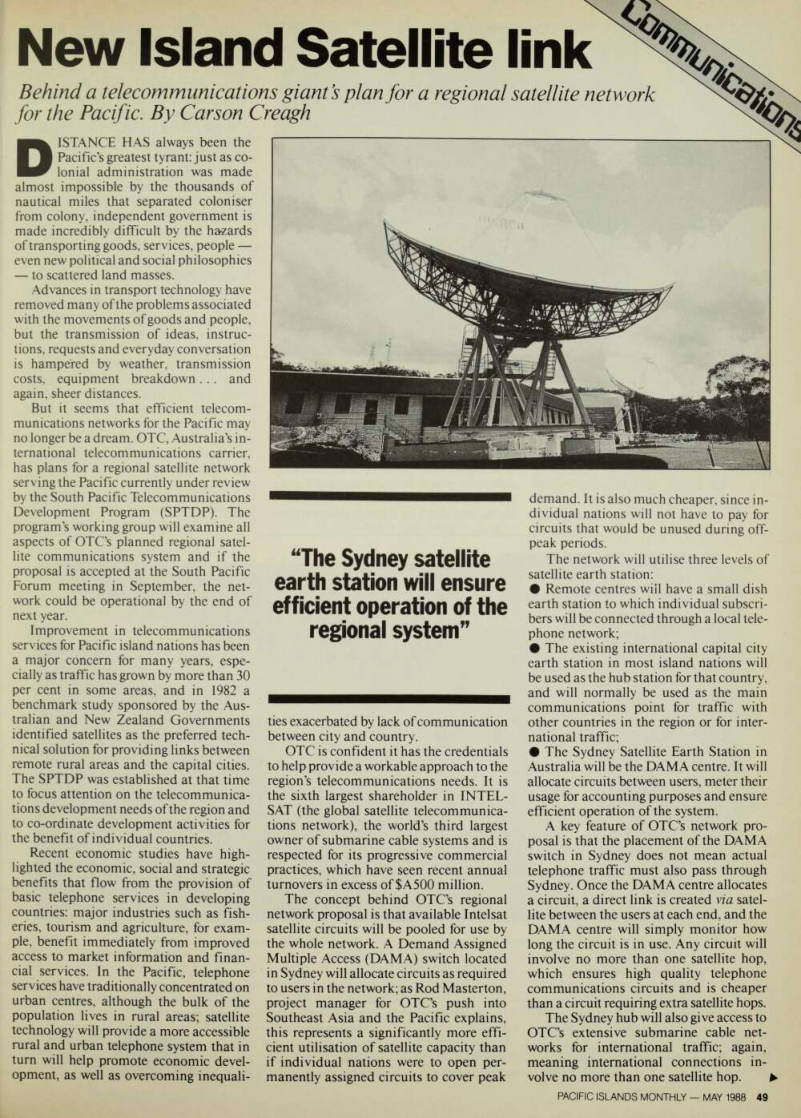

Behind a telecommunications giant’s plan for a regional satellite network
for the Pacific.
By Carson Creagh
DISTANCE HAS always been the Pacific’s greatest tyrant: just as co lonial administration was made almost impossible by the thousands of nautical miles that separated coloniser from colony, independent government is made incredibly difficult by the hazards of transporting goods, services, people even new political and social philosophies to scattered land masses.
Advances in transport technology have removed many of the problems associated with the movements of goods and people, but the transmission of ideas, instruc tions, requests and everyday conversation is hampered by weather, transmission costs, equipment breakdown ... and again, sheer distances.
But it seems that efficient telecom munications networks for the Pacific may no longer be a dream. OTC, Australia’s in ternational telecommunications carrier, has plans for a regional satellite network serving the Pacific currently under review by the South Pacific Telecommunications Development Program (SPTDP). The program’s working group will examine all aspects of OTC’s planned regional satel lite communications system and if the proposal is accepted at the South Pacific Forum meeting in September, the net work could be operational by the end of next year.
Improvement in telecommunications services for Pacific island nations has been a major concern for many years, espe cially as traffic has grown by more than 30 per cent in some areas, and in 1982 a benchmark study sponsored by the Aus tralian and New Zealand Governments identified satellites as the preferred tech nical solution for providing links between remote rural areas and the capital cities.
The SPTDP was established at that time to focus attention on the telecommunica tions development needs of the region and to co-ordinate development activities for the benefit of individual countries.
Recent economic studies have high lighted the economic, social and strategic benefits that flow from the provision of basic telephone services in developing countries: major industries such as fish eries, tourism and agriculture, for exam ple, benefit immediately from improved access to market information and finan cial services. In the Pacific, telephone services have traditionally concentrated on urban centres, although the bulk of the population lives in rural areas; satellite technology will provide a more accessible rural and urban telephone system that in turn will help promote economic devel opment, as well as overcoming inequali-
“The Sydney satellite earth station will ensure efficient operation of the regional system”
ties exacerbated by lack of communication between city and country.
OTC is confident it has the credentials to help provide a workable approach to the region’s telecommunications needs. It is the sixth largest shareholder in INTEL SAT (the global satellite telecommunica tions network), the world’s third largest owner of submarine cable systems and is respected for its progressive commercial practices, which have seen recent annual turnovers in excess of SASOO million.
The concept behind OTC’s regional network proposal is that available Intelsat satellite circuits will be pooled for use by the whole network. A Demand Assigned Multiple Access (DAMA) switch located in Sydney will allocate circuits as required to users in the network; as Rod Masterton, project manager for OTC’s push into Southeast Asia and the Pacific explains, this represents a significantly more effi cient utilisation of satellite capacity than if individual nations were to open per manently assigned circuits to cover peak
demand. It is also much cheaper, since in dividual nations will not have to pay for circuits that would be unused during off peak periods.
The network will utilise three levels of satellite earth station: • Remote centres will have a small dish earth station to which individual subscri bers will be connected through a local tele phone network; • The existing international capital city earth station in most island nations will be used as the hub station for that country, and will normally be used as the main communications point for traffic with other countries in the region or for inter national traffic; • The Sydney Satellite Earth Station in Australia will be the DAM A centre. It will allocate circuits between users, meter their usage for accounting purposes and ensure efficient operation of the system.
A key feature of OTC’s network pro posal is that the placement of the DAM A switch in Sydney does not mean actual telephone traffic must also pass through Sydney. Once the DAMA centre allocates a circuit, a direct link is created via satel lite between the users at each end, and the DAMA centre will simply monitor how long the circuit is in use. Any circuit will involve no more than one satellite hop, which ensures high quality telephone communications circuits and is cheaper than a circuit requiring extra satellite hops.
The Sydney hub will also give access to OTCs extensive submarine cable net works for international traffic; again, meaning international connections in volve no more than one satellite hop. ►
Under the terms of the proposal, OTC will structure a network tariff on a per minute basis to cover both the satellite and network switching costs.
OTC plans to have full backup facilities at its DAM A control centre in the event of technical failure. An additional level of backup capacity will also be built in to ensure the network is virtually failure-proof,
As well as installing and maintaining facilities, OTC is to train local personnel to manage island installations.
Another issue of concern to some na tions relates to the question of national sovereignty and the level of control they will have over a network managed from abroad. “OTC is sensitive to these con cems, and won’t be seeking absolute con
trol over the network,” says Masterton. “In fact, our network proposal includes plans for a management board composed of par ticipating nations, which will be respon sible for determining (in consultation with OTC) the structure of the network and fu ture directions for its development.”
As part of the current examination by the SPTDP working group, an expert con sultant will be looking at this and other in stitutional issues.
Masterton is confident OTC’s proposal will be viewed favourably, especially since Kiribati has recently signed a two-year contract to develop its telecommunica tions network to an international capacity.
Aside from the region’s growing need for communications, the OTC proposal represents a hard-headed business prop osition: at a cost of SA3 million for instal lation and initial operating costs it is a major investment, but Masterton antici pates a net return of 12 to 14 per cent to OTC, after an introductory period in which establishment costs will outweigh profits. “We are looking at a 150 to 300 per cent increase in traffic,” he says, “espe cially where networks simply do not exist at present. Communications will be the world’s single largest industry before the end of this century and OTC aims to be providing a significant amount of com munications hardware and services by that time.” □
INTELSAT, the global satellite communications network.