Hi Tech On The High Seas
pp. 45-47 · Read in the full issue
Ed Rampell attended a meeting of some of technology’s best minds at Hawaii’s 10th Annual Pacific Telecommunications Conference.
The future came to the Pacific recently with February’s 10th Annual Pacific Telecommunications Conference (PTC) and its message is that the brave world of tomorrow will be one of high technology on the high seas, where remote Pacific islands are intricately connected by a network of computers, video, fibre optic cables, satellites, small dish terminals, earth stations, high-speed data transmission, tele-conferencing, transportable satellite news-gathering stations, teleports, electronic mail, integrated services digital networks ... and more.
Experts from industry, academics, government and business decision makers from more than 20 Pacific nations gathered at Honolulu for the conference,
Papua New Guinea, the Solomon Islands, French Polynesia, Guam, Hawaii, Aus tralia, New Zealand and the South Pacific Forum all sent representatives, while in dividuals from Samoa and Fiji also at tended. Mr Neil Anthony, of PNG’s Post and Telecommunications Corporation, told Pacific Islands Monthly that Port Moresby sent him to the PTC “as part of my training development and to gather in formation on telecommunications equip ment and applications for PNG. We need better performance ... and to know what technology is available.”
According to the PTC, one of its key objectives is “to provide a forum for dis cussion and interchange of information, ideas and expressions of views regarding telecommunications in the Pacific.” The 1988 Conference focused on “Pacific te lecommunications development and the alternatives for the next decade”. The con vention, at the Sheraton-Waikiki Hotel, included slick displays and exhibits of the very latest high technology communica tions gadgetry. More than 85 papers were presented during the three day symposium.
This information revolution’s impli cations for Polynesia, Melanesia and Mi cronesia are major. It promises or threatens, depending on your perspective to absolutely alter the Pacific way of life.
The isolation that has characterised island societies scattered across a third of the
globe’s surface greatly divided by great ex panses of ocean, will be much changed.
The coming Information Age has the po tential to transform the Pacific.
The communications applications linking the islands with each other and the world beyond the reef are manifold. For example, PTC participant Charlie Wilk inson, of the South Pacific Forum’s Fish eries Agency, has a surprising yet extremely practical use for scientific equipment: “Telecommunications can be utilised for surveillance, to catch poachers illegally fishing within 320-kilometre Ex clusive Economic Zones,” he said.
Education is another field where is landers can reap benefits with the new technology. Papers on educational tele vision were presented by the Morelos Mexican Satellite System, Japan’s Uni versity of the Air, and the California State University. Through satellites, earth sta tions and so on, educational TV program ming can reach masses of people who may be unable to attend colleges. With the par allel mushrooming of video-cassette re corders, workers and housewives for example can incorporate higher education into their schedules at their convenience.
Another form of technology enhancing TV’s educational potential is tele-confer encing. This live medium of two-way communication enables students and teachers simultaneously to see and hear each other. Thus, the classroom experi-^
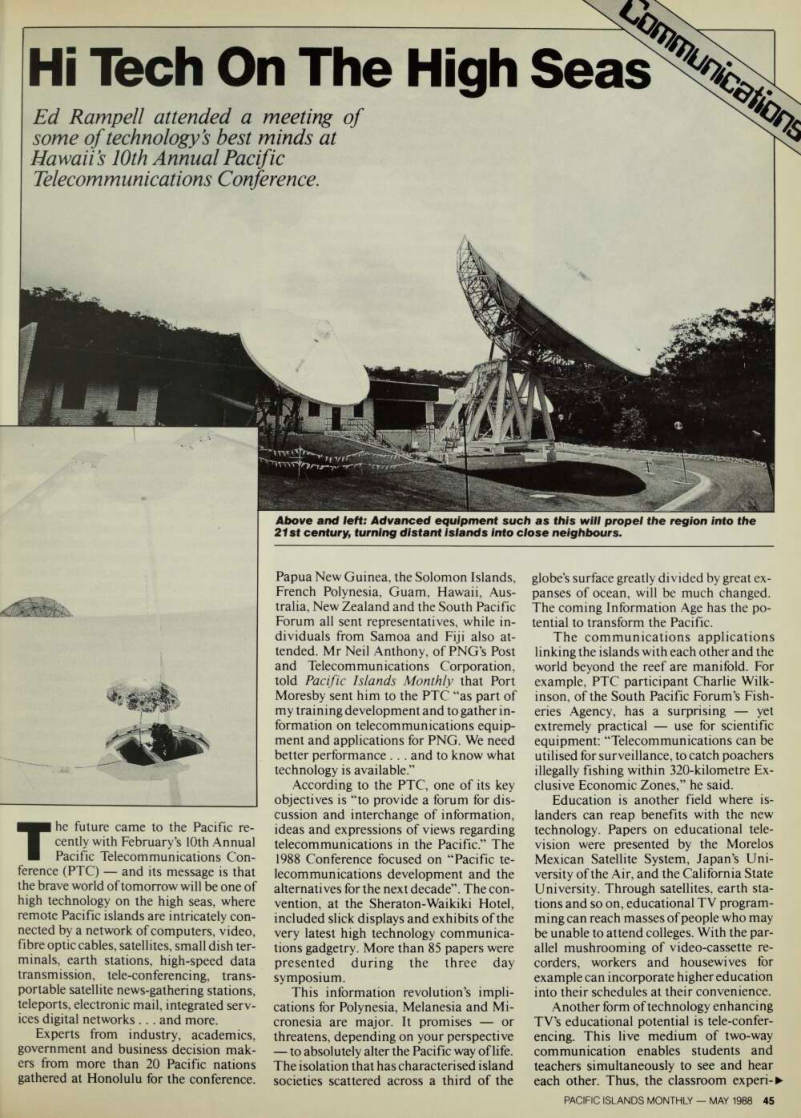
Above and left: Advanced equipment such as this will propel the region into the 21st century, turning distant islands into close neighbours.
4 ence can be simulated via TV, and a professor at UCLA or ANU can instruct pupils at UPNG and USP. Conceivably, a taro farmer at Kapingamarangi Atoll can receive a degree from Harvard, without the trauma of being tom from hearth and home. Tele-conferencing hardware is, however, still quite costly and for now is generally restricted to business and news applications.
High technology has an unlimited potential for enhancing island mass media; in particular news reporting, within and beyond Oceania. Perhaps the greatest advantage will be the increased speed of news delivery. Even live TV coverage of major events such as regional meetings, coups and hurricanes will be made possible by satellite and underwater cable systems.
Telefaxing, computerisation, laser printing and the like also will improve print
journalism with more up-to-date news.
Another aspect of this mechanisation of journalism is that news from the Pacific can become a regular staple of broadcasts around the world.
At the same time, islanders will be able to keep up with global events as they hap pen and in more detail than is currently possible. Transportable News Gathering Satellite stations with compact video ca pacities linked to orbiting satellites can provide spot reporting for intra-island, in ter-island and international audiences.
High technology telecommunications can also profoundly speed postal services in a region where planes and cargo ships still deliver mail at a snail’s pace. Elec tronic mail, telefax, and high speed data transmission can become instantaneous, making the postage stamp as obsolete as the Pan-Am Clipper or the clipper ship.
The telephone can become a mini-in formation centre in this advanced infor mation society. And telephone service itself will be substantially upgraded.
through the use of satellites and undersea fibre optic cables systems. Dispersed ar chipelagos such as Vanuatu, large land masses such as PNG, even islets on a Mar shallese atoll will be able to phone isle-to isle and village-to-village, or place inter national calls around the world in less than 80 seconds.
The Integrated Services Digital Net work (ISDN) is just one example of the scientific advances that form a backdrop to telecommunications developments, According to Michigan State University s Drs Robert Laßose and Charles Stein field in a PTC paper titled Waiting for ISDN: Toward an Agenda for Social Re search”, this new technology will have inl mense improvements over the current analogue based telephone systems.
“ISDNs will be all-digital and will allow the integration of voice, data and image
transmission within a single universal public network .. . greatly reducing the complexity and variety of interface de vices required to let computers and people talk to one another. .. ISDN will present the average user with the ability to per form several transactions at once ... The 28+D interface offers a total of.. . about 20 to 60 times the bandwidth available on existing public switched voice networks.”
All of these steps offer tremendous pos sibilities for government, business and economics. However, Oceania is still a de veloping area, where electricity and phones have yet to reach large sectors of the pop ulation. As PTC participant Billy Misi of the Solomons Post and Telecommunica tions Agency says: “We are still backward compared with what is here at this convention.”
How the islands can afford high tech nology telecommunications is a legitimate question. But so is: how can the islands af ford not to invest in this essential field?
According to Hawaii’s East-West Centre’s Michael Ogden and Meheroo Jussawalla in their outstanding PTC paper “Pacific Islands and the Maitland Commission Mandate”, telecommunications networks “.. .have become recognised as an infras tructure that aids economic development anywhere in the world ... The disparity demonstrated by three quarters of the world’s telephones being concentrated in nine countries while the remaining quarter are scattered unevenly throughout the rest of the world prompted the Maitland Com mission to state that, ‘Neither in the name of common humanity nor on grounds of common interest is such a disparity ac ceptable’ . .. South Pacific Forum leaders see the bridging of the communications gap, in the most expedient and economi cal manner, as the essential prerequisite to economic development and self sufficiency.”
Thus in this Age of Information, tele communications is as important a com ponent of development as roads, running water, power and natural resources. As
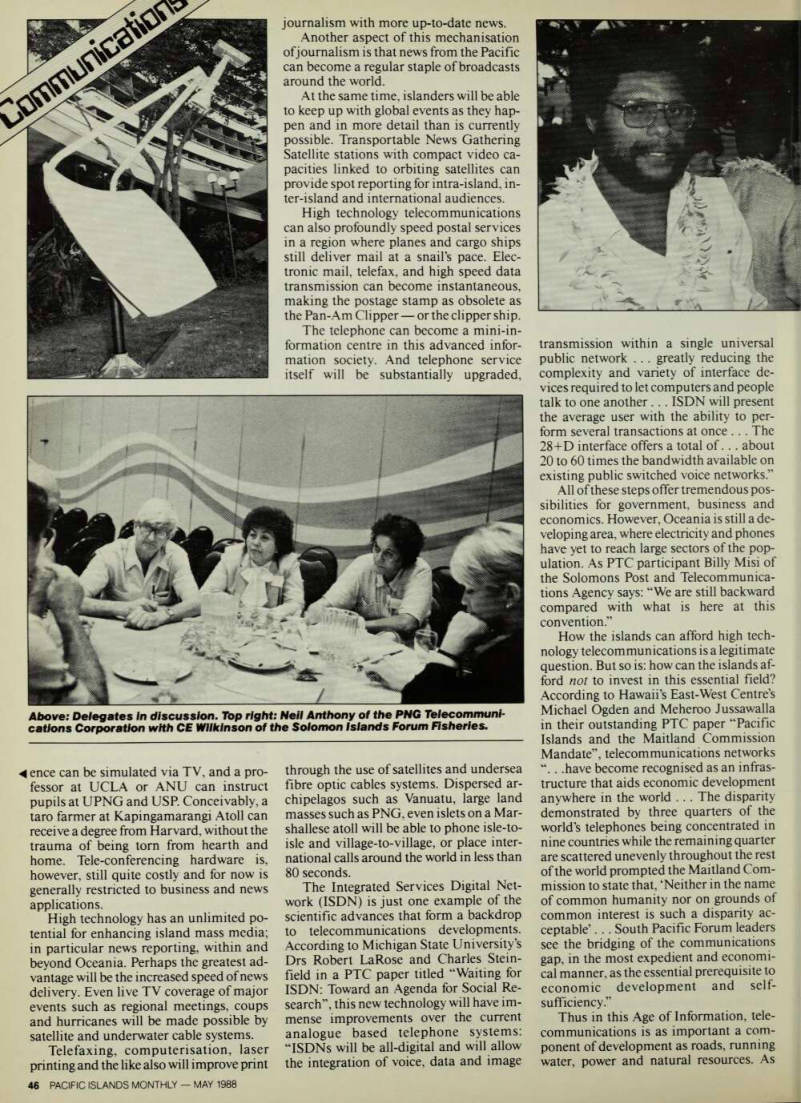
Above: Delegates In discussion. Top right: Neil Anthony of the PNG Telecommuni cations Corporation with CE Wilkinson of the Solomon Islands Forum Fisheries.
PTC observer Samoan Don Sa’aga of the University of Hawaii’s Pacific Business Centre says, despite relatively large initial capital outlays, “this is a very cost effi cient way to provide information data, video, voice for the Pacific islands.”
Some methods are especially suited to the Oceanic reality, financially and geographically.
Pooling resources is a viable way for the Pacific community to maximise benefits while minimising costs, with less devel oped islands co-operating with their more industrialised neighbours. High technol ogy hubs concentrate and centralise tele communication needs for regional sharing.
Ogden and Jussawalla say that with the Celstar I and II satellites, the relatively modern American territory of Guam will, by 1991, serve as a communications hub with North America, Hawaii, the South Pacific, Asia, Africa and Europe.
Teleports will be to the 21st century what “shipping ports . . . and airports” have been up to now, accordingly to PTC participant John Reiser, of Teleport Com munications, New York. “Instead of transporting people or products, teleports will transmit information” from commu nications capitals. Tele-cottages are mini teleports on the town hall level for isolated villages. They have worked well in Scan dinavia, and could be adopted for moun tainous land masses such as PNG.
Australia’s Overseas Telecommunica tions Commission is planning a South Pa cific optical fibre submarine cable network that will link islands with Asia and the Americas. INTELSAT, the first satellite series specifically designed for Oceania, continues to expand its services here. So lar-powered small earth stations are ideal for rural and remote isles in the South Seas.
And Very Small Aperture Terminal (VSAT) satellites are also particularly con ducive to limited non-urban populaces, as this system provides the cheapest and smallest earth stations.
However, telecommunications poses a number of problems and promises for the
Pacific. What Japan’s assistant vice-min ister of Posts and Telecommunications, Mr Makoto Miura, refers to as the “One World One Network” has its “uplinks” and “downlinks” for the islands. Serious ques tions must be asked about this technology, which has the potential to radically trans figure the obscurity and isolation of Oceania.
First, does the Pacific really need high technology communications? Is there anything inherently wrong with a pas toral, non-technological existence, where people are not directly plugged into “civ ilisation” and its attendant complica tions? After all, from Rousseau to Gauguin and beyond, Western man has extolled the virtues of simple living close to nature, ex emplified by the South Seas. Will these gadgets make our islands more separate than ever by replacing face-to-face meet ings between the peoples of different is lands with tele-conferencing, videotex, telefax and so on? Are we heading for a so ciety where everybody watches a screen and reading is taboo?
There are even more ominous aspects of this new-fangled equipment. High tech nology telecommunications also can have military applications, which is potentially dangerous for a region already becoming a focus of superpower confrontation. In terms of shared teleport and hub facilities, PTC participant and University of Colo rado political scientist George Codding points out that “most sovereign nations would have serious reservations about al lowing their domestic telecommunica tions systems to depend on the goodwill of another state . ..”
The deepest source of anxiety is the possibility that this video-computer-ca ble-satellite data-digital matrix will fall into the wrong hands, creating a totalitar ian technocracy. Fiji coup leader Briga dier Sitiveni Rabuka has already offered this chilling vision of a Pacific police state by proposing an “intelligence agency, an office of national assessment, where political, economic and the strategic de velopment in and around Fiji can be mon itored closely so that intelligence is passed on early . ..”
On the other hand, high technology on the high seas has the potential of creating a communications cornucopia. One-di mensional cultures forged out of isolation, distances, and low educational levels could be gone with the trade winds. Fishermen will no longer be lost at sea; farmers will be alerted to weather patterns; natural ca tastrophes can be prepared for; medical emergencies can be expedited. Electronic town hall meetings can lead to direct, par ticipatory democracy and greater under standing of development programs through broad community participation.
Man will be able to connect with his fellow man a village, islet, island, ocean or continent away. The innumerable scat tered atolls and islands will form a single, unified archipelago. □