Ratu Mara: “Our Great Challenge”
pp. 35-37 · Read in the full issue
Fiji
The Fijian PM reports on the task facing the interim administration to restore democratic, economic and social order to the nation.
I WOULD Like to bring you up to date on the progress the interim Govern ment has made toward its fundamen tal goal of restoring order and normalcy in our country, of laying a secure foundation as the basis for sustained economic growth and for enduring political stability, social progress and harmony in our nation.
At the outset of the interim adminis tration, I had made a special public appeal asking each Fijian for understanding, for co-operation and for full support in our difficult but challenging task of rebuilding our nation and of creating a future of hope and promise for all the people of Fiji.
As I look back over this first 100 days, I can say with humble pride and with much satisfaction that we have taken a big step forward. And what pleases me most of all is that this positive beginning has been made possible by Fijians’ understanding, their readiness to accept less in order to help others, and their unshakeable faith that we can overcome our present hard ships and difficulties.
In a concerted endeavour to arrest the contraction in our country’s economy, the interim Government had to act immedi ately and, in our national interest, put in place an austerity national budget. Public operating expenditure was cut by 30 per cent; salaries and wages had to be reduced by 15 per cent. But even with these severe measures, the budget was still in deficit to the tune of SFII9 million.
It has, therefore, been absolutely nec essary to keep a tight control on public ex penditure and to allocate resources only to those activities that are essential and con ducive to the earliest possible recovery of the national economy.
Consistent with this, the interim Government will leave no stone unturned in ensuring, with the support of the police and the security forces and, indeed, the public at large that any genuine alle gations of corruption, misappropriation or fraud involving any public servant, a Government Minister (or the Prime Min ister, for that matter), are immediately and thoroughly investigated and appropriate punitive and corrective action taken if they are proven.
With prudent management, and with your patience and fortitude, I am pleased to report that our combined efforts and sacrifices are beginning to bear fruit. In this respect I am particularly grateful to all public servants for their hard work, loyalty and dedication.
As an example of the positive trends that are starting to emerge, actual revenue
collected for the month of January totalled more than SF22 million, which represented an increase of $F4.5 million over the projected revenue figure 0f5F17.5 million for that month.
As another example, the projected revenue from customs, excise and export duty for February was set at SF7.B million.
However, for the period from February 1 to February 24 actual revenue collected was $F7.3 million and it is expected that the total figure for February will exceed the projected revenue for that month.
Government’s revenue position is therefore starting to improve on projections. But not to the extent that we can now afford to relax those cost controls and other restrictions, including the salary and wage reductions, that the interim Government
had found unavoidable, However, the Government is monitor ing its financial position closely and if the trend in revenue collection shows a con tinuing substantive improvement, the in terim administration will consider amending the current national budget in June this year.
A further welcome development is that all of our overseas friends have restored their economic relationships with Fiji, Overseas aid assistance already pledged to support economic and social develop ment in our country this year is estimated at more than SF34 million. It is the highest ever level of foreign aid to Fiji in any single year. This undoubtedly is a clear indica tion of the readiness of our overseas friends to lend full support to our endeavours in
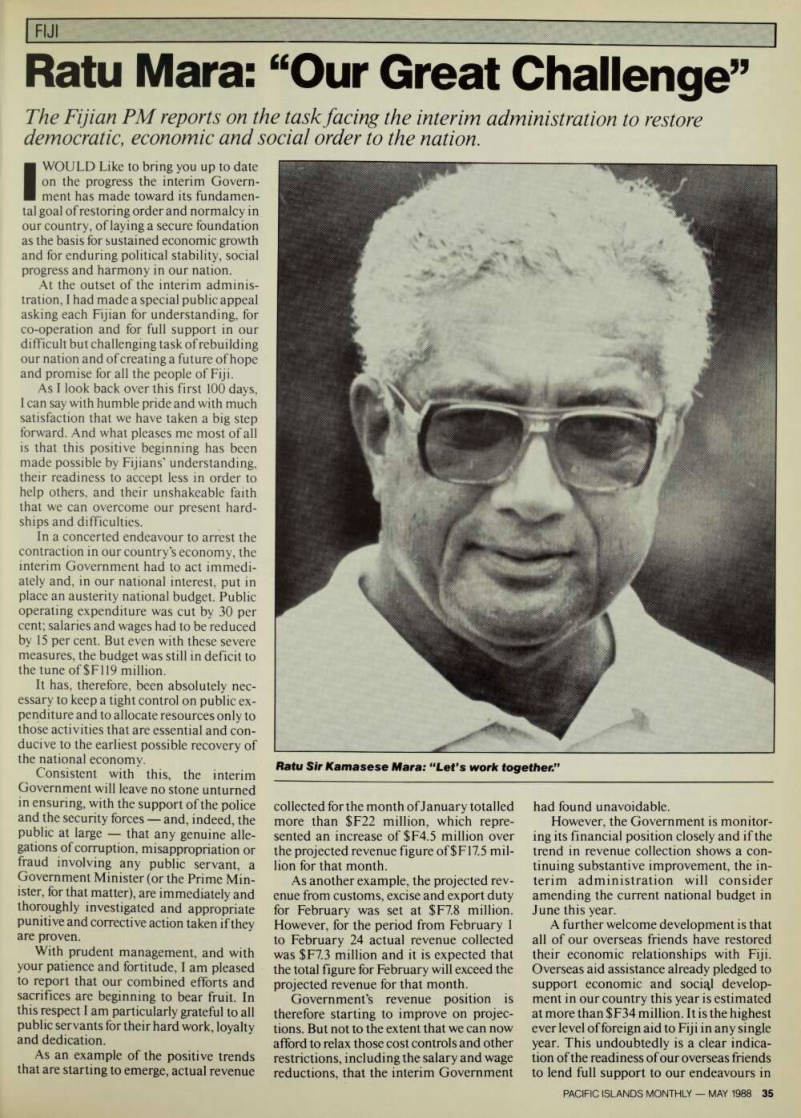
Ratu Sir Kamasese Mara: “Let's work together."
Fiji. It is comforting to know that we do not stand alone as a member of the inter national community of nations, but that we do have friends who genuinely care for our future.
I would like to express our sincere ap preciation to all the governments and in ternational organisations that have rallied to our support. I can assure them that their generous contribution will greatly facili tate the economic recovery and social sta bility we all want for Fiji, and which we must have if we are to ensure lasting peace and harmony in our country.
I n my address to you last December and in my New Year message to the nation, I informed you then that the protection of employment and the creation of new jobs for our people was an immediate priority of the interim Government. As we saw it, this was to be approached in several ways.
One was to implement development proj ects in the public sector. In the capital budget for this year, a total of SFS7 million is to be spent on capital works. Work has already begun on several projects.
The SF34 million in foreign aid already committed to Fiji for this year will be used to complement and to supplement our ef forts in the public sector. And we shall continue our efforts to attract additional capital aid to Fiji.
The interim Government will, for ex ample, be following up my recent discus sions in South Korea and Japan, for the South Korean Government to assist in the financing of the reconstruction of the Ba and Sigatoka River bridges, and for the Government of Japan to consider financ ing the construction of a new teaching hospital complex in Suva.
These projects, if successfully followed through, will contribute not only in pro viding jobs for hundreds of our people but also in improving economic and social services. But in addition to all these, it is the private sector we believe that has tre mendous potential to bring about and to foster the quick recovery of our economy.
The essential first step must be to re store and to raise the level of investor con fidence, both within our own business community and among overseas busi nessmen. We have begun that process and we are succeeding in restoring that confi dence. Furthermore, with the establish ment of special tax free zones, the interim Government has been making every ef fort to attract increased investment inter est and participation in Fiji. In this regard I am most grateful to the Australia/Fiji and Fiji/Australia Business Councils for the constructive contribution they have made.
In particular, I wish to acknowledge with Warm appreciation the extremely helpful attitude they have adopted in agreeing unanimously to express their collective confidence in the future of Fiji as a focus for substantial business investment and development.
Indeed, as a direct reflection of the growing business interest and confidence
in Fiji, 20 new investment proposals involving local businessmen and overseas partners have already been received to take full advantage of the tax free facilities that were recently introduced. Of these applications, three have already been approved and 17 are still being processed by the Fiji Trade and Investment Board.
The establishment of these new enterprises will create many new jobs for our people and earn increased foreign exchange for our country.
The interim Government will continue to do its utmost to encourage and promote new investment in our country, in order to stimulate and accelerate our economic recovery and provide employment and income generation for our people.
Tourism is another major area of primary focus by the interim administration.
A number of tourist development projects with a total value of more than SF3OO million are already in the pipeline.
“The essential first step must be to restore and to raise the level of investor confidence”
In January this year, Government re cruited a tourist expert to work with the Ministry of Tourism to identify small projects for indigenous Fijians. The objec tive of this project is to diversify and to spread the location of tourism-related ac tivities, so as to help in improving eco nomic conditions in our rural areas and at the same time create employment for our rural population.
Meanwhile, the Fiji Visitors Bureau has embarked on an active marketing cam paign to restore growth in tourist visitor arrivals in Fiji. In fact, forward bookings look optimistic for the tourist industry for the rest of this year. And plans for the ex pansion of our tourist industry have been given a real boost by the recent start of the Nadi airport terminal redevelopment pro ject. This is estimated to cost $F 10 million and will create 200 new jobs.
In my discussions with the Govern ment of Japan during my recent visit to Tokyo, I was able to urge the Japanese authorities to facilitate the commence ment by our own Air Pacific of direct air services to Japan later this year.
With Air Pacific flying to Japan, and with the renewed Japanese business inter est in direct participation in hotel devel opment and operation in Fiji, I have every confidence that we can develop an impor
tant tourist market in Japan.
Australia, of course, will continue to be Fiji’s most important tourist market. Ac cordingly, we welcome the recent under taking by the Australia-Fiji Business Council to promote Fiji as a continuing destination for Australian tourists and as an attractive venue for holding conven tions and meetings.
The commencement of improvement in the Government’s financial position, the increased and extended public sector pro grams of public works, the restoration of overseas economic aid support for Fiji, the return of investor confidence, the start of new joint venture businesses in our coun try, and the gradual recovery of our tour ism industry are all positive indications that our economy is moving forward.
If we can continue and perservere with our concerted and united efforts, with our sacrifice and readiness to help our fellow men with hard work and an unyielding de termination never to be defeated, I have no doubt that our present endeavours to overcome our economic difficulties will be rewarded ultimately with resounding success.
In my address on December 8, I also said that the formation of an acceptable Constitution for our country was without question another top priority for the in terim administration. To this end, a cab inet committee has already started looking at proposals for a new constitution. We re gard this task as a matter of paramount national importance.
We also recognise that it would have to be approached delicately, with meticulous care and with extra sensitivity, but tem pered by a realisation and an acceptance that the only solution that can have any real hope of lasting success is one that takes fully into account the realities of the pres ent situation.
By various decrees that have already been promulgated, order and normalcy have been restored to the functioning of Government and of public services. An independent judiciary has been re-estab lished. Under the new fundamental rights and freedoms decree, basic human rights and fundamental freedoms have been re stored. But we have begun a new stage in our life as a nation. We are now a republic the Republic of Fiji.
We must realise that there can never be a return to the Dominion status we had before this change in our Constitution.
Nevertheless, the interim administration is firmly committed to exploring every possible avenue of an acceptable arrange ment that would allow the entire people of Fiji the opportunity to be able to show, in the most direct way, their continuing loy alty to, and affection for, the British Crown.
In keeping with traditional Fijian cus tom and courtesy... the recommenda tions of our cabinet on the Constitution will be conveyed first to a special meeting of traditional chiefs from all parts of Fiji.
This hose ni turaga will be convened in
May (or June) this year. This will then be followed by reference to the Great Council of Chiefs, which is to meet in J une (or July).
As we are all aware, the reconstitution of this council is presently under considera tion. However, I would like to assure you all that any changes in the composition or the structure of the Great Council of Chiefs will be a matter entirely for selective de cision by the traditional chiefs of Fiji and not by the interim administration or any other body.
At the meetings of the bose ni turaga and the Great Council of Chiefs, there will also be full consultation on the wider as pects of the constitutional future of Fiji.
From the counsels of our traditional chiefs and elders, it is hoped that a clear and unanimous consensus will emerge on a possible way ahead for our country. An advisory committee, widely representa tive of major ethnic communities and cul tural groups in Fiji, will then be appointed by the interim administration to give care ful scrutiny to the constitutional proposals.
Within this overall framework it is the intention of the interim administration to hold free and open elections once a broadly acceptable Constitution, including its provisions and enabling regulations, has been completed.
The interim administration has no il lusion about the difficulty of its task. We
are, however, clear in our perception and firm in our belief that a new Constitution will have to ensure the full protection of the fundamental interests and concerns of the indigenous Fijian people, but at the same time accommodate on a fair and eq uitable basis the position of the other com munities in our multi-ethnic and multi cultural society.
We are also confident that through the framework of consultations and dialogue I have outlined, it shall be possible to de velop a broadly acceptable Constitution that will provide for a speedy return to parliamentary democracy, and a freely elected parliamentary representative government.
It is our sincere hope that all these can be achieved within the two-year time frame the interim administration has set for it self to complete these tasks.
We have all gone through a period of turmoil and strife, of fear and anxiety. I can only hope that this most disturbing period in our history is now well behind us. Indeed, I am happy to say that peace, stability and harmony prevail in our country. I would therefore urge us all to continue to work together to strengthen the unity of our nation. □
From Ratu Mara s March address to the nation in Suva.
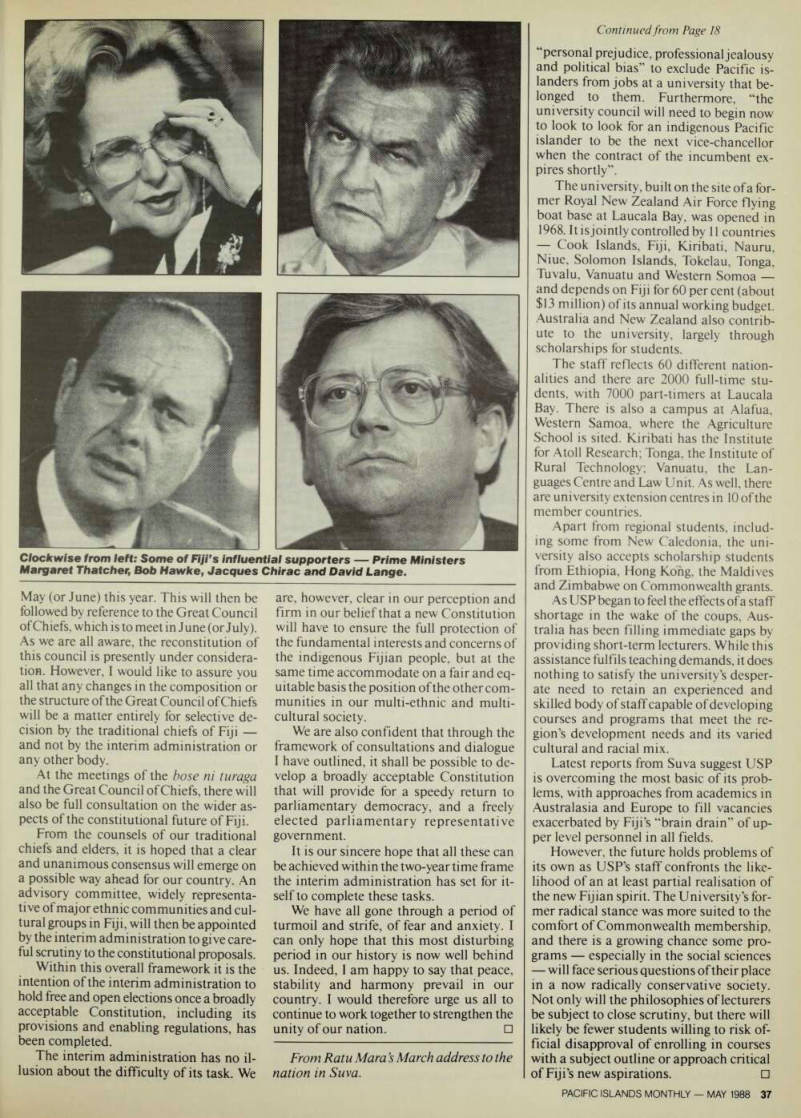
Clockwise from left: Some of Fiji's influential supporters - Prime Ministers Margaret Thatcher, Bob Hawke, Jacques Chirac and David Lange.