Backing A Business Recovery
pp. 32-34 · Read in the full issue
Fiji
Businessmen are giving Fiji s ailing economy a boost.
By Larry Writer
AT LAST there is cause for opti mism. A good sugar crop, the re sumption of aid from neighbours and the first signs of a revival of tourism have raised hopes that the Fiji economy is on the mend.
Government and business leaders, however, are under no illusions. One look at the books is enough to shake the bullish from any premature complacency: inter national investor confidence is still decid edly shaky, the economy declined by 11 per cent in 1987 (and that decline is tipped to continue in 1988, with a negative growth rate of 6.5 per cent on the cards), and the 1987 deficit of SA73 million could crash to SAI24 million. The Fiji dollar has been devalued by about 34 per cent and this while having many positive effects has made essential imports more expensive.
Inflation is growing, and so is unemployment.
But the interim Government is taking this parlous situation by the scruff of the neck and shaking it hard. Prime Minister Ratu Sir Kamisese Mara knows that eco nomic recovery is the only hope Fiji has of regaining its once proud and influential position in the Pacific. In a recent address to the nation, Ratu Mara spelled out a brave and dynamic action plan to rescue the economy. (See page 35).
The Prime Minister can take heart from a positive and successful conference of the Australia/Fiji Business Council (AFBC) and the Fiji/Australia Business Council (FABC) held in Suva in March. The pre vailing mood at the conference, said Aus tralian businessman Russell Leitch, president of the AFBC, was one of “All right, what’s done is done; now business has to do everything in its power to get Fiji back on the rails for everybody’s sake.”
In an exclusive interview with Pacific Islands Monthly, Mr Leitch said his con fidence in Fiji becoming again a viable business centre was high. But like Ratu Mara, Mr Leitch realises there is much to do. The brain drain must be staunched and vacancies filled by professionals. Tourism has to regain the high levels of pre-coup days, a small manufacturing base needs to be established, the good performance by the sugar industry has to be maintained and such encumbrances to trade as Sun day observance have to be reviewed.
“Fiji will recover,” says Mr Leitch. “It has excellent natural resources, it is well placed geographically and its people are used to hard work. My company, West pac, has been in Fiji since 1901 and within a few days of last year’s May 14 coup we
made our position clear when you are in a country for the long term you take the vicissitudes of the short term in your stride and keep planning for the future.”
Mr Leitch considers that Fiji is now stable, and that will be his message to Aus tralian and other countries’ businessmen; “I have visited four times in the past six months and I have never felt any sense of instability. However, I do understand the concerns many local people have. But from my viewpoint, Fiji is once more the place it was before the coups.”
The media is an important tool in Fiji’s rehabilitation. “It has a responsibility to report when things are going well.”
Governments and businesspeople had a similar responsibility to be candid with the media. Similarly, a return to pre-coup tourism levels is vital, and again positive
“The economy can be rebuilt to the point where investors are queueing up at the door” Russell Leitch
stories in the media can help. But so can anybody who visits Fiji and has a good time: “They should spread the word,” says Mr Leitch.
“The tourist infrastructure, in the form of excellent hotels and holiday destina tions, is already well established. What is needed is favourable publicity to encour age the return of tourists in large numbers, and an increase in airline schedules.
“Airline schedules will increase if the demand for seats is high. There would be a reason for some of those airlines that pulled out of Fiji after the coup to start their services again.
“Cheap air fares are a good short-term way of getting tourists back to Fiji, but a concerted and co-ordinated marketing campaign selling Fiji as a destination would have more lasting benefits. There should also be an education program for travel agents. “If the people selling tickets at the travel agency or the airline are con vinced Fiji is a good place to go, they’ll make an effort to convince their clients.”
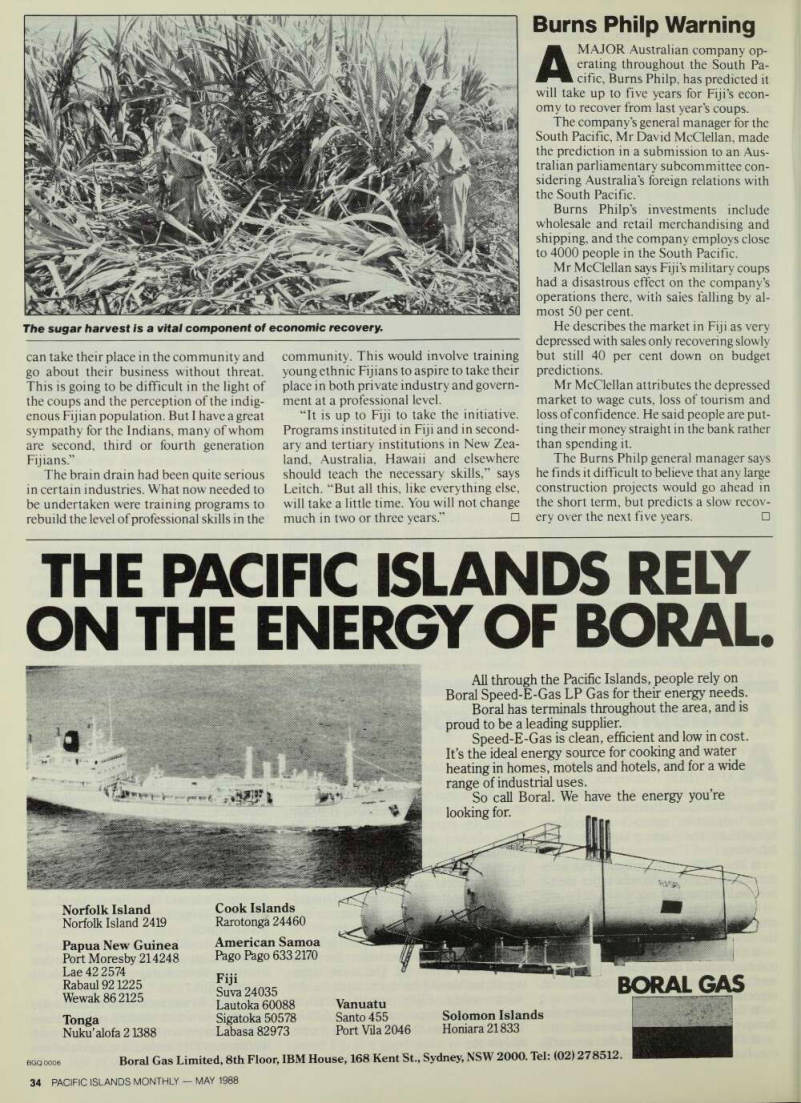
The Fijian sugar industry is as impor tant to the nation as tourism but, unlike tourism, it is in good shape. “The industry is now doing better than immediately be fore the coup,” says Mr Leitch. “The cli mate is good for the current harvest. The main growers are Indian families who have worked on the land for many years: their livelihood depends on a good crop and they will do their best to ensure a good harvest.”
Russell Leitch predicts a good harvest this year but admits much depends on the world price of sugar (“although Fiji is largely immune to that,” he says, “thanks to its long-term contracts”). Mr Leitch says the onus is on Fiji to be an efficient pro ducer, especially when world prices are low. “The Fiji Sugar Corporation itself is a very efficient organisation; it needs to remain so and to support the industry with technology and milling capacity.”
Asked whether Fiji could guarantee se curity for investors, Mr Leitch has his doubts. “I don’t think any country can guarantee that, but Fiji can provide a cli mate where investors can make their de cisions knowing that they have a good chance of turning a profit and repatriating their capital,” he says.
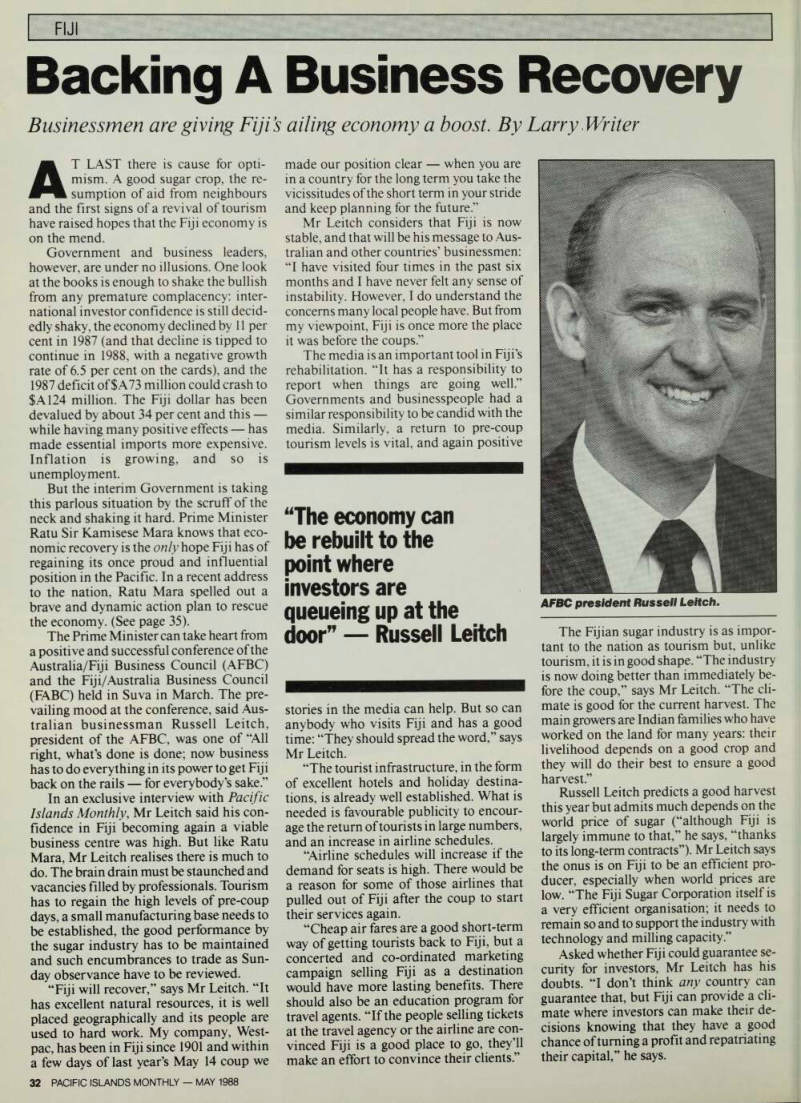
AFBC president Russell Leitch.
“The state of the economy is the best guarantee investors can get. If the econ omy can recover—and quickly the flow of investment will speed up. The Fiji economy has suffered a knockback, but the resources are there; if the right moves are made and Fiji is given the time to recover, the economy can be rebuilt to the point where investors queue at the door.”
Mr Leitch also told businessmen in Fiji that the full restoration of democracy in Fiji needs to be encouraged, and the people need to be reassured that the military would not again interfere in the running of the country. “Business must know that the country will be run in an orderly and pre dictable manner, on the basis of laws en acted through a democratic process. The arbitrary exercise of power will only un dermine business confidence,” he stresses.
Recent moves by the Government to provide tax minimisation incentives, such as making land available for industry, manufacturing and commerce in tax-free zones, would help in the short term, says Mr Leitch. “But the most attractive incen tive is the up to 13 year tax holiday for investors [whereby profits are not taxed for a specified number of years], which is par ticularly beneficial when geared to the SPARTECA agreement and other agree ments that allow favoured access into markets.”
The tax holiday would draw investors to Fiji. “Fiji has a good work force able to produce quality goods garments, tim ber, furniture. Wages are relatively low, and Fiji has good shipping access to the United States, Asia, New Zealand and Australia.”
In his address at the AFBC/FABC con ference, Mr Leitch said that SPARTECA in particular could serve a useful role in helping build Fiji’s manufacturing base.
“And this benefit can be assisted by Aus tralia, for example, by easing the remain-
ing restrictions on some Fijian items such as garments, which face import restrictions in Australia.”
He says manufactured items could be encouraged to establish a niche in the Australian market. “In fact, under the SPAR- TECA agreement the climate exists for a major push by Fiji into Australia with manufactured items, if the base industries can be set up in Fiji. The establishment of the duty free zone will be very helpful in this regard.”
What form should foreign investment take? “Any form of investment that brings capital into a country is welcome.” Which industries? “Existing industries such as
tourism, sugar, gold, and timber could all use an increase in capital. Such an injec tion is probably not as important for them, however, as they are all established. What is needed are new industries that are fairly labour intensive, that use the capacity in the workforce and provide export poten tial for Fiji. Small manufacturing con cerns would provide ideal foreign investment potential.”
Mr Leitch regrets the so-called “brain drain” the flight from Fiji of top people, mainly Indian, in the professions, the public sector and manufacturing. “I’d like to think there was a solution. Perhaps the constitution needs to ensure that Indians
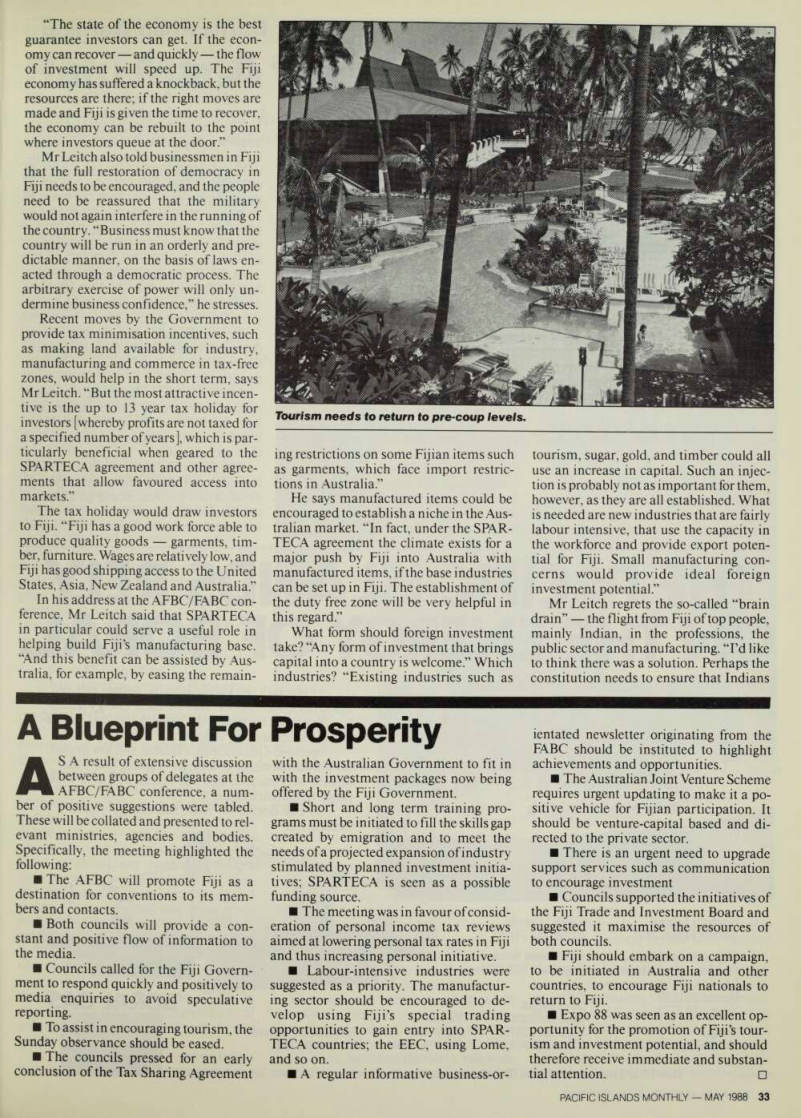
Tourism needs to return to pre-coup levels.
can take their place in the community and go about their business without threat, This is going to be difficult in the light of the coups and the perception of the indigenous Fijian population. But I have a great sympathy for the Indians, many of whom are second, third or fourth generation Fijians.’’
The brain drain had been quite serious in certain industries. What now needed to be undertaken were training programs to rebuild the level of professional skills in the
community. This would involve training young ethnic Fijians to aspire to take their place in both private industry and govern ment at a professional level.
“It is up to Fiji to take the initiative.
Programs instituted in Fiji and in second ary and tertiary institutions in New Zea land, Australia, Hawaii and elsewhere should teach the necessary skills,” says Leitch. “But all this, like everything else, will take a little time. You will not change much in two or three years.” □
The sugar harvest is a vital component of economic recovery.