Palau: The US Angle
pp. 26-27 · Read in the full issue
Forum
James D Berg of the US Department of State hits out at critics of American policies in troubled Palau. Allegations that the US is forcing the republic to host nuclear bases and that America is behind a wave of violence is, he says, nonsense.
MUCH has appeared in the media in recent months concerning the future political status of the Re public of Palau. There have been allega tions that the United States is coercing Palau into a Compact of Free Association with the US in order to establish a major military complex, including nuclear bases, in those islands. These allegations bear no relationship to reality. As one specific ex ample, that Compact approved by the Palauan people in six UN-observed acts of self-determination specifically pro vides that the US will not “use, test, store or dispose of’ any nuclear weapons in Pa lau. (Aside from that fact, one frequent specific allegation is particularly absurd that the US plans to base Trident sub marines in Palau. That allegation, if noth ing else, ignores the fact that all Trident submarines are based in mainland US ports; their range is such that overseas basing is not necessary.) Aside from rotating 13-man Civic Action Teams engaged in public works projects, there is no US military presence in Palau and none is planned. Not only are no “nuclear bases” contemplated for Pa lau, but neither are any other elements of a major military complex as has been alleged in media reports. The only “nu clear issue” has been whether US Navy ships will, under a free association rela tionship, be able to visit Palauan ports from time to time on the same basis as they do the ports of other friends and allies.
The limited military options available to the US in Palau are precisely identified in a subsidiary agreement to the Compact of Free Association, and can be exercised only after consultations with the Palauan Government. They are: (a) anchorage rights for visiting US Navy ships in Palau’s main harbour and use of a nearby 16-hec tare site for support facilities; (b) contin gency joint use with Palau of Palau’s two airports; (c) contingency use of limited areas for logistics installations; and (d) oc casional access to uninhabited areas of one island for training exercises. There is no plan to exercise these limited options, and under no circumstances could they be a substitute for US installations in the Philippines.
If there had been a need to establish “nuclear bases” in Palau, the US could
have done so at any time under the exist ing US Trusteeship Agreement. It has not done so because there is neither need nor intent. Given the character of allegations about US intentions, it is ironic that Palau will be legally more “nuclear-free” with implementation of free association that is, an existing but never exercised US legal right will be terminated.
To place recent events in their proper context, a little history is in order. In 1947 the Micronesian islands of the North Pa cific (the Northern Marianas, Caroline and Marshall Islands) became the Trust Ter ritory of the Pacific Islands under US ad ministration pursuant to an agreement between the US and the UN Security Council. Previously they had been under Japanese control. In 1969 Micronesia and the US began negotiations directed at ter mination of the Trusteeship Agreement and the identification of the future politi cal status of these islands.
In the early 19705, despite US hopes for a unified Micro nesia, it became clear that political fragmentation was in evitable. The Caroline Islands (including Palau) and the Mar shalls sought a “free associ ation” relationship with the US, while the Northern Marianas sought US commonwealth sta tus and US citizenship. In 1975 the Northern Marianas, in a UN-observed act of self-deter mination, formally opted for commonwealth status, which was implemented in 1986.
The remaining Microne sian islands continued to pur sue free association, but in 1976
fragmented into three separate political units that have since become the Republic of the Marshall Islands, the Federated States of Micronesia (the Carolines minus Palau), and the Republic of Palau. In the early 1980 s all three entities became self governing under the Trusteeship with the US, retaining only reserve powers pend ing termination of the Trusteeship Agree ment. Agreement was also reached on a Compact of Free Association between the US and each of these states a status much like the relationship between the Cook Islands and New Zealand. Each state would be sovereign and self-governing, and would conduct its own foreign affairs.
Defence responsibilities would be vested in the US. There also are provisions for each state to terminate unilaterally its re lationship with the US and for the US to provide the three states with about SUS 2.2
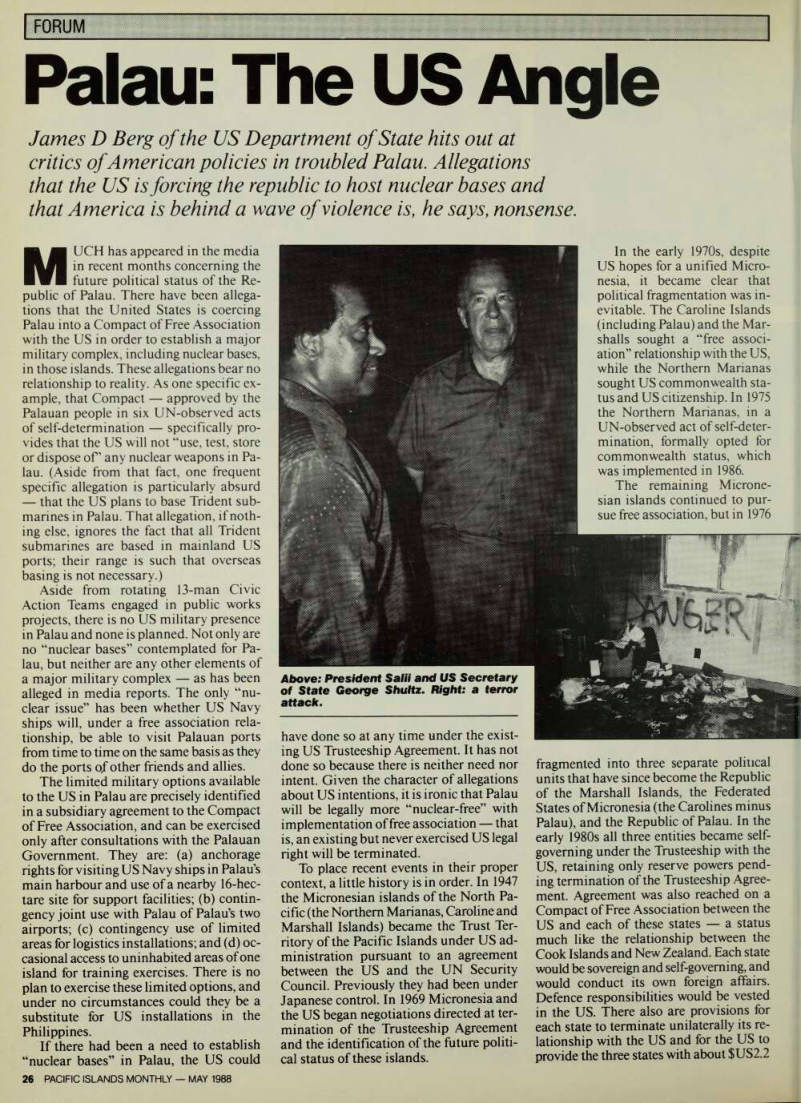
Above: President Salii and US Secretary of State George Shultz. Right: a terror attack.
billion in grant assistance over 15 years, with periodic adjustments for inflation. In 1986, following UN-observed acts of self determination in which the majority of the people of these states rejected full inde pendence and approved free association, the Marshall Islands and Federated States entered into free association with the United States as sovereign, self-governing nations.
The Trusteeship for Palau could not end, however, because Palau had yet to complete its approval of the Compact ac cording to its own constitutional require ments. The dilemma was that Palau’s Constitution declared Palau “nuclear-free” in language inconsistent with US defence responsibilities in a free association rela tionship. Those responsibilities require that US Navy ships have access to Palauan ports for visits on the same basis as to the ports of other friends and allies. Since nearly half of the US Navy’s ships are nu clear-powered and some are capable of carrying nuclear weapons (and the US neither confirms nor denies the presence of nuclear weapons on its ships), Palauan courts had ruled that the Compact of Free Association was in conflict with the nu clear provisions of Palau’s Constitution.
However, the Constitution also provides that these provisions could be overridden by a 75 percent majority vote for free association.
In five acts of self-determination the Palauan people, by majorities ranging from 62 to 72 percent, rejected full inde pendence and approved the Compact of Free Association, including US defence responsibility. But the constitutionally mandated 75 percent vote was never achieved. However, another constitu tional clause permits amendment of that document by a simple majority in three fourths of Palau’s states. In a referendum on August 4, 1987, 72 percent approved an amendment reducing the vote required for free association from 75 percent to a sim ple majority.
That amendment was accepted by the Palau National Congress and confirmed by the Trial Division of Palau’s Supreme Court. It was in effect when, on August 21, 1987, 73 percent of Palau’s voters in a sixth act of self-determination voted to bring the Compact into force as soon as possible. (As with all other acts of self-determination, UN observers subsequently reported the act was fairly and appropriately con ducted.) The Palauan Government then certified to the US Government that ap proval of the Compact had been com pleted in accordance with Palau’s constitutional processes. This action cleared the way for the US to take steps es sential under US legislation to implement the new relationship with Palau and ter minate the trusteeship.
Against the above background allega tions that the US is somehow coercing Pa lau into an undesired relationship with the US are nonsense. These allegations ignore
the facts that free association (including US defence responsibility) had been the objective of Palau’s elected leaders and Government since 1971; that Palau’s Government is freely elected by the Pa lauan people; that most members of Pa lau’s legislature support that relationship (as do most traditional leaders); and that this objective, favoured by the majority of elected and traditional leaders, was en dorsed by large majorities of the Palauan people in six acts of self-determination.
The violence that took place in Palau recently is, of course, tragic and deeply to be regretted. Some related cases are already before the courts, so detailed comment would be inappropriate. However, one can observe that in Palau’s volatile atmos phere, some of that violence may be at tributable to the frustration of a few among the large majority who perceived that their free choice for the political future of Palau has been thwarted time and again by a rel atively small minority. That is not an ex cuse for criminal violence but it may be an explanation.
Other allegations are equally ludicrous, especially one to the effect that the US has withheld funds from Palau in an effort to blackmail Palau into free association. In fact, US grants to Palau in recent years have resulted in one of the highest levels of as sistance, on a per capita basis, received by any state or territory in the Pacific. The Palauan Government’s recent financial problems arose from its own over-obliga tion of available funds. Similarly, it has been argued that the US Government en couraged Palau to assume a large debt in connection with development of a new power plant. The US Government in fact advised the Palauan Government against that contract. Both actions were unfortun ate, but the US cannot be responsible for actions taken by Palau in its exercise of self government.
The “last word” on these issues should appropriately go to the President of the Senate of the Palau National Congress, who recently said: “We have shown to the entire world that the basic rule of democracy majority rule is at work in our islands and that we stand for human rights on our shores.
Let it be known to the world that the in terest and welfare of the citizens of the Re public of Palau come first and foremost in our islands, and that we will not tolerate outside interests which invade our home land disguised in the cloak of an over zealous anti-nuclear movement. Let it be known that no outside interference or in fluence will deter us from our cherished, ultimate goal of self-governance.” □ Mr Berg has been deeply involved in Mi cronesian affairs since 1971 —first as a Peace Corps volunteer in the islands and then (until his present appointment) as a participant in the future political status negotiations between Micronesia and the United States.