Why Teaching Is In Turmoil
pp. 17-37 · Read in the full issue


The Region
David Robie and Carson Creagh examine the crisis in Pacific education
PACIFIC policy makers face a di lemma that is at once blindingly simple and exquisitely complex.
Heirs of a colonial education system that sought behind its pious claims of “de velopment” to educate natives as la bourers and servants while giving the children of the white masters a metropol itan education, they govern nations that are ill-prepared for the tomorrow that, in most cases, has already arrived.
As more and more school-leavers dis cover they cannot find work, pressure grows to change the curriculum that trained them. Proponents argue that the strategy of creating national and regional universities such as the University of Papua New Guinea (UPNG) in Port Mo resby, the University of Technology in Lae and the University of the South Pacific (USP) in Fiji creates an underemployed elite . . . and an elite that is trained pri marily for politics rather than the devel opment of emerging nations. Graduates in law and economics are numerous; those in technical, scientific or educational disci plines are all too uncommon.
Those who support a redefinition of educational priorities propose a re-orien tation toward rural needs, claiming that training for a degree of self-sufficiency in village and agricultural sectors will lead to the creation of rural employment oppor tunities and will perhaps slow the drift of unemployed rural youth to the cities. It is a laudable and, on the surface, workable approach, according to observers outside the affected countries and one that re quires a massive change of emphasis from tertiary professional education to primary and lower secondary schooling.
But it ignores history, for the despised colonialist curriculum took the same path and is now acknowledged as having been as ineffective as it was paternalistic. Dr Sheldon Weeks, of the Education Re search Unit at UPNG, wrote recently that “indigenous parents rightly saw the prac tical curriculum as inferior in status and feared it would exclude their children from access to the modem sector... where jobs, high income and social and political power were to be obtained”.
Yet today’s parents are calling for a cur riculum that is at once practical, offering a greater chance of employment in the ru ral sector, and one that will raise the qual ity and availability of white-collar trainees.
They seek the best of both elements of the old colonial curriculum while rejecting the philosophies, the appearance and the products of that curriculum.
The opposite approach (and the ap proach currently in favour with most South Pacific governments) is to look to the needs of the future by training managerial and professional leaders: without high quality tertiary education, they say, there will simply be no teachers, health workers, en gineers or scientists, lawyers or writers.
The situation is particularly poignant in Papua New Guinea. With a national lit eracy rate of around 30 per cent, it is claimed that universities train those who will train the next generation; but exami nation of postgraduate careers indicates that there is little motive for graduates to use their skills in low-status, poorly paid work as teachers or regional health offi cers: they elect to stay in the cities, where they have at least a chance of finding em ployment commensurate with their expectations.
The corollary of this result was exam ined by Dr Ken Gannicott, senior lecturer at the Australian Defence Force Academy at the University of New South Wales and director of the Centre for Studies in Man agement and Logistics. His findings are depressing for those who support the no tion of graduates training the leaders of to morrow. In truth, says Dr Gannicott, “Papua New Guinea receives a very poor payoff on its educational investment. Rates of return to all levels of education are low by the standards of other developing countries, while private returns are high.
The extent of public subsidy is highest at university level the level where, it has
been discovered, social returns are lowest.”
Dr Gannicott’s research, which ap plied the concept ofjudging the returns to the nation as a whole from its investment in education in comparison with returns to private industry for the same national investment, revealed that although PNG spends one of the highest proportions of GNP on education of all developing coun tries, it succeeds in educating a worryingly low percentage of children.
The number of primary schools, for ex ample, increased from 1762 at Independ ence to 2224 by 1983 yet enrolments expanded by an annual average of only 3.9 per cent. During the same period the num ber of institutions of higher learning dou bled, from 30 to 60, and enrolments increased by a yearly average of 7.3 per cent almost twice as much as primary school enrolments.
“It does not seem harsh to note that progress has been modest,” Dr Gannicott says. “Increases in the numbers attending school at primary and secondary level have barely been sufficient to keep pace with the increase in numbers of the relevant age groups.” Less than one third of the popu lation aged 15 or over can read or write; 86 per cent of the adult population has re ceived no formal education, and of the 14 per cent who have attended school, 80 per cent have gone no further than primary level; only two thirds of the relevant age group are enrolled in primary school and a shockingly low 13 per cent are in sec ondary school. ►
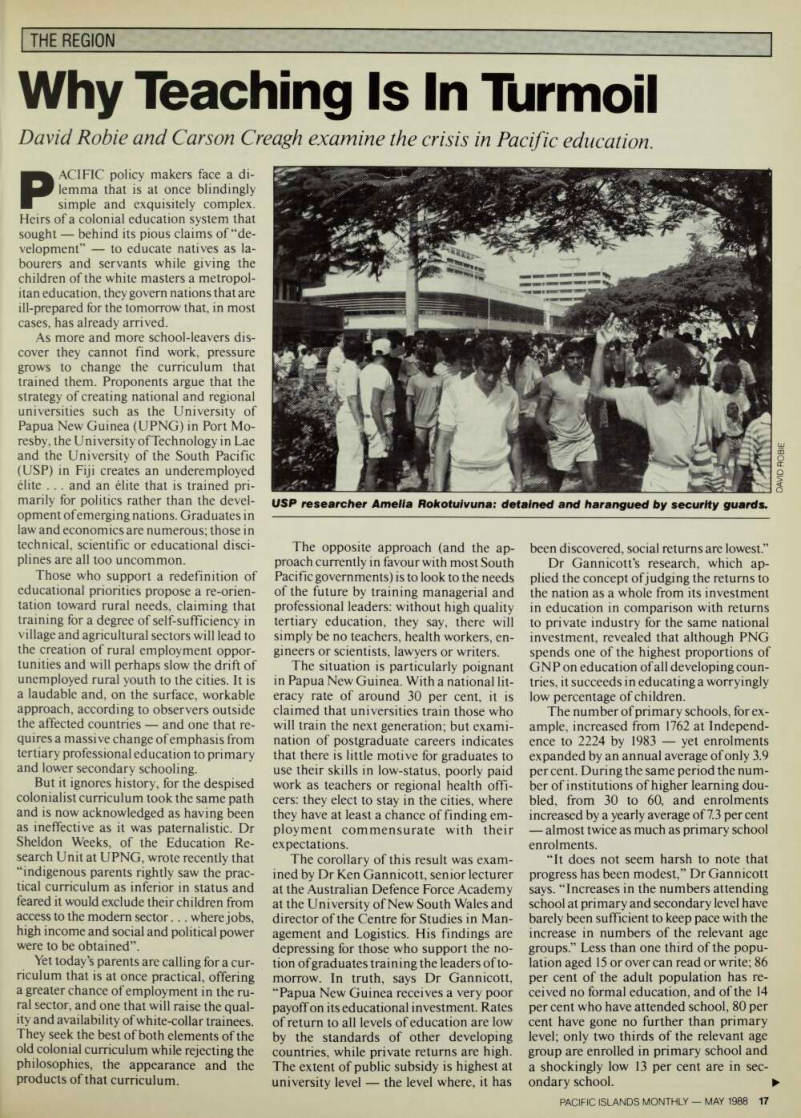
USP researcher Amelia Rokotuivuna: detained and harangued by security guards.
David Robie
Equally depressing is Dr Gannicott’s conclusion, presented in an ANU Re search School of Pacific Studies paper.
“Economic returns to human capital in vestment in PNG are low,” he writes, “not because of a lack of demand for skills but because the education system is internally inefficient: the output it produces, from primary graduates onward, is both expen sive and of poor quality.”
What, then, is the future for education in PNG? Dr Gannicott notes that the Government has learned from the expe rience of other developing nations that education seems not to play any direct role in creating employment but that it has, if anything, learned the lesson too well.
Education at lower levels has stagnated and there is a severe shortage of high-level manpower, producing a recipe for main taining a labour force with low skill levels and, ironically, for denying the benefits of higher education to those sectors of the economy that need it most. He argues for rigorous cost cutting at all levels, espe cially in the tertiary sector, and for ex panded enrolments (which necessitates expanded facilities) at primary and sec ondary levels to overcome continued shortages of higher level manpower.
Academics and university students alike might feel threatened by the severe streamlining suggested, but in the long term they would reap the benefits of a new approach. Arguing that heavy subsidies and absence of tertiary fees are luxuries PNG cannot afford. Dr Gannicott advo cates “novel and cost-reducing forms of management/academic structure” at UPPG and UoT. These include a broad reduction in the range of courses offered, those deleted to be made available at uni-
versities in Australasia or southeast Asia; “cost sharing” in which universities would take on expensive expatriate staff for six or nine months, after which their services would be on offer to the private sector as consultants or researchers; and with drawal of public funding to small tertiary institutions offering training that can be provided more cheaply or at a higher standard in overseas locations.
Below the tertiary level, Dr Gannicott proposes a realignment of teacher train ing; provision of higher quality and ex panded resources to teachers; the introduction of school fees at national high schools and the raising of fees at provin cial high schools; and a searching exami nation of the practice of boarding high school students.
The adoption of these strategies would result immediately in significant amounts of funding becoming available for capital works the construction of new schools and their linking, through upgraded com munications, with others and in in creased proficiency in the delivery of education. None are total solutions, of course, but they offer a model of efficiency that would not only inspire confidence in PNG’s education and technical training, but would please international aid donors anxious to see their assistance being used in a “businesslike” manner.
THE University of the South Pacific is today facing the gravest threat to its existence since last year’s coups.
Already troubled by financial difficulties, the campus now also faces a crisis over academic freedom.
A small group of “new wave” indige nous thinkers who have played a key role in shaping the university’s identity over the past seven years are now gravely con cerned about their future. “We are con fronted with academic censorship,” said one university academic, who declined to be named. “The university faces the big gest threat in its 20-year history.”
A handful of USP lecturers was in volved in drawing up the progressive re form policies of the multiracial Fiji Labour Party; others, while not being involved politically, were still suspected by the con servative Fijian establishment as having a hand in the party’s spectacular rise to power last year.
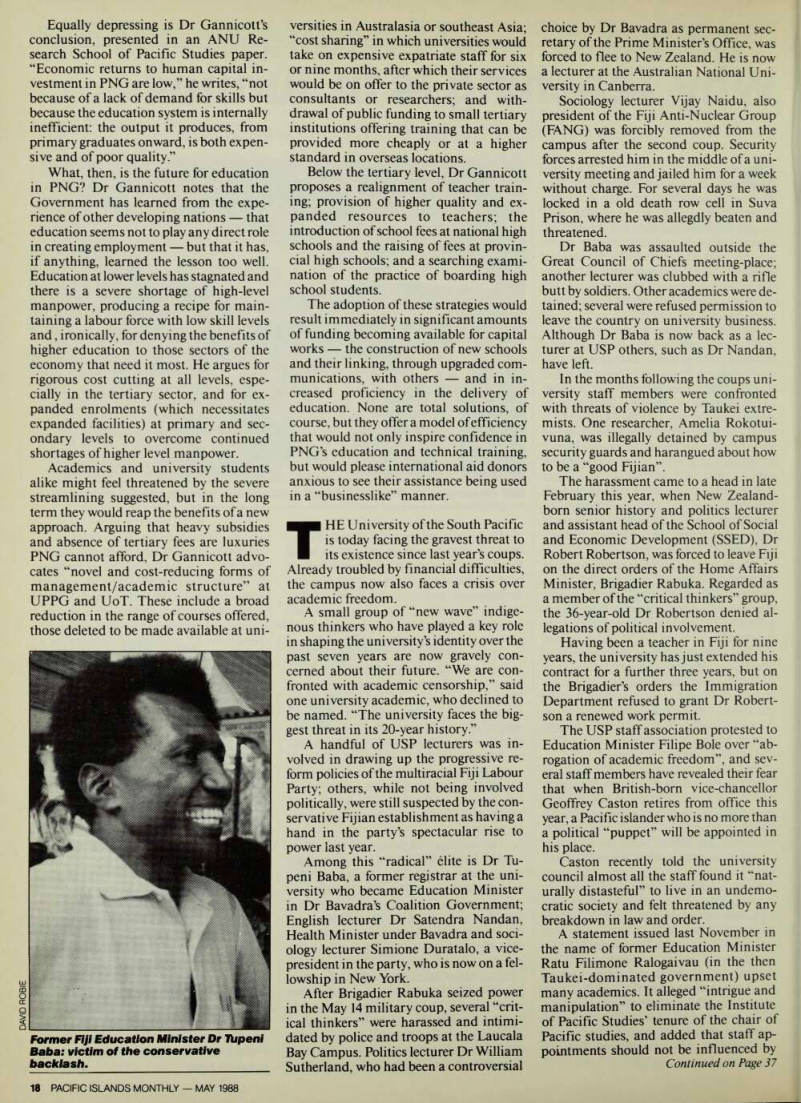
Among this “radical” elite is Dr Tu peni Baba, a former registrar at the uni versity who became Education Minister in Dr Bavadra’s Coalition Government; English lecturer Dr Satendra Nandan, Health Minister under Bavadra and soci ology lecturer Simione Duratalo, a vice president in the party, who is now on a fel lowship in New York.
After Brigadier Rabuka seized power in the May 14 military coup, several “crit ical thinkers” were harassed and intimi dated by police and troops at the Laucala Bay Campus. Politics lecturer Dr William Sutherland, who had been a controversial
choice by Dr Bavadra as permanent sec retary of the Prime Minister’s Office, was forced to flee to New Zealand. He is now a lecturer at the Australian National Uni versity in Canberra.
Sociology lecturer Vijay Naidu, also president of the Fiji Anti-Nuclear Group (FANG) was forcibly removed from the campus after the second coup. Security forces arrested him in the middle of a uni versity meeting and jailed him for a week without charge. For several days he was locked in a old death row cell in Suva Prison, where he was allegdly beaten and threatened.
Dr Baba was assaulted outside the Great Council of Chiefs meeting-place; another lecturer was clubbed with a rifle butt by soldiers. Other academics were de tained; several were refused permission to leave the country on university business.
Although Dr Baba is now back as a lec turer at USP others, such as Dr Nandan, have left.
In the months following the coups uni versity staff members were confronted with threats of violence by Taukei extre mists. One researcher, Amelia Rokotui vuna, was illegally detained by campus security guards and harangued about how to be a “good Fijian”.
The harassment came to a head in late February this year, when New Zealand born senior history and politics lecturer and assistant head of the School of Social and Economic Development (SSED), Dr Robert Robertson, was forced to leave Fiji on the direct orders of the Home Affairs Minister, Brigadier Rabuka. Regarded as a member of the “critical thinkers” group, the 36-year-old Dr Robertson denied al legations of political involvement.
Having been a teacher in Fiji for nine years, the university has just extended his contract for a further three years, but on the Brigadier’s orders the Immigration Department refused to grant Dr Robert son a renewed work permit.
The USP staff association protested to Education Minister Filipe Bole over “ab rogation of academic freedom”, and sev eral staff members have revealed their fear that when British-born vice-chancellor Geoffrey Gaston retires from office this year, a Pacific islander who is no more than a political “puppet” will be appointed in his place.
Gaston recently told the university council almost all the staff found it “nat urally distasteful” to live in an undemo cratic society and felt threatened by any breakdown in law and order.
A statement issued last November in the name of former Education Minister Ratu Filimone Ralogaivau (in the then Taukei-dominated government) upset many academics. It alleged “intrigue and manipulation” to eliminate the Institute of Pacific Studies’ tenure of the chair of Pacific studies, and added that staff ap pointments should not be influenced by
Continued on Page 37
Former Fiji Education Minister Dr Tupeni Baba: victim of the conservative backlash.
Continued from Page 18
“personal prejudice, professional jealousy and political bias” to exclude Pacific is landers from jobs at a university that be longed to them. Furthermore, “the university council will need to begin now to look to look for an indigenous Pacific islander to be the next vice-chancellor when the contract of the incumbent ex pires shortly”.
The university, built on the site of a for mer Royal New Zealand Air Force flying boat base at Laucala Bay, was opened in 1968. It is jointly controlled by 11 countries Cook Islands, Fiji, Kiribati, Nauru, Niue, Solomon Islands, Tokelau, Tonga, Tuvalu, Vanuatu and Western Somoa and depends on Fiji for 60 per cent (about $l3 million) of its annual working budget.
Australia and New Zealand also contrib ute to the university, largely through scholarships for students.
The staff reflects 60 different nation alities and there are 2000 full-time stu dents, with 7000 part-timers at Laucala Bay. There is also a campus at Alafua, Western Samoa, where the Agriculture School is sited. Kiribati has the Institute for Atoll Research; Tonga, the Institute of Rural Technology; Vanuatu, the Lan guages Centre and Law Unit. As well, there are university extension centres in 10 of the member countries.
Apart from regional students, includ ing some from New Caledonia, the uni versity also accepts scholarship students from Ethiopia, Flong Kong, the Maldives and Zimbabwe on Commonwealth grants.
As USP began to feel the effects of a staff shortage in the wake of the coups, Aus tralia has been filling immediate gaps by providing short-term lecturers. While this assistance fulfils teaching demands, it does nothing to satisfy the university’s desper ate need to retain an experienced and skilled body of staff capable of developing courses and programs that meet the re gion’s development needs and its varied cultural and racial mix.
Latest reports from Suva suggest USP is overcoming the most basic of its prob lems, with approaches from academics in Australasia and Europe to fill vacancies exacerbated by Fiji’s “brain drain” of up per level personnel in all fields.
However, the future holds problems of its own as USP’s staff confronts the like lihood of an at least partial realisation of the new Fijian spirit. The University’s for mer radical stance was more suited to the comfort of Commonwealth membership, and there is a growing chance some pro grams especially in the social sciences will face serious questions of their place in a now radically conservative society.
Not only will the philosophies of lecturers be subject to close scrutiny, but there will likely be fewer students willing to risk of ficial disapproval of enrolling in courses with a subject outline or approach critical of Fiji’s new aspirations. □