How They Killed Yamamoto
p. 58 · Read in the full issue
Out Of The Past
The great admiral was the victim of an ingenious US plot.
By Larry Writer
Admiral Isoruku Yamamo
to’s brilliant masterminding of the Japanese attack on Pearl Harbour on December 7, 1941, made this great Commander in Chief of the Japanese Combined Fleet the man the Americans hated most. With their Pacific Battleship Fleet crippled and their pride in tatters, the US military chiefs resolved that Yama moto would pay with his life if possible.
The Americans’ chance came on April 17, 1943, when a US interception post in the Aleutians picked up a cypher signal from Truk revealing that Admiral Yama moto would be flying to Bougainville four days later to raise the morale of Japanese troops there.
The Commander in Chief of America’s Pacific Fleet, Admiral Chester Nimitz, conceived a plan to shoot down Yama moto’s plane. However, because of the Japanese hero’s importance, the death plan had to be approved by the US Secretary of the Navy Frank Knox and President Roo sevelt himself. Approval was granted.
Integral to the Americans’ plan was the fact that Yamamoto took immense pride in always being on time. The intelligence was that the great admiral, travelling in one of two camouflaged Betty bombers and guarded by six Zeke fighters, would make a one-night stopover at Rabaul then leave at precisely 6am to arrive at Kahili at ex actly 9.45 am.
The airborne ambush would take place at 9.30 am, with the admiral just 50 kilo metres from his destination. A group of 18 P-38 Lightning fighters from Henderson Field, Guadalcanal, would be employed;
12 to fly interference for the six that would attack the Japanese.
Yamamoto and his party left Rabaul right on time. With him in his jungle green bomber were his secretary, his surgeon, his air staff officer and a naval commander.
In the other bomber flew Yamamoto’s chief of staff, a paymaster and a commu nications officer.
At 9.30, when the American fighters fell on their prey, the bombers were flying about 600 metres above the dense jungle; the six Zekes were higher to afford protec tion. When the bombers saw the Ameri can P-38s hurtling in for the kill they dropped even lower and attempted to es cape. But it was to no avail. Lieutenant Thomas Lanphier, in one of the attacking US fighters, singled out the lighter in col our of the two fleeing bombers. His hunch was right. It was Yamamoto’s. Lanphier powered through the Zekes, shooting one down, and fired both his cannon and ma chine guns at the bomber.
Admiral Yamamoto must have seen the right wing of his bomber shot clean through and would have felt his aircraft
pitch violently. It crashed into the jungle and exploded in flames. The other bomber was also hit and fell in the sea. There maining Zekes fled in disarray.
When news of the ambush was known, Japanese troops were dispatched to the jungle. There they found Yamamoto’s charred body in the bomber’s wreckage.
They cremated the hero on a mountain peak, his ashes were flown to Truk, then transported by destroyer to Japan where Yamamoto was given a state funeral.
The death of the revered admiral dealt Japan a mighty blow. His demise signi fied that the tide of the war was turning.
The Americans rejoiced their precision plan was executed brilliantly and the man who plotted the attack on Pearl Harbour had been repaid in kind. The plan’s code name? Operation Vengeance.
The admiral’s shattered plane was left in the jungle where it crashed, and was re discovered only a few years ago. Today the Papua New Guinea Government plans to facilitate access to the bomber, to con struct amenities nearby and to promote a memorial to Admiral Yamamoto. □
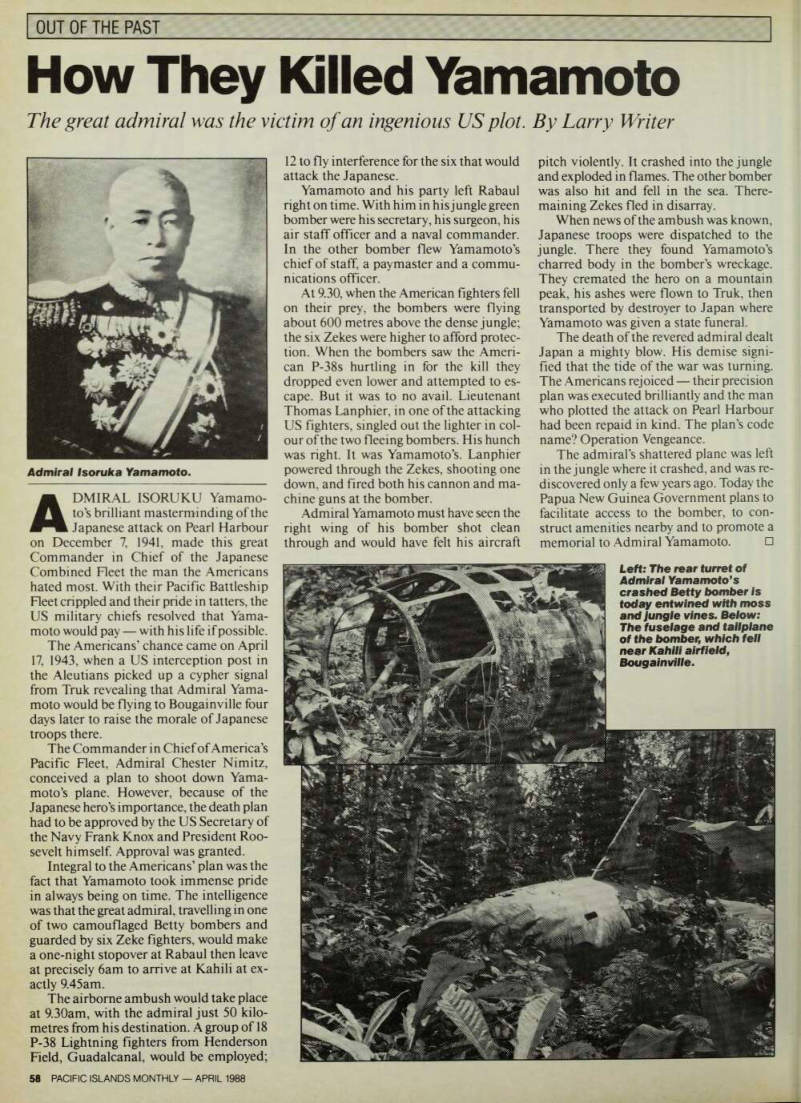
Admiral Isoruka Yamamoto.
Left: The rear turret of Admiral Yamamoto’s crashed Betty bomber is today entwined with moss and jungle vines. Below: The fuselage and tailplane of the bomber, which fell near Kahili airfield, Bougainville.