Pacific Stamp Box
p. 53 · Read in the full issue
Edited by John Hunter
EACH YEAR I report on the annual survey of stamp issues prepared by Michel Rundschau and appearing in the Michel Catalogue Stamp Magazine produced in West Germany. In this month’s column I review the 1986 survey, with particular reference to the Pacific.
One of the most notable features in re cent times has been the ever increasing number of stamp issues each year. But in 1986, for the first time in many years, the number of issues has fallen dramatically.
The following shows the trend over the past five years: in 1982 there were 7793 stamps issued with 886 miniature sheets and 8679 total issues; in 1983, 7830 stamps, 825 miniature sheets and 8655 total issues; in 1984,9254 stamps, 908 sheets, 10,162 total issues; in 1985,9141 stamps, 915 miniature sheets, 10,056 total issues; in 1986, 8716 stamps, 793 miniature sheets, 9509 total issues.
Unlike many other industries where one looks with satisfaction at an increase in units produced, stamp collectors are horrified by the spiralling number of new issues each year. Many countries’ stamp authorities are guilty of putting out new is sues simply to increase their revenue. But this does not work in reality because, over the past few years, collectors have reacted against this practice by dropping or cut ting down on stamps from countries at fault.
Many countries, it seems from the lat est figures, are at last listening to the cries of collectors. Australia Post reluctantly cut down on its proposed program of new is sues in 1986 due to collectors’ appeals that the cost of the program was a heavy finan cial burden. I believe that next year will see further falls in the number of issues.
But let us look more closely at what countries produced in 1986. According to Rundschau, 17 out of 250 stamp issuing countries in the world produced almost 30 per cent of all new issues in 1986. It is these countries that need to heed the message that flooding the stamp scene with new is sues does not necessarily increase the number of collectors or revenue.
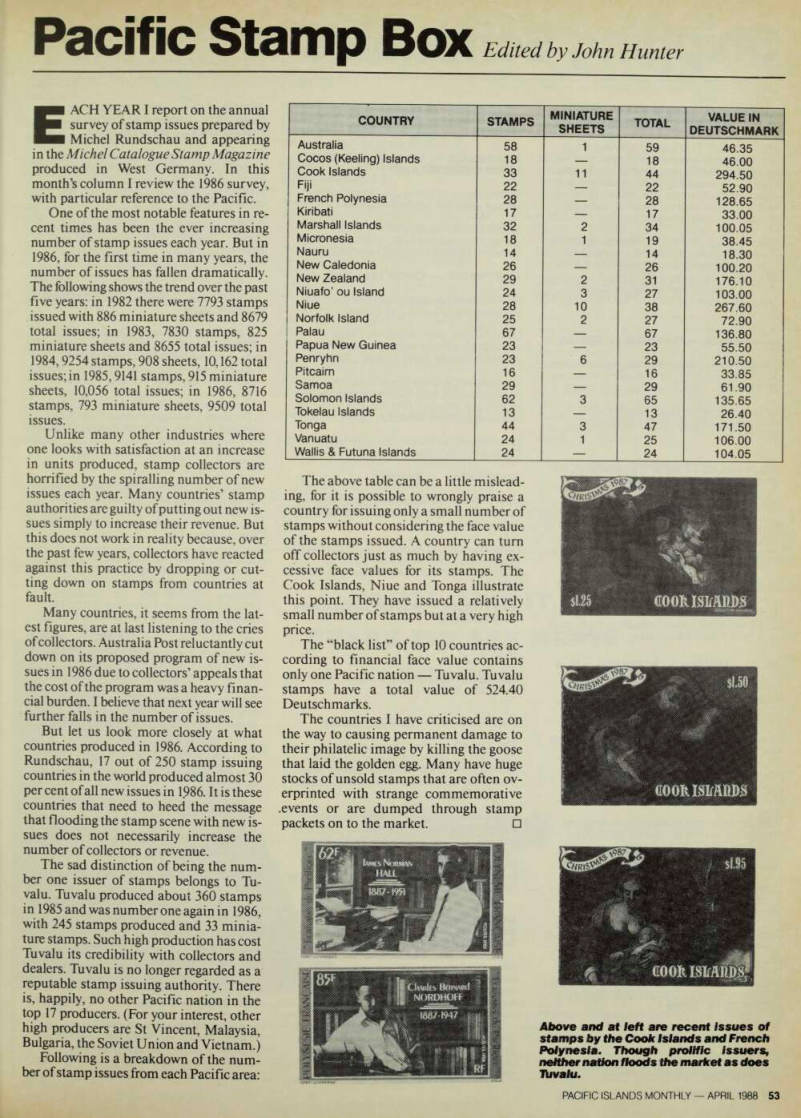
The sad distinction of being the num ber one issuer of stamps belongs to Tu valu. Tuvalu produced about 360 stamps in 1985 and was number one again in 1986, with 245 stamps produced and 33 minia ture stamps. Such high production has cost Tuvalu its credibility with collectors and dealers. Tuvalu is no longer regarded as a reputable stamp issuing authority. There is, happily, no other Pacific nation in the top 17 producers. (For your interest, other high producers are St Vincent, Malaysia, Bulgaria, the Soviet Union and Vietnam.) Following is a breakdown of the num ber of stamp issues from each Pacific area:
The above table can be a little mislead ing, for it is possible to wrongly praise a country for issuing only a small number of stamps without considering the face value of the stamps issued. A country can turn off collectors just as much by having ex cessive face values for its stamps. The Cook Islands, Niue and Tonga illustrate this point. They have issued a relatively small number of stamps but at a very high price.
The “black list” of top 10 countries ac cording to financial face value contains only one Pacific nation Tuvalu. Tuvalu stamps have a total value of 524.40 Deutschmarks.
The countries I have criticised are on the way to causing permanent damage to their philatelic image by killing the goose that laid the golden egg. Many have huge stocks of unsold stamps that are often ov erprinted with strange commemorative events or are dumped through stamp packets on to the market. □
Above and at left are recent issues of stamps by the Cook Islands and French Polynesia. Though prolific issuers, neither nation floods the market as does Tuvalu.
Country
Stamps
Miniature
Sheets
Total
Value In
Deutschmark
Australia 58 1 59 46.35 Cocos (Keeling) Islands 18 — 18 46.00 Cook Islands 33 11 44 294.50
Fiji
22 — 22 52.90
French Polynesia
28 — 28 128.65 Kiribati 17 — 17 33.00 Marshall Islands 32 2 34 100.05 Micronesia 18 1 19 38.45 Nauru 14 — 14 18.30 New Caledonia 26 — 26 100.20 New Zealand 29 2 31 176.10 Niuafo’ ou Island 24 3 27 103.00 Niue 28 10 38 267.60 Norfolk Island 25 2 27 72.90 i Palau 67 — 67 136.80 Papua New Guinea 23 — 23 55.50
Penryhn
23 6 29 210.50 Pitcairn 16 — 16 33.85 Samoa 29 — 29 61.90 Solomon Islands 62 3 65 135.65 Tokelau Islands 13 — 13 26.40
Tonga
44 3 47 171.50 Vanuatu 24 1 25 106.00 Wallis & Futuna Islands 24 - 24 104.05