Taking Care Of Business
pp. 34-35 · Read in the full issue
Business Special
Diane Armstrong looks at moves to teach islanders the subtleties of commerce
AT ARARUA College in the Cook Islands, 13-year-old Polynesians are learning about division of la bour, bad debts and capital expenditure.
They are among 2000 children in the Pa cific being taught new business studies courses designed especially for them.
“When I visit these classes, my biggest thrill is when the kids tell me they enjoy learning about commerce, and when I see that they’ve really grasped it,” says Mike Horsley, lecturer in Education at the School of Teaching and Curriculum Stud ies at the University of Sydney.
His enthusiasm is understandable: for the past four years, he has been consultant to an extraordinary UNESCO-funded project aimed at introducing vocational courses into Pacific island schools.
There has been a push since the mid seventies for courses with a strong local content for the newly independent slates of the Pacific. “When the Institute of Ed ucation at the University of the South Pa cific in Fiji co-ordinated an indigenous curriculum in business studies, home eco nomics and industrial arts, I became the commercial studies consultant. Three years before, I’d been seconded to teach commerce at the USP, so I was a natural choice,” Horsley explains.
Until then, school courses had been largely academic, geared for the elite. But local educationists wanted courses suita ble for islanders who were likely to remain in the villages. “Our job was to help create courses that were relevant to local life styles. Many islanders operate small busi nesses and our aim was to make sure they would do so successfully. In time, these courses would also help them pursue higher studies. Our task involved writing textbooks, devising leaching materials, training the teachers, and holding work shops to assess progress,” he says.
When teachers from the Pacific islands began writing business studies courses for their schools, it soon became obvious that a special glossary of commercial terms was essential so that students could under stand the basic concepts. In the past 20 years, the culture of the Pacific has changed rapidly and many new concepts needed to be expressed. As time was running out for the project, only one fully developed glos sary could be completed and the team de cided to compile one for the Cook Islands, whose Ministry of Education was ex tremely enthusiastic about the project.
The challenge of co-ordinating this glossary, the first of its kind in the Pacific, fell to Mike Horsley. Sitting beneath a map
of the Pacific in his cluttered office at the university, he hands over a textbook. Au Kupu Anga Anga Kimi Pu Apinga, or The Words of Accounting, Small Business, Bookkeeping and Commerce is a softcover book whose text is interspersed with cartoons and illustrations. Each page is divided into two columns, with English explanations on one side and Maori on the other.
“We didn’t know what we were in for when we decided to compile a lexicon of basic business terms in the vernacular,”
Horsley smiles. “For one thing, Cook Island Maori doesn’t have a vocabulary capable of expressing business concepts! In the end, we had to invent 400 of the 550 words in the glossary.”
Mike Horsley makes it sound simple, but compiling a dictionary in a language not suited to cope with modern concepts is anything but straightforward. “Our first step was to see if the word existed in Maori, with the help of local translators such as Rangi Moekka, whose knowledge of Maori is astonishing,” he explains. As few business terms existed in the spoken language, the search began for written material. The Savage Dictionary, the major linguistic resource of the Maori language of Rarotonga, contained very little in the way of a business vocabulary. Legal and accounting documents didn’t help much, since
very few of them had been translated.
The most unusual source of words was the Bible. “Rangi Moekka looked up words like ‘usury’ and ‘wages’ in an 1850 Maori Bible and re-used these archaic terms for our glossary. He used the Tahitian Bible as well. It’s amazing, really, using the Bible to translate commercial terms of the 1980 s!”
Where no Maori words, either current or archaic, existed, the glossary team coined new words, by Maorifying or tran sliterating English words. So “cheque” be came tieke, “accounts” became akanuti, “collateral” became kortura, “assets” be came atteti and “glossary” became grotari.
But finding the right word was only part of the conundrum; the next phase was to explain the concept. For example, the dif ference between “goods” and “services” is a crucial one in commerce, yet Cook Is land Maori only has one word to cover both and it’s a word that is not precise enough to convey the exact meaning. Successful businessmen must understand the differ ence between supply, demand, needs and wants, but in most Polynesian languages one or two words express all these ideas.
Another instance of the difficulty the glos sary-makers faced concerns the word “money”, which is expressed by only one word in Maori moni while English has more than 30 words expressing subtle
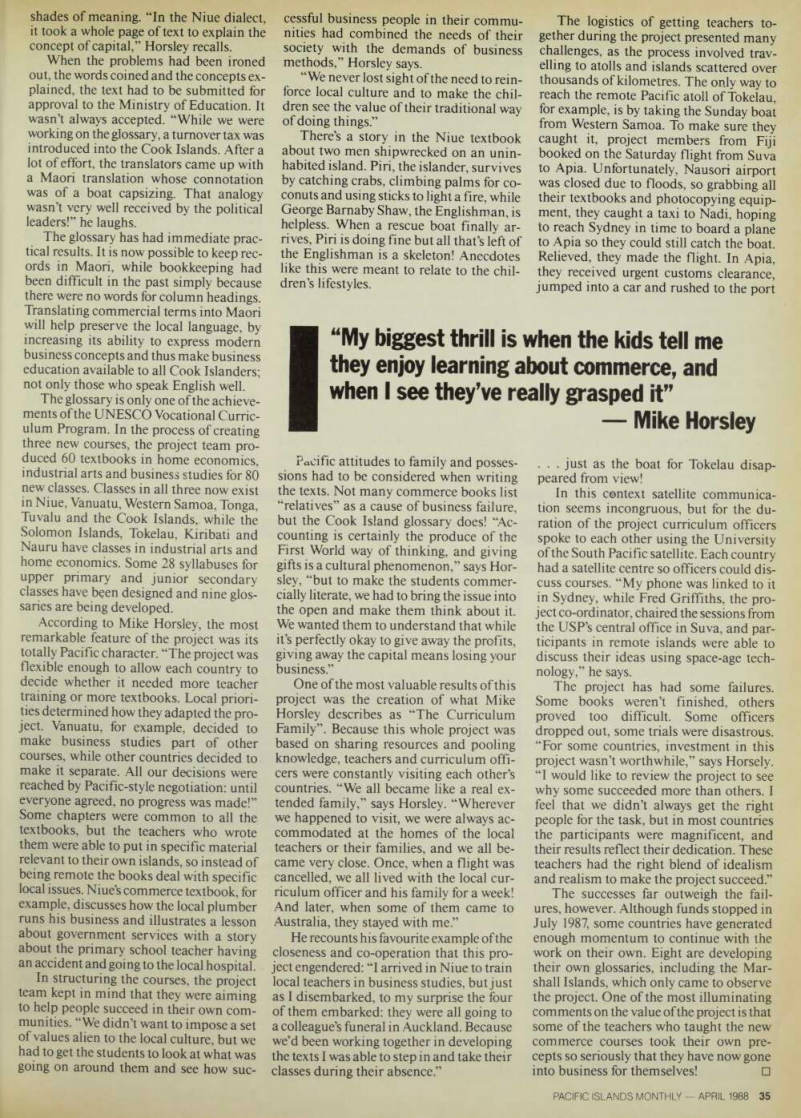
Mike Horsley introduces students from the Cook Islands, Niue, Vanuatu, Tonga, West ern Samoa and the Marshall Islands to computer practices at Ararua Collegae in the Cook Islands.
shades of meaning. “In the Niue dialect, it took a whole page of text to explain the concept of capital,” Horsley recalls.
When the problems had been ironed out, the words coined and the concepts ex plained, the text had to be submitted for approval to the Ministry of Education. It wasn’t always accepted. “While we were working on the glossary, a turnover tax was introduced into the Cook Islands. After a lot of effort, the translators came up with a Maori translation whose connotation was of a boat capsizing. That analogy wasn’t very well received by the political leaders!” he laughs.
The glossary has had immediate prac tical results. It is now possible to keep rec ords in Maori, while bookkeeping had been difficult in the past simply because there were no words for column headings.
Translating commercial terms into Maori will help preserve the local language, by increasing its ability to express modern business concepts and thus make business education available to all Cook Islanders; not only those who speak English well.
The glossary is only one of the achieve ments of the UNESCO Vocational Curric ulum Program. In the process of creating three new courses, the project team pro duced 60 textbooks in home economics, industrial arts and business studies for 80 new classes. Classes in all three now exist in Niue, Vanuatu, Western Samoa, Tonga, Tuvalu and the Cook Islands, while the Solomon Islands, Tokelau, Kiribati and Nauru have classes in industrial arts and home economics. Some 28 syllabuses for upper primary and junior secondary classes have been designed and nine glos saries are being developed.
According to Mike Horsley, the most remarkable feature of the project was its totally Pacific character. “The project was flexible enough to allow each country to decide whether it needed more teacher training or more textbooks. Local priori ties determined how they adapted the pro ject. Vanuatu, for example, decided to make business studies part of other courses, while other countries decided to make it separate. All our decisions were reached by Pacific-style negotiation: until everyone agreed, no progress was made!”
Some chapters were common to all the textbooks, but the teachers who wrote them were able to put in specific material relevant to their own islands, so instead of being remote the books deal with specific local issues. Niue’s commerce textbook, for example, discusses how the local plumber runs his business and illustrates a lesson about government services with a story about the primary school teacher having an accident and going to the local hospital.
In structuring the courses, the project team kept in mind that they were aiming to help people succeed in their own com munities. “We didn’t want to impose a set of values alien to the local culture, but we had to get the students to look at what was going on around them and see how sue
cessful business people in their commu nities had combined the needs of their society with the demands of business methods,” Horsley says.
“We never lost sight of the need to rein force local culture and to make the chil dren see the value of their traditional way of doing things.”
There’s a story in the Niue textbook about two men shipwrecked on an unin habited island. Piri, the islander, survives by catching crabs, climbing palms for co conuts and using sticks to light a fire, while George Barnaby Shaw, the Englishman, is helpless. When a rescue boat finally ar rives, Piri is doing fine but all that’s left of the Englishman is a skeleton! Anecdotes like this were meant to relate to the chil dren’s lifestyles.
“My biggest thrill is when the kids tell me they enjoy learning about commerce, and when I see they’ve really grasped it”
Mike Horsley
Pacific attitudes to family and posses sions had to be considered when writing the texts. Not many commerce books list “relatives” as a cause of business failure, but the Cook Island glossary does! “Ac counting is certainly the produce of the First World way of thinking, and giving gifts is a cultural phenomenon,” says Hor sley, “but to make the students commer cially literate, we had to bring the issue into the open and make them think about it.
We wanted them to understand that while it’s perfectly okay to give away the profits, giving away the capital means losing your business.”
One of the most valuable results of this project was the creation of what Mike Horsley describes as “The Curriculum Family”. Because this whole project was based on sharing resources and pooling knowledge, teachers and curriculum offi cers were constantly visiting each other’s countries. “We all became like a real ex tended family,” says Horsley. “Wherever we happened to visit, we were always ac commodated at the homes of the local teachers or their families, and we all be came very close. Once, when a flight was cancelled, we all lived with the local cur riculum officer and his family for a week!
And later, when some of them came to Australia, they stayed with me.”
He recounts his favourite example of the closeness and co-operation that this pro ject engendered: “I arrived in Niue to train local teachers in business studies, but just as I disembarked, to my surprise the four of them embarked: they were all going to a colleague’s funeral in Auckland. Because we’d been working together in developing the texts I was able to step in and take their classes during their absence.”
The logistics of getting teachers to gether during the project presented many challenges, as the process involved trav elling to atolls and islands scattered over thousands of kilometres. The only way to reach the remote Pacific atoll of Tokelau, for example, is by taking the Sunday boat from Western Samoa. To make sure they caught it, project members from Fiji booked on the Saturday flight from Suva to Apia. Unfortunately, Nausori airport was closed due to floods, so grabbing all their textbooks and photocopying equip ment, they caught a taxi to Nadi, hoping to reach Sydney in time to board a plane to Apia so they could still catch the boat.
Relieved, they made the flight. In Apia, they received urgent customs clearance, jumped into a car and rushed to the port
. . . just as the boat for Tokelau disap peared from view!
In this context satellite communica tion seems incongruous, but for the du ration of the project curriculum officers spoke to each other using the University of the South Pacific satellite. Each country had a satellite centre so officers could dis cuss courses. “My phone was linked to it in Sydney, while Fred Griffiths, the pro ject co-ordinator, chaired the sessions from the USP’s central office in Suva, and par ticipants in remote islands were able to discuss their ideas using space-age tech nology,” he says.
The project has had some failures.
Some books weren’t finished, others proved too difficult. Some officers dropped out, some trials were disastrous.
“For some countries, investment in this project wasn’t worthwhile,” says Horsely.
“I would like to review the project to see why some succeeded more than others. I feel that we didn’t always get the right people for the task, but in most countries the participants were magnificent, and their results reflect their dedication. These teachers had the right blend of idealism and realism to make the project succeed.”
The successes far outweigh the fail ures, however. Although funds stopped in July 1987, some countries have generated enough momentum to continue with the work on their own. Eight are developing their own glossaries, including the Mar shall Islands, which only came to observe the project. One of the most illuminating comments on the value of the project is that some of the teachers who taught the new commerce courses took their own pre cepts so seriously that they have now gone into business for themselves! □