First Contact Under Fire
pp. 26-50 · Read in the full issue
Forum
Authors Bob Connolly and Robin Anderson respond to writer Chris Ashton’s critical review of their new book, First Contact, an account of the PNG Highlanders’first encounter with the outside world. Carson Creagh mediates the debate, adding some criticism of his own.
History holds many traps for the re searcher. Contemporary records vary ac cording to the point of view ofthe recorder, written records are lost, destroyed or sup pressed, eyewitnesses to events die, or for get, or will not reveal secrets. Even when the subject is open to all, memories and perceptions vary.
And, significantly, the historian car ries particular prejudices into his or her research. Just as people live up or down to what is expected of them, so histo rians (like all of us) tend to find what they are looking for in their analysis of events.
These are just some of the problems with Bob Connolly and Robin Anderson’s otherwise excellent book First Contact, reviewed with honest and openly de clared passion by Chris Ashton in our February issue. We have printed Bob and Robin s reply to Chris Ashton s review here, plus a critique from longtime Mt Hagen resident Lois Logan. As Pacific Islands Monthly deputy editor, I have added my own impressions.
Carson Creagh Says. . .
I AM, LIKE others, fascinated by the story First Contact tells of the meet ings between Highlanders and Euro peans; that there are people alive and in their middle years who can remember with such clarity their first encounter with my own society makes me aware of how far re moved my generation has become from the adventure of life. That those same people can report honestly, with amusement, on their initial reactions is a tribute to their sophistication and intelligence.
But that Connelly and Anderson can mask their polemical intentions with some oral history window-dressing is an insult to their subjects. In too many instances and anecdotes, the reader is distracted from the story by invitations to share the author’s good, solid middle-class abhorr ence of the Leahy’s racism and brutality.
An air of testiness pervades the pages that deal with the Highlanders’ acceptance of colonial rule. “Fifty years later it is im possible to establish the exact number of killed or wounded,” Connolly and Ander son write, as if disappointed that the High landers seem to have understood, much less forgiven , the Mauser-toting Europe ans. “But this was a frontier, and frontier justice prevailed,” they say elsewhere
meaning that the violence of the Highlanders toward each other and toward the explorers is sanctioned by their primitiveness. European violence is presumably worse than Highlander violence, These, however, are mere nagging objections. There are others that relate to the book’s stated intention of providing a hislorical account of first contact. The authors claim that the “rich documentary evidence lay largely neglected for 50 years”
before the intrepid pair “came across it”, This, as Chris Ashton has noted, is non sense. Not only has the evidence been quite thoroughly raked over many times, but it has appeared in a number of publications.
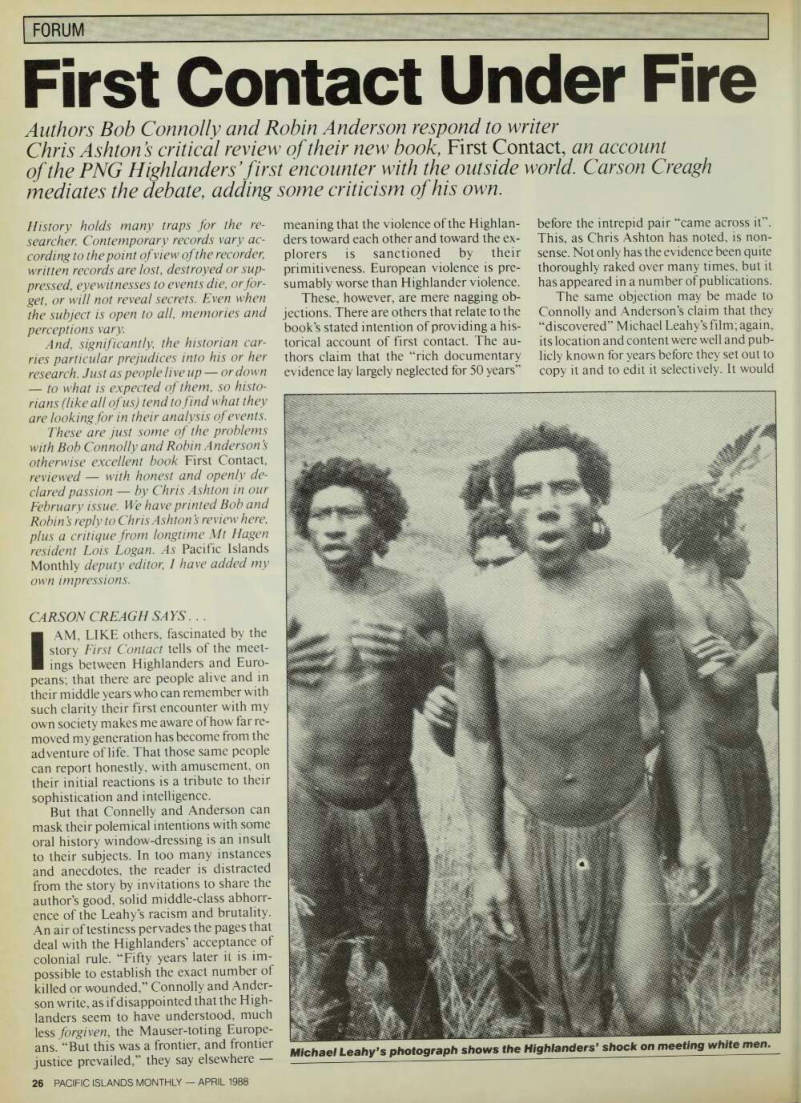
The same objection may be made to Connolly and Anderson’s claim that they “discovered” Michael Leahy’s film; again, its location and content were well and pub licly known for years before they set out to copy it and to edit it selectively. It would
Michael Leahy’s photograph shows the Highlanders' shock on meeting while men.
appear the same process has “enhanced” their book ... in which case it can make no claim to be history.
The book’s analysis of events and their broader meaning is selective at best and downright shoddy at worst. Certainly the young women “married” to the Aus tralians were, in part, a sacrifice by their fellow tribespeople. But they were also power-brokers of considerable influence, which is of far greater importance as far as the Highlanders are concerned. They, un fettered by fashionable racial guilt, real ised the potential for economic and political profit that lay in what was always perceived to be a liaison of convenience with the explorers, and utilised it for its advantages of shell wealth, steel and sim ple social cachet as if to demonstrate to rival and enemy clans that “we” are on such good terms with the white men that they will buy our women. What better way of keeping up with the Joneses than by marrying them?
Errors of omission compound the problems. James Lindsay Taylor, one of the most formidable from an intellectual as well as historical point of view figures in the exploration and administration of PNG, is given scant attention. Yet his life, his philosophy and his actions contradict the authors’ central tenet that all Europe ans were rapacious black haters who could kill anyone who stood in their way.
This is offensive as much for its inac curacy as for its implicit insult to Taylor.
He was certainly of a different stamp from the Leahys; he was an administrator, not a prospector, so his motives were more disinterested. He was a sensitive, roman tic man whose identification with the people he helped govern was so complete he married a Wahgi woman.
He did not, however, see the people of the Highlands as some prelapsarian ideal of humanity. He recognised their weak nesses as well as their strengths, their ag gressive and politicised society. And he was a European, far from home and with few other Europeans for company. Natu rally he would be sympathetic to the actions of his countrymen simply because he could understand the whole unspoken, unseen basis for their actions. Would a co lonialist Highlander have acted any dif ferently if he were a patrol officer in Australia? Connolly and Anderson are not interested in such idle speculation; with a true Calvinist’s appetite for fallibility, they point out the forest and ignore the trees.
One final point should be made. Mi chael, Dan, Jim and Patrick Leahy, James Taylor and their fellows were entering adulthood when their fathers’ generation returned from the bloody savagery of World War I. They themselves were facing what was to become The Great Depres sion. They cannot be expected to have shared the perceptions of the 1980 s, and by looking down on them for being men of their time the authors are inviting the same fate from future readers of First Contact.
808 Connolly And
Robin Anderson Say . . .
CHRIS Ashton, in his review of our book First Contact, says we were “spot on” in our assessment of Mi chael Leahy. Not everyone agrees. Leahy’s family was extremely annoyed that cer tain information was revealed that other writers Ashton among them had in the past chosen to ignore. The family re sponse underlines the difficulties writers can sometimes face when dealing with near-contemporary historical events and personalities.
“Ashton’s review was so completely uninformed we were left wondering if he had muddled his time and place.”
The latter part of Ashton’s review un wittingly illustrates these difficulties, which seem particularly to apply when the subject in question is Australia’s colonial role in PNG. Many Australians Ashton among them lived and worked there, and so have a vested interest, naturally, in what is written about the place: a bias, if you like. They are capable of reacting with hostility when newcomers stray into “their” patch, particularly when the writ ing attempts to be analytical of what Aus tralians did there rather than merely celebratory. This antipathy can border on the hilarious, as in the PNG “old hand” who stated the reason some academics wrote critically of our stewardship in PNG was that they were jealous about missing out on the fun of being there!
Ashton’s review places him securely in this myopic camp. Thus when we attempt, as a backdrop to the story of contact in the Highlands, to present an analysis of Aus tralia’s wider role in prewar New Guinea as opposed to merely celebrating it, Ash ton labels us “urban liberals”, driven to overcompensate for our guilty cringe over the sins of “white supremacy”. When we describe pre-contact Highlands culture as vigorous and viable (hardly an unreason able proposition) Ashton has us describ ing it as “almost Arcadian”, which it manifestly wasn’t. When we suggest the colonial period was a mixed blessing again hardly a revolutionary proposition Ashton has us describing it as “an un mitigated evil”, which again, it was not.
Ashton says our assessment of Aus tralian colonialism in prewar New Guinea
is “nonsense”, because we say it was largely exploitative. He says Australia put far more into New Guinea than it took out, which even a cursory look at, for example, the Bulolo Gold Dredging Company would reveal as nonsense. About a hundred tons of gold taken out and 10 per cent paid in royalties (most of which went back into the mining industry infrastructure); nothing much in it for the New Guineans.
But this is hardly original stuff. It was the usual colonial situation, which has been thoroughly documented and exam ined by a generation of distinguished scholars. Indeed, Ashton’s review was so completely uninformed we were left won dering whether for one reason or another he had muddled his time and place. Our book is predominantly about prewar New Guinea the League [of Nations] Man date. It is not about pre- or postwar Papua, and it touches lightly on Australia’s post war trusteeship of Papua and New Guinea.
The mandated Territory of New Guinea was a very different place from the colony of Papua, and Ashton might like to start his education by reading what Hubert Murray had to say about New Guinea be fore the war. He regarded it as a foreign country, with an administration domi nated by white business interests who ex ploited the place for all they were worth, despite the efforts of a handful of dedi cated and able government officers.
No well-informed student of this sub ject matter could seriously disagree with Murray today, just as no well-informed student would deny that Australia’s postwar record in Papua and New Guinea was a very different story; and one which, by and large, Australia has reason for look ing back on with a measure of pride.
We would suggest that Chris Ashton is the one who got out of his depth in this matter, not us.
Lois Logan Says. . .
I WISH to make some comments about First Contact, and have the first-hand knowledge to be able to do so, as I lived in the Western Highlands Province of Papua New Guinea from 1970 to 1985, know the area well, know Danny Leahy and his sons, know most of the Hagen people who are represented in the book, and know Joh and Clem Leahy very well.
I have a basic knowledge of the local dia lect, and worked in the newspaper busi ness in Hagen before joining the staff of the then Premier Nambuga Mara OBE as his assistant.
I saw Bob Connolly and Robin Ander son making the movie First Contact, which we watched at George Leahy’s and later at Joh Leahy’s coffee shed, in 1984.1 knew the book would be forthcoming, and that Connolly and Anderson were plan ning a second film. I have eagerly awaited both of them.
Continued on page 50
Fi r st Contact (the book) is disappoint ing, and hardly likely to be a bestseller ex cept among that small audience familiar with the Western Highlands of Papua New Guinea and its recent history.
The Leahy brothers, the late James Taylor and the Hagen people themselves experienced a shifting of their lives in 1933 when they met. The massive impact of first contact and its aftermath does not per vade the book: contact that was the very first meeting between a sophisticated and diverse stone age culture and an arguably less sophisticated Caucasian influence is not portrayed effectively; precious records in the form of movie film and still pho tographs by Mick Leahy create little, if any, impression.
The book also errs, for example, by not explaining the naming of some of the Papua New Guinea people in the book.
This has, in some cases, been done in a specific way, but meaning is lost because the naming process is not explained by the authors. It appears as if people have mas sive names when in fact their representa tive clan name has also been mentioned. (This style of naming is only used by clans around Mount Hagen and does not apply to the naming of Papua New Guineans from other areas such as from around Go-
roka. To make matters worse, nowhere in the book is any explanation of pronunci ation given about names.) One example of the naming process is Ndika Opramb Rumint, on Page 107.
Ndika (pronounced Jika or Jiga) repre sents the (Ndika) Jiga clan; Opramb Rum int (pronunciation Roomint) is his name.
Similarly, on Page 108, Mokei Nambuka (Sir) Wamp Wan should be divided as Mokei (Mogei): Nambuka (pronounced Nam-boo-ga); is the sub-clan. Wamp Wan, the name, when translated from the Melpa language means Wamp = man, wan - top or leader. Sir Wamp Wan was honoured with a CBE in 1981/1982.
Because there is no explanation of
names as such, the significance of the names and tribal affiliations is lost. Yet it was that incessant inter- and intra-tribal competition and conflict in which the Leahys and Taylor unwittingly found themselves. To the Hagens (the Yamugas, the Jigas and the Mogeis), once the white men had been perceived as “friendly spir its”, a tremendous competition took place between and within clans to see which clan or sub-clan could win their favour. This happened because the white men were perceived as having supernatural powers and were believed to bring added strength or prestige to the clan that “won” them.
Leahy and Taylor were oblivious to these undercurrents; when they moved from one site to another, the Hagen people would have perceived such a move as being a shift in favouritism from one clan to an other, and jealousies and tribal repercus sions would have resulted. First Contact makes no attempt to cover those aspects, with the result that it lacks depth and substance.
Other inaccuracies occur when Mick Leahy’s son is referred to as Joe, when his name is Johannes and he has always been known as Jo, or Joh.
Inaccurate and vague details occur in many places throughout First Contact; I can only express the disappointment I felt at such excellent material being treated with less dynamism and less accuracy than the subject warrants. □
Mlcheal Leahy In Wabag, 1934.