Heart Of The French Pacific
pp. 22-24 · Read in the full issue
Rangiroa
A vision splendid in the throes of evolution.
By Nicolas Rothwell
A VISION of changeless paradise... with fast-rising tensions beneath its placid surface. The great atoll of Rangiroa, jewel of the Tuamotu archipel ago, seems an apt emblem for the French Pacific. Rangiroa is a meeting-place of cultures, crossroads of the traditional and modem worlds. The main centre in one million square kilometres of ocean, with a lagoon that could comfortably enclose the whole island of Tahiti, Rangiroa itself has fewer than 2000 inhabitants and the whole Tuamotu-Gambier group some 12,000 yet Paris is engaged in a substantial spend ing program to improve conditions on the tiniest and most strategic of its South Pa cific possessions.
On his first official mission to Rangi roa earlier this year, France’s new High Commissioner in Papeete, Mr Jean Mont pezat, experienced firsthand a complex and isolated society in a state of evolution.
Behind the facade of welcoming speeches and children singing the Marseillaise, some intriguing dilemmas remain.
Though remote, the Tuamotus have long known the impress of Tahitian cul ture. French Polynesia’s pre-eminent lin guistic expert, Mr Maco Tevane of the Academic Tahitienne, points out that the Tuamotu dialect is increasingly mingled with the dominant Tahitian language as communications and contacts between the islands and Papeete improve.
But even today, many of the 43 inhab ited atolls of the Tuamotus and Gambiers remain havens of fervent religious faith, their vivid beliefs rarely touched by out side influences. While the Evangelical church is the chief force in much of French Polynesia, here it has few adherents. Two thirds of the Tuamotu people are Catho lics; almost all the rest are Mormons or be long to fundamentalist creeds.
Many islanders, attracted by the prom ise and the seductive lifestyle of Tahiti, have left their atolls in past years for the bright lights of French Polynesia’s capital creating an acute social problem for ter ritorial authorities, who are confronted by unemployment and over-population in Papeete even as the islands are being emp tied. The new President of French Poly nesia’s Government, Mr Alexandre Leontieff, has stressed his commitment to improving the existence of the islanders; this is also the key thrust in France’s own development plans for the islands. For the Tuamotus are absolutely vital to France the archipelago contains the military base at Hao Atoll and the nuclear test site of Mururoa, twin components of the all-im
portant CEP (Pacific Experiment Centre).
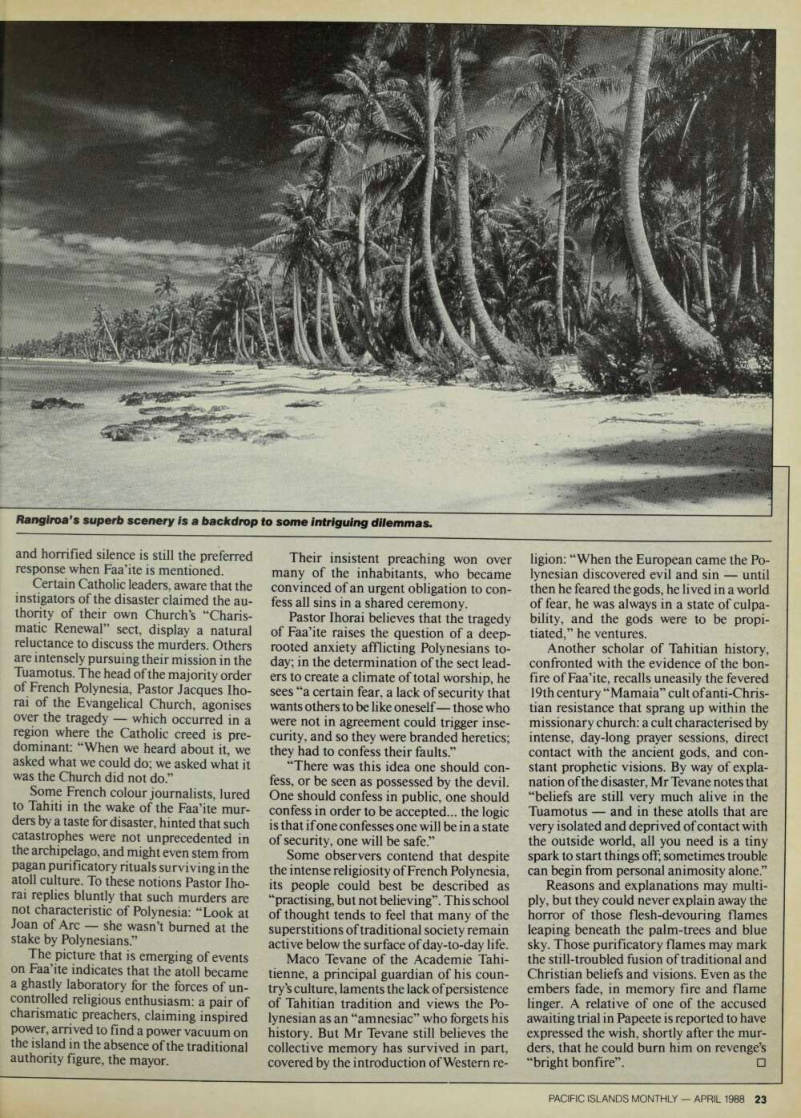
Rangiroa itself besieges the visitor with its splendours; so wide is its span that sometimes rainclouds blanket one islet while sun shines across the atoll and vast rainbows seem to span the lagoon waters.
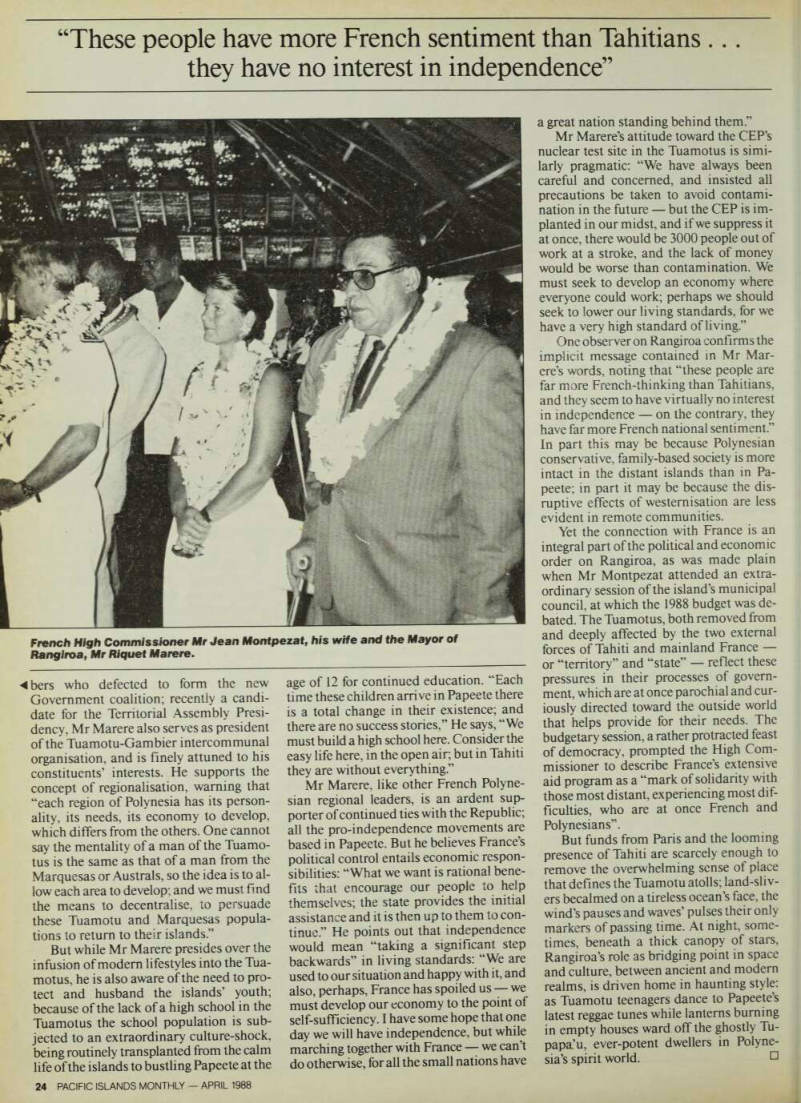
Paved roads, almost daily air services, re search centres and a new satellite station all testify to the infusion of high technol ogy into traditional Polynesian culture. But as the most powerful political leader of the Tuamotus, Mr Riquet Marere, Mayor of Rangiroa, explained in his welcoming ad dress to the High Commissioner’s party, development problems remain.
While French administrators in their snow-white uniforms looked on and Tua motu children draped the visiting digni taries with the traditional Tifaifai cloth of welcome, the bemedalled Mr Marere listed his priorities; aid for water collection and distribution, an earlier census and a study of increased regionalisation of the terri torial Government.
France’s policies for Rangiroa and the Tuamotus illustrate the potential of ad vanced development for such small and isolated communities. Paris has an unu sual commitment to these Polynesian atolls for they are legally part of France and the administration of aid is eased by the fact that there is only one major do nor. Life not only on Rangiroa, but on many of the Tuamotu-Gambier group as well as some islands in the far-flung Mar quesas, will be revolutionised by mid-year when a new satellite system introduces a direct television link with Tahiti’s French programs, greatly increasing the sense of connection between these communities and the outside world and also, the authorities hope, helping to reverse the migration from the islands.
Until today, the archipelago has been without television except for videos re broadcast by local centres and telephone services beyond Rangiroa and Hao have been minimal. These, too, will be im proved by the satellite link.
Elsewhere on Rangiroa, Mr Montpe zat, by now much-garlanded and rechris tened “Tetiare Tane” by the welcoming party, could inspect the various projects that help strengthen the links between far away Paris and the Tuamotus: a sophisti cated seismic station for tsunami warnings, a medical centre and, in the vil lage of Avatoru, the territorial maritime research centre. Known as EVAAM (Es tablishment for the Validation of Sea Farming and Maritime Activities), this fa cility carries out research into such fields
as mother-of-pearl production and live baits for tuna fishing both vital if the Tuamotus are to establish self-supporting commercial economies in co-operation with institutions including the University of Orleans and Canberra’s Baas Becking Geological and Biological Laboratory.
But life in the Tuamotus is not a con stant process of harmonious development mediated by the largesse of France; inev itable problems confront the islanders. Mr Marere, a politician equally at home on the atolls and in the cut-throat world of Pa peete’s Territorial Assembly, gave Pacific Islands Monthly a thumbnail sketch of the issues confronting the Tuamotus today.
A co-founder of the Tahoeraa Huiraa tira party that controlled Tahitian politics until late last year, he was one of the mem- ►
and horrified silence is still the preferred response when Faa’ite is mentioned.
Certain Catholic leaders, aware that the instigators of the disaster claimed the au thority of their own Church’s “Charis matic Renewal” sect, display a natural reluctance to discuss the murders. Others are intensely pursuing their mission in the Tuamotus. The head of the majority order of French Polynesia, Pastor Jacques Iho rai of the Evangelical Church, agonises over the tragedy which occurred in a region where the Catholic creed is pre dominant: “When we heard about it, we asked what we could do; we asked what it was the Church did not do.”
Some French colour journalists, lured to Tahiti in the wake of the Faa’ite mur ders by a taste for disaster, hinted that such catastrophes were not unprecedented in the archipelago, and might even stem from pagan purificatory rituals surviving in the atoll culture. To these notions Pastor Iho rai replies bluntly that such murders are not characteristic of Polynesia: “Look at Joan of Arc she wasn’t burned at the stake by Polynesians.”
The picture that is emerging of events on Faa’ite indicates that the atoll became a ghastly laboratory for the forces of un controlled religious enthusiasm: a pair of charismatic preachers, claiming inspired power, arrived to find a power vacuum on the island in the absence of the traditional authority figure, the mayor.
Their insistent preaching won over many of the inhabitants, who became convinced of an urgent obligation to con fess all sins in a shared ceremony.
Pastor Ihorai believes that the tragedy of Faa’ite raises the question of a deep rooted anxiety afflicting Polynesians to day; in the determination of the sect lead ers to create a climate of total worship, he sees “a certain fear, a lack of security that wants others to be like oneself—those who were not in agreement could trigger inse curity, and so they were branded heretics; they had to confess their faults.”
“There was this idea one should con fess, or be seen as possessed by the devil, One should confess in public, one should confess in order to be accepted... the logic is that if one confesses one will be in a state of security, one will be safe.”
Some observers contend that despite the intense religiosity of French Polynesia, its people could best be described as “practising, but not believing”. This school of thought tends to feel that many of the superstitions of traditional society remain active below the surface of day-to-day life.
Maco Tevane of the Academic Tahi tienne, a principal guardian of his coun try’s culture, laments the lack of persistence of Tahitian tradition and views the Po lynesian as an “amnesiac” who forgets his history. But Mr Tevane still believes the collective memory has survived in part, covered by the introduction of Western re
ligion: “When the European came the Po lynesian discovered evil and sin until then he feared the gods, he lived in a world of fear, he was always in a state of culpa bility, and the gods were to be propi tiated,” he ventures, Another scholar of Tahitian history, confronted with the evidence of the bon fire of Faa’ite, recalls uneasily the fevered 19th century “Mamaia” cult of anti-Chris tian resistance that sprang up within the missionary church: a cult characterised by intense, day-long prayer sessions, direct contact with the ancient gods, and con stant prophetic visions. By way of expla nation of the disaster, Mr Tevane notes that “beliefs are still very much alive in the Tuamotus and in these atolls that are very isolated and deprived of contact with the outside world, all you need is a tiny spark to start things off; sometimes trouble can begin from personal animosity alone.”
Reasons and explanations may multi ply, but they could never explain away the horror of those flesh-devouring flames leaping beneath the palm-trees and blue sky. Those purificatory flames may mark the still-troubled fusion of traditional and Christian beliefs and visions. Even as the embers fade, in memory fire and flame linger. A relative of one of the accused awaiting trial in Papeete is reported to have expressed the wish, shortly after the mur ders, that he could burn him on revenge’s “bright bonfire”. □
Rangiroa’s superb scenery is a backdrop to some Intriguing dilemmas.
“These people have more French sentiment than Tahitians ... they have no interest in independence”
◄ bers who defected to form the new Government coalition; recently a candidate for the Territorial Assembly Presidency, Mr Marere also serves as president of the Tuamotu-Gambier intercommunal organisation, and is finely attuned to his constituents’ interests. He supports the concept of regionalisation, warning that “each region of Polynesia has its personality, its needs, its economy to develop, which differs from the others. One cannot say the mentality of a man of the Tuamotus is the same as that of a man from the Marquesas or Australs, so the idea is to allow each area to develop; and we must find the means to decentralise, to persuade these Tuamotu and Marquesas populations to return to their islands.”
But while Mr Marere presides over the infusion of modem lifestyles into the Tuamotus, he is also aware of the need to protect and husband the islands’ youth; because of the lack of a high school in the Tuamotus the school population is subjected to an extraordinary culture-shock, being routinely transplanted from the calm life of the islands to bustling Papeete at the
age of 12 for continued education. “Each time these children arrive in Papeete there is a total change in their existence; and there are no success stories,” He says, We must build a high school here. Consider the easy life here, in the open air; but in Tahiti they are without everything.”
Mr Marere, like other French Polyne sian regional leaders, is an ardent sup porter of continued ties with the Republic; all the pro-independence movements are based in Papeete. But he believes Frances political control entails economic respon sibilities: “What we want is rational bene fits that encourage our people to help themselves; the state provides the initial assistance and it is then up to them to con tinue.” He points out that independence would mean “taking a significant step backwards” in living standards: We are used to our situation and happy with it, and also, perhaps, France has spoiled us we must develop our economy to the point ot self-sufficiency. I have some hope that one day we will have independence, but while marching together with France we can t do otherwise, for all the small nations have
a great nation standing behind them.”
Mr Marere’s attitude toward the CEP’s nuclear test site in the Tuamotus is simi larly pragmatic: “We have always been careful and concerned, and insisted all precautions be taken to avoid contami nation in the future but the CEP is im planted in our midst, and if we suppress it at once, there would be 3000 people out of work at a stroke, and the lack of money would be worse than contamination. We must seek to develop an economy where everyone could work; perhaps we should seek to lower our living standards, for we have a very high standard of living.”
One observer on Rangiroa confirms the implicit message contained in Mr Mar ere’s words, noting that “these people are far more French-thinking than Tahitians, and they seem to have virtually no interest in independence on the contrary, they have far more French national sentiment.”
In part this may be because Polynesian conservative, family-based society is more intact in the distant islands than in Pa peete; in part it may be because the dis ruptive effects of westernisation are less evident in remote communities.
Yet the connection with France is an integral part of the political and economic order on Rangiroa, as was made plain when Mr Montpezat attended an extra ordinary session of the island’s municipal council, at which the 1988 budget was de bated. The Tuamotus, both removed from and deeply affected by the two external forces of Tahiti and mainland France or “territory” and “state” reflect these pressures in their processes of govern ment, which are at once parochial and cur iously directed toward the outside world that helps provide for their needs. The budgetary session, a rather protracted feast of democracy, prompted the High Com missioner to describe France’s extensive aid program as a “mark of solidarity with those most distant, experiencing most dif ficulties, who are at once French and Polynesians”.
But funds from Paris and the looming presence of Tahiti are scarcely enough to remove the overwhelming sense of place that defines the Tuamotu atolls; land-sliv ers becalmed on a tireless ocean’s face, the wind’s pauses and waves’ pulses their only markers of passing time. At night, some times, beneath a thick canopy of stars, Rangiroa’s role as bridging point in space and culture, between ancient and modem realms, is driven home in haunting style: as Tuamotu teenagers dance to Papeete’s latest reggae tunes while lanterns burning in empty houses ward off the ghostly Tu papa’u, ever-potent dwellers in Polyne sia’s spirit world. D
French High Commissioner Mr Jean Montpezat, his wife and the Mayor of Rangiroa, Mr Riquet Marere.