Gabby Pahinui’s Musical Legacy
pp. 18-19 · Read in the full issue
Hawaii
The late, great Hawaiian guitarist inspires a new generation.
By Ed Rampell
EVEN in death, the great Hawaiian slack key guitarist and singer Gabby Pahinui is the maestro of South Seas music. Although he passed away in the early 1980 s, Gabby’s traditional musical legacy endures as a link between generations.
According to Pahinui protege Peter Moon, “people idolised and fell in love with Gabby because he represented a lost, vanishing Hawaii.
“This old man is his overalls was an ideal grass-roots figurehead, a folk artist who mirrored his times. He did not com promise his heritage and principles. In the early ’7os, young Hawaiians had no one else to look up to. Gabby remained true to his beliefs,” asserts Moon, the leader of the band that bears his name and perpetuates the exotic Pahinui sound.
Gabby’s indigenous authenticity went far beyond his public persona, for the trou badour revived the traditional and dis tinctive Hawaiian music that had become adulterated by foreign influences. Martin Pahinui, one of Gabby’s 10 children and a member of the Peter Moon Band, says his father “revived the old ways, bringing back the unique open chord tuning known as slack-key.”
Gabby had an innate musical genius.
Moon says that “the old man” had a nat ural ear and was an all-round musician, though he could not read music. Gabby’s first instrument was the eight string gui tar, and he also played ukulele. Before Gabby, Moon says, “Hawaiian music had no introduction and conclusions. The way Gabby told a story in his songs was like a book told through pure music, rhythm, structure and melody.”
Gabby was a high school dropout and self-taught musician. He was born in 1920 and raised at Waimanalo, a Polynesian preserve on Oahu. His career started at the age of 13, singing in bars. Moon says that Pahinui “had perfect pitch and a pure fal setto in his youth”, and Martin adds that his father possessed a unique yodel. Gabby was one of the first Hawaiians to sing and play at the same time.
Gabby really came of age in the 19705.
Influenced by the resurgence of national ism by minorities in the continental United States during the 19605, a new staunchly Hawaiian generation emerged in the 50th state. Gabby became these people’s hero ahead of his contemporary, Don Ho, who “sold out” by deliberately appealing to tourists and the mainstream mainland audience with Las Vegas style “hapa haole” ditties, such as his hit Tiny
Bubbles. Gabby’s tra ditional Hawaiian harmonics, lyrics and personality won the hearts of the Hawaiians.
Gabby’s artistic triumph was bitter sweet, however.
While he retained the integrity of Waiman alo, where he and his family lived on Ha waiian homestead land in a corrugated Quonset hut, it was Don Ho’s So-called “Waikiki orienta tion” that was com mercially successful.
Don Ho became a multi-millionaire, but Martin Pahinui re calls that until the day his father died, Gabby “had to continue to work on road main tenance for Honolulu City and County.
After a day’s work Dad played music...”
Despite his popular ity with island audi ences and TV specials, albums and concerts, Hawaii’s population simply was not large enough to support its greatest musician. Gabby suf fered for his art, pay ing a price for staying true to the beat of a different drummer.
Nor did fame suit this local boy well.
Moon insists that
while Gabby’s celebrity status did not make him hi-makamaka (snobbish), “fame affected him. He didn’t known how to handle it. Gabby didn’t become famous until he had already passed his musical prime. Everybody wanted to be his friend, and when he went to the store, his money was no good.” But Martin says that Gabby just wanted to be alone, and to escape the pressures of stardom he would play golf or go to the beach.
Martin Pahinui remembers how his father used to “drive us crazy, blasting classical music on the stereo! He liked rock music the Beatles, Chicago, Boston. He
went to a Three Dog Night concert. He li ked Mexican music and went to see Don Ho, who used to be a beach boy with Dad way back when” Moon adds that “Gabby was a product of this times. He was a semi jazz man, inspired by Duke Ellington, Count Basie and Benny Goodman.”
Country and Western guitarist Chet At kins w ho performed in a slack-key style once telephoned the Pahinui house hold but, Martin recalls, his father was too nervous to return the call of one of his idols.
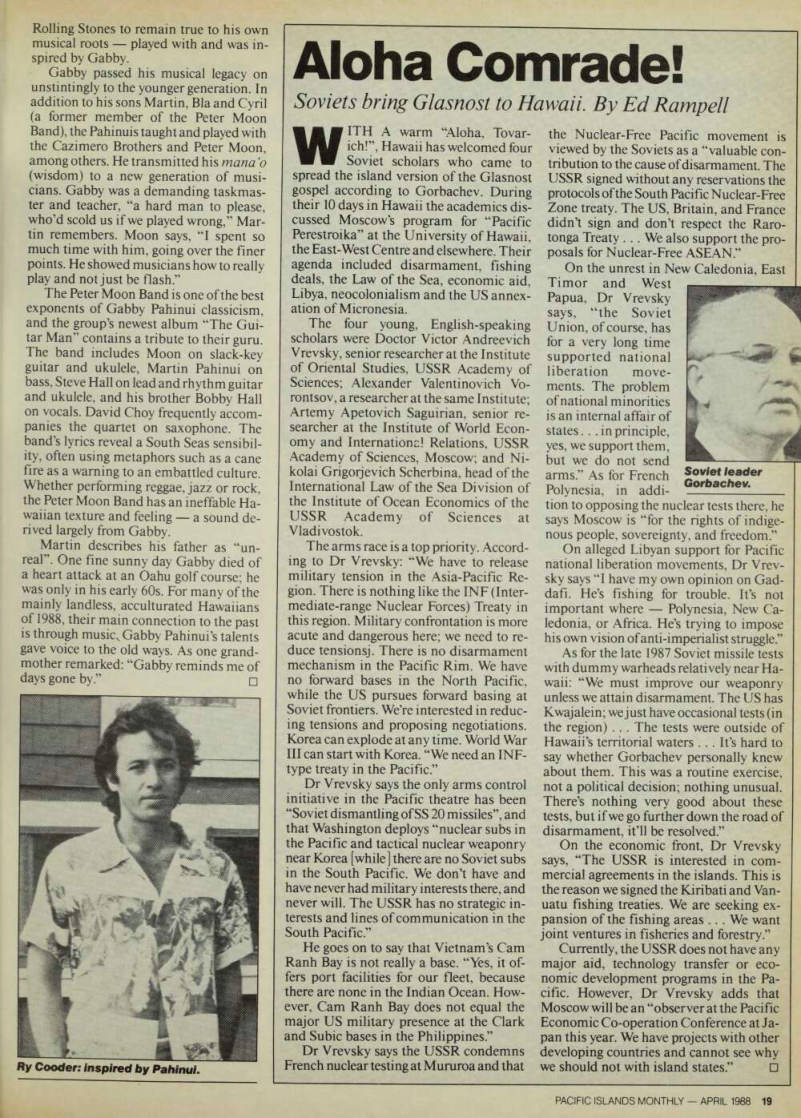
However, superb American guitarist Ry Cooder who once turned down Mick Jagger’s offer to become a member of the
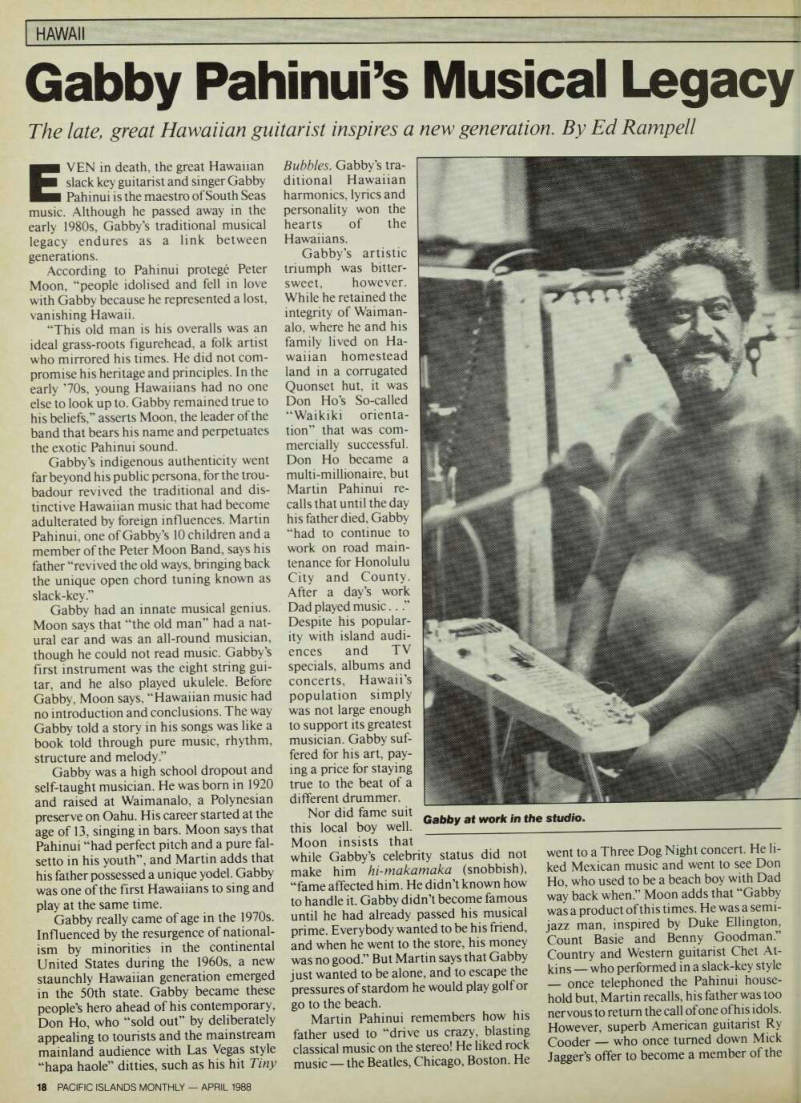
Gabby at work in the studio.
Rolling Stones to remain true to his own musical roots played with and was in spired by Gabby.
Gabby passed his musical legacy on unstintingly to the younger generation. In addition to his sons Martin, Bla and Cyril (a former member of the Peter Moon Band), the Pahinuis taught and played with the Cazimero Brothers and Peter Moon, among others. He transmitted his mana o (wisdom) to a new generation of musi cians. Gabby was a demanding taskmas ter and teacher, “a hard man to please, who’d scold us if we played wrong,” Mar tin remembers. Moon says, “I spent so much time with him, going over the finer points. He showed musicians how to really play and not just be flash.”
The Peter Moon Band is one of the best exponents of Gabby Pahinui classicism, and the group’s newest album “The Gui tar Man” contains a tribute to their guru.
The band includes Moon on slack-key guitar and ukulele, Martin Pahinui on bass, Steve Hall on lead and rhythm guitar and ukulele, and his brother Bobby Hall on vocals. David Choy frequently accom panies the quartet on saxophone. The band’s lyrics reveal a South Seas sensibil ity, often using metaphors such as a cane fire as a warning to an embattled culture.
Whether performing reggae, jazz or rock, the Peter Moon Band has an ineffable Ha waiian texture and feeling a sound de rived largely from Gabby.
Martin describes his father as “un real”. One fine sunny day Gabby died of a heart attack at an Oahu golf course; he was only in his early 60s. For many of the mainly landless, acculturated Hawaiians of 1988, their main connection to the past is through music.. Gabby Pahinui’s talents gave voice to the old ways. As one grand mother remarked: “Gabby reminds me of days gone by.” □
Ry Cooder: inspired by Pahinui.