Happy Birthday HMS Bounty
p. 58 · Read in the full issue
Hell on board, paradise ashore for the men of the Bounty.
By Sven Wahlroos
TWO HUNDRED years ago HMS Bounty was beating southward to Cape Horn and the beginning of one of history’s most famous voyages, cele brated in art, fiction, movies and myth.
She left Portsmouth on December 23, 1787, and spent the next two months on the 18th century equivalent of a shakedown cruise, tightening equipment and discipline as she prepared to sail to Tahiti to gather bread fruit for the use of Britain’s West Indian slaves.
Bounty's commander. Lieutenant Wil liam Bligh, has been portrayed as a sadist and a flogger; a maritime Caligula. He was neither; rather, he was a compulsive dis ciplinarian, both of himself and his men, and it was his tongue that was to bring him to ruin on more than one occasion (he was court-martialled in 1805 for his insulting and offensive remarks to fellow officers in a Royal Navy famed for its foul language).
Bligh was also, on occasion, a remark ably poor judge of character, for it was in March 1788 that he made two errors of judgment; he promoted Fletcher Chris tian to second-in-command, and sen tenced to the lash Matthew Quintal men who were, 13 months later, to lead the mu tiny on the Bounty.
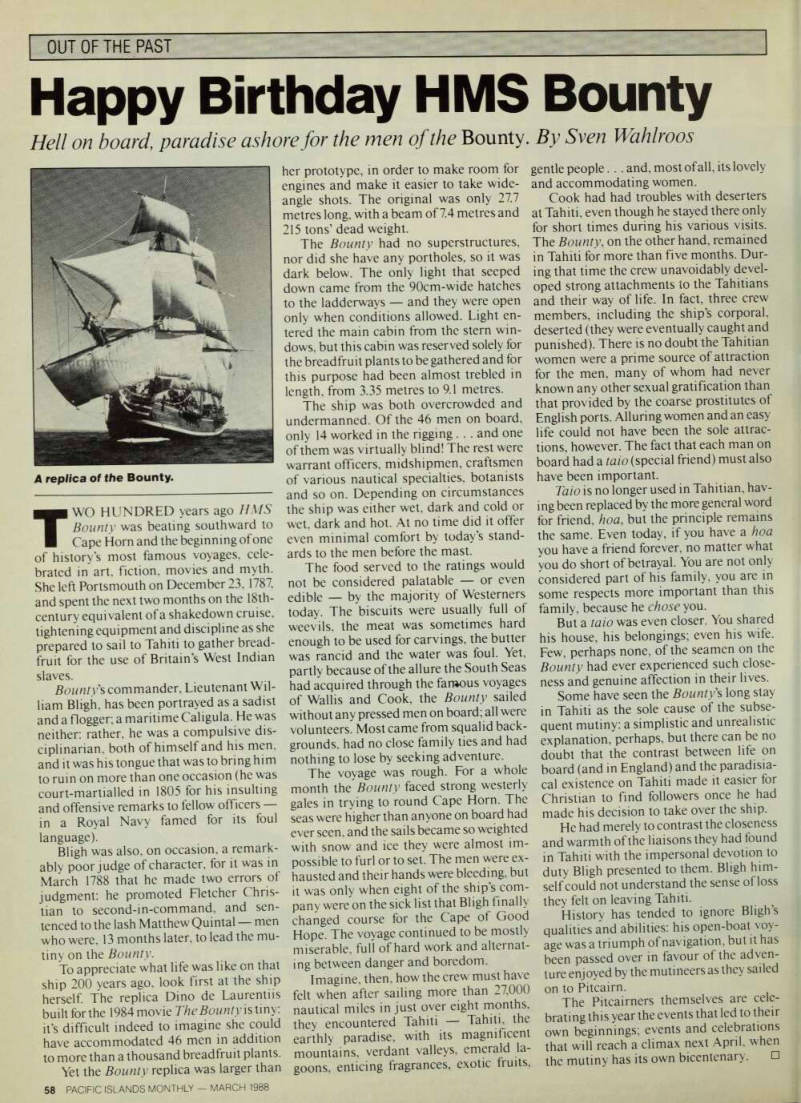
To appreciate what life was like on that ship 200 years ago, look first at the ship herself. The replica Dino de Laurentns built forthe 1984 movie The Bounty isiiny: it’s difficult indeed to imagine she could have accommodated 46 men in addition to more than a thousand breadfruit plants.
Yet the Bounty replica was larger than
her prototype, in order to make room for engines and make it easier to take wide angle shots. The original was only 27.7 metres long, with a beam of 7.4 metres and 215 tons’ dead weight.
The Bounty had no superstructures, nor did she have any portholes, so it was dark below. The only light that seeped down came from the 90cm-wide hatches to the ladderways and they were open only when conditions allowed. Light en tered the main cabin from the stern win dows, but this cabin was reserved solely for the breadfruit plants to be gathered and for this purpose had been almost trebled in length, from 3.35 metres to 9.1 metres.
The ship was both overcrowded and undermanned. Of the 46 men on board, only 14 worked in the rigging . . . and one of them was virtually blind! The rest were warrant officers, midshipmen, craftsmen of various nautical specialties, botanists and so on. Depending on circumstances the ship was either wet, dark and cold or wet, dark and hot. At no time did it offer even minimal comfort by today’s stand ards to the men before the mast.
The food served to the ratings would not be considered palatable or even edible by the majority of Westerners today. The biscuits were usually full of weevils, the meat was sometimes hard enough to be used for carvings, the butter was rancid and the water was foul. Yet, partly because of the allure the South Seas had acquired through the famous voyages of Wallis and Cook, the Bounty sailed without any pressed men on board; all were volunteers. Most came from squalid back grounds, had no close family ties and had nothing to lose by seeking adventure.
The voyage was rough. For a whole month the Bounty faced strong westerly gales in trying to round Cape Horn. The seas were higher than anyone on board had ever seen, and the sails became so weighted with snow and ice they were almost im possible to furl or to set. The men were ex hausted and their hands were bleeding, but it was only when eight of the ship’s com pany were on the sick list that Bligh finally changed course for the Cape of Good Hope. The voyage continued to be mostly miserable, full of hard work and alternat ing between danger and boredom.
Imagine, then, how the crew must have felt when after sailing more than 27,000 nautical miles in just over eight months, they encountered Tahiti Tahiti, the earthly paradise, with its magnificent mountains, verdant valleys, emerald la goons, enticing fragrances, exotic fruits,
gentle people. . . and, most of all, its lovely and accommodating women.
Cook had had troubles with deserters at Tahiti, even though he stayed there only for short times during his various visits.
The Bounty, on the other hand, remained in Tahiti for more than five months. Dur ing that time the crew unavoidably devel oped strong attachments to the Tahitians and their way of life. In fact, three crew members, including the ship’s corporal, deserted (they were eventually caught and punished). There is no doubt the Tahitian women were a prime source of attraction for the men, many of whom had never known any other sexual gratification than that provided by the coarse prostitutes of English ports. Alluring women and an easy life could not have been the sole attrac tions, however. The fact that each man on board had a taio (special friend) must also have been important.
Taio is no longer used in Tahitian, hav ing been replaced by the more general word for friend, hoa, but the principle remains the same. Even today, if you have a hoa you have a friend forever, no matter what you do short of betrayal. You are not only considered part of his family, you are in some respects more important than this family, because he chose you.
But a taio was even closer. You shared his house, his belongings; even his wife.
Few, perhaps none, of the seamen on the Bounty had ever experienced such close ness and genuine affection in their lives.
Some have seen the Bounty's long stay in Tahiti as the sole cause of the subse quent mutiny: a simplistic and unrealistic explanation, perhaps, but there can be no doubt that the contrast between life on board (and in England) and the paradisia cal existence on Tahiti made it easier for Christian to find followers once he had made his decision to take over the ship.
He had merely to contrast the closeness and warmth of the liaisons they had found in Tahiti with the impersonal devotion to duty Bligh presented to them. Bligh him self could not understand the sense of loss they felt on leaving Tahiti.
History has tended to ignore Bhgh’s qualities and abilities: his open-boat voy age was a triumph of navigation, but it has been passed over in favour of the adven ture enjoyed by the mutineers as they sailed on to Pitcairn.
The Pitcairners themselves are cele brating this year the events that led to their own beginnings; events and celebrations that will reach a climax next April, when the mutiny has its own bicentenary. □
A replica of the Bounty.