Maui Loa Renaissance Man
p. 47 · Read in the full issue
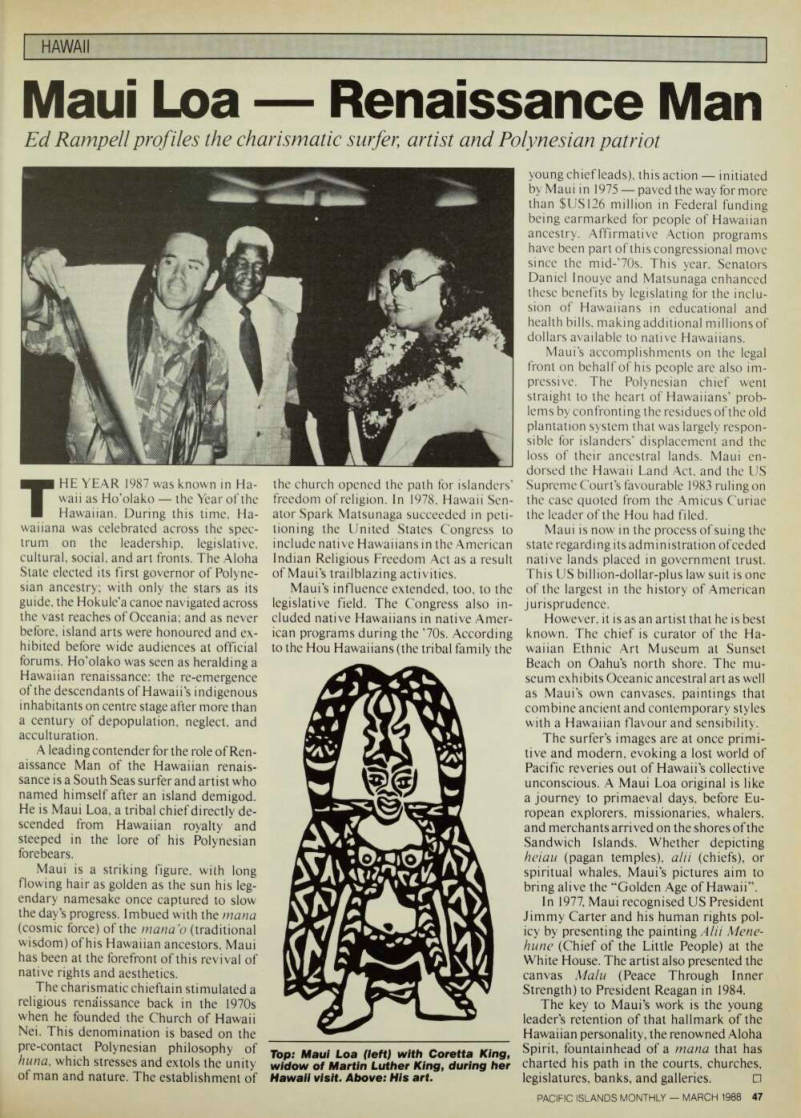
Ed Rampell profiles the charismatic surfer, artist and Polynesian patriot
THE YEAR 1987 was known in Ha waii as Ho’olako the Year of the Hawaiian. During this lime. Ha waiiana was celebrated across the spec trum on the leadership, legislative, cultural, social, and art fronts. The Aloha Slate elected its first governor of Polyne sian ancestry; with only the stars as its guide, the Hokule’a canoe navigated across the vast reaches of Oceania; and as never before, island arts were honoured and ex hibited before wide audiences at official forums. Ho’olako was seen as heralding a Hawaiian renaissance: the re-emergence of the descendants of Hawaii’s indigenous inhabitants on centre stage after more than a century of depopulation, neglect, and acculturation.
A leading contender for the role of Ren aissance Man of the Hawaiian renais sance is a South Seas surfer and artist who named himself after an island demigod.
He is Maui Loa, a tribal chief directly de scended from Hawaiian royalty and steeped in the lore of his Polynesian forebears.
Maui is a striking figure, with long flowing hair as golden as the sun his leg endary namesake once captured to slow the day’s progress. Imbued with the mana (cosmic force) of the mana’o (traditional wisdom) of his Hawaiian ancestors, Maui has been at the forefront of this revival of native rights and aesthetics.
The charismatic chieftain stimulated a religious renaissance back in the 1970 s when he founded the Church of Hawaii Nei. This denomination is based on the pre-contact Polynesian philosophy of huna , which stresses and extols the unity of man and nature. The establishment of
the church opened the path for islanders' freedom of religion. In 1978, Hawaii Sen ator Spark Malsunaga succeeded in peti tioning the United Stales Congress to include native Hawaiians in the American Indian Religious Freedom Act as a result of Maui’s trailblazing activities.
Maui’s influence extended, too, to the legislative field. The Congress also in cluded native Hawaiians in native Amer ican programs during the ’7os. According to the Hou Hawaiians (the tribal family the
young chief leads), this action initiated by Maui in 1975 paved the way for more than SUSI 26 million in Federal funding being earmarked for people of Hawaiian ancestry. Affirmative Action programs have been part of this congressional move since the mid-’7os. This year. Senators Daniel Inouye and Malsunaga enhanced these benefits by legislating for the inclu sion of Hawaiians in educational and health bills, makingadditional millionsof dollars available to native Hawaiians.
Maui’s accomplishments on the legal front on behalf of his people are also im pressive. The Polynesian chief went straight to the heart of Hawaiians’ prob lems by confronting the residues of the old plantation system that was largely respon sible for islanders' displacement and the loss of their ancestral lands. Maui en dorsed the Hawaii Land Act, and the US Supreme Court’s favourable 1983 ruling on the case quoted from the Amicus Curiae the leader of the Hou had filed.
Maui is now in the process of suing the stale regarding its administration ofceded native lands placed in government trust.
This US billion-dollar-plus law suit is one of the largest in the history of American jurisprudence.
However, it is as an artist that he is best known. The chief is curator of the Ha waiian Ethnic Art Museum at Sunset Beach on Oahu’s north shore. The mu seum exhibits Oceanic ancestral art as well as Maui’s own canvases, paintings that combine ancient and contemporary styles with a Hawaiian flavour and sensibility.
The surfer’s images are at once primi tive and modern, evoking a lost world of Pacific reveries out of Hawaii’s collective unconscious. A Maui Loa original is like a journey to primaeval days, before Eu ropean explorers, missionaries, whalers, and merchants arrived on the shores of the Sandwich Islands. Whether depicting heiau (pagan temples), alii (chiefs), or spiritual whales, Maui’s pictures aim to bring alive the “Golden Age of Hawaii’’.
In 1977, Maui recognised US President Jimmy Carter and his human rights pol icy by presenting the painting Alii Mene hune (Chief of the Little People) at the White House. The artist also presented the canvas Main (Peace Through Inner Strength) to President Reagan in 1984.
The key to Maui’s work is the young leader’s retention of that hallmark of the Hawaiian personality, the renowned Aloha Spirit, fountainhead of a mana that has charted his path in the courts, churches, legislatures, banks, and galleries. □
Top: Maui Loa (left) with Coretta King, widow of Martin Luther King, during her Hawaii visit. Above: His art.