Solomon Islands
p. 42 · Read in the full issue
UNTIL Cyclone Namu struck in May, 1986, the Solomon Islands managed an annual trade surplus.
The estimated figures for 1985 show im ports of 5564.5 million and exports ofsS6B million: growth exports had been fish, logs and copra.
According to the latest report from the National Bank of Solomon Islands, de pressed world commodity prices coupled with damage sustained by copra and palm oil plantations in the cyclone have placed the economy under severe pressure. Clo sure of the country’s largest logging oper ation and the resultant loss of valuable foreign exchange were also major setbacks.
The Central Bank of Solomon Islands has tightened private sector domestic credit and moved to reduce surplus liq uidity of the commercial banks, and a sus tained level of consumer spending has placed pressure on foreign reserves.
The cyclone exacerbated the country’s foreign debt. The Solomon Islands dollar has depreciated against the US dollar, re sulting in a marked increase in the foreign debt which, with the fall in imports, has climbed higher than the 1985 level of SUSBO million.
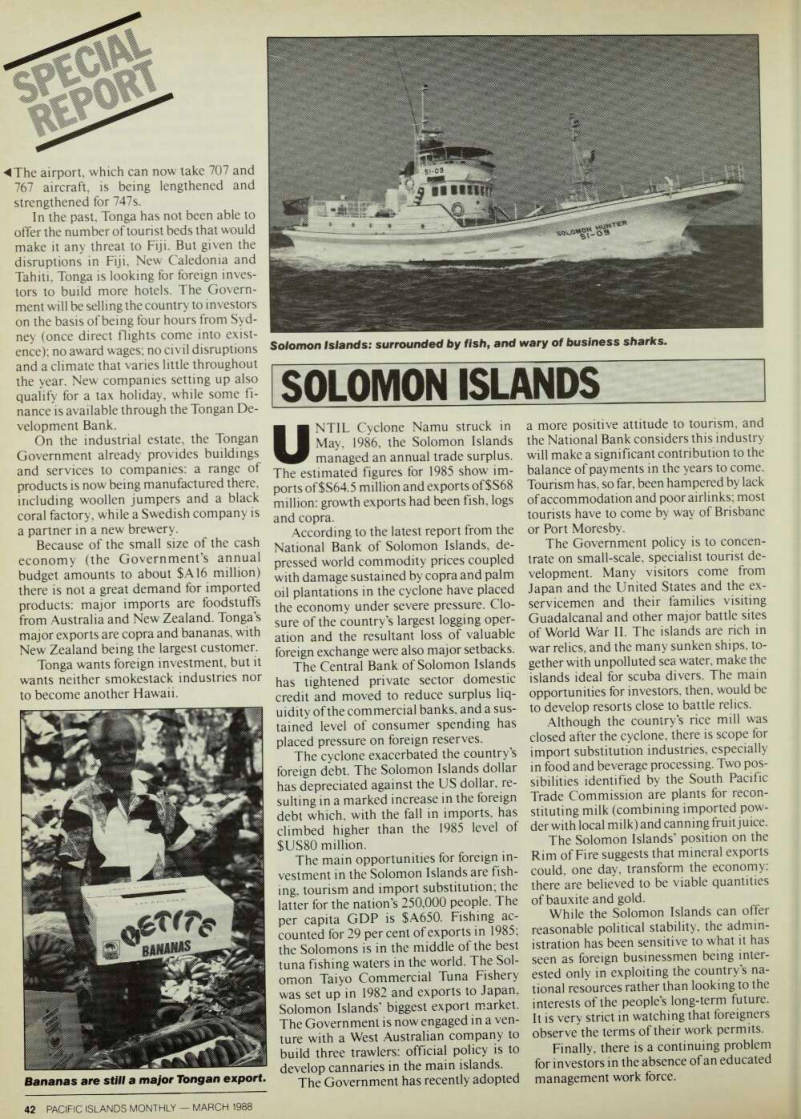
The main opportunities for foreign in vestment in the Solomon Islands are fish ing, tourism and import substitution; the latter for the nation’s 250,000 people. The per capita GDP is SA6SO. Fishing ac counted for 29 per cent of exports in 1985: the Solomons is in the middle of the best tuna fishing waters in the world. The Sol omon Taiyo Commercial Tuna Fishery was set up in 1982 and exports to Japan, Solomon Islands’ biggest export market.
The Government is now engaged in a ven ture with a West Australian company to build three trawlers: official policy is to develop cannaries in the main islands.
The Government has recently adopted
a more positive attitude to tourism, and the National Bank considers this industry will make a significant contribution to the balance of payments in the years to come.
Tourism has, so far, been hampered by lack of accommodation and poor airlinks; most tourists have to come by way of Brisbane or Port Moresby.
The Government policy is to concen trate on small-scale, specialist tourist de velopment. Many visitors come from Japan and the United States and the ex servicemen and their families visiting Guadalcanal and other major battle sites of World War 11. The islands are rich in war relics, and the many sunken ships, to gether with unpolluted sea water, make the islands ideal for scuba divers. The main opportunities for investors, then, would be to develop resorts close to battle relics.
Although the country’s rice mill was closed after the cyclone, there is scope for import substitution industries, especially in food and beverage processing. Two pos sibilities identified by the South Pacific Trade Commission are plants for recon stituting milk (combining imported pow der with local milk) and canning fruit juice.
The Solomon Islands’ position on the Rim of Fire suggests that mineral exports could, one day, transform the economy: there are believed to be viable quantities of bauxite and gold.
While the Solomon Islands can offer reasonable political stability, the admin istration has been sensitive to what it has seen as foreign businessmen being inter ested only in exploiting the country’s na tional resources rather than looking to the interests of the people’s long-term future.
It is very strict in watching that foreigners observe the terms of their work permits.
Finally, there is a continuing problem for investors in the absence of an educated management work force.
Solomon Islands: surrounded by fish, and wary of business sharks.