Vanuatu
p. 41 · Read in the full issue
DECISIONS by the Government of Vanuatu to sign a fishing agree ment with the Soviet Union and to enter into a friendly relationship with Li bya have both worked to diminish the country’s appeal as a finance centre and tourist destination. It is understood that in January (normally one of the top months for tourism in Vanuatu) this year some of the hotels around Port Vila had occu pancy rates of only 50 per cent.
The coups in Fiji have diverted tourist business to Vanuatu, but that is expected to be a temporary benefit. Holidaying in Vila is not made more attractive by the fact that Ansett and Air Vanuatu each operate only one return flight a week from Syd ney, both at the weekend: Air Nuigini flights from Port Moresby or the Air Pa cific service from Fiji are not important in tourist industry terms. Furthermore, while Fiji is a shopping mecca for Australian and New Zealand tourists, Vanuatu’s duty-free prices are often higher than those at Syd ney Airport.
Reports suggest that a lack of confi dence in the Vanuatu tourist industry has led to an unwillingness to invest in new developments or, in many cases, to main tain existing facilities to the highest standards.
Real economic growth in this nation of 130,000 people is expected to lag. Real GDP growth was predicted to have grown by about two per cent in 1986 after falling the year before. Estimated GDP in 1986 was SUSI2B million; exports were worth SUS 14.4 million, with imports of $U557.6 million. While the nation imports many
products (alcohol, tobacco, petroleum and wheat) from Australia, trade in the other direction is negligible.
Vanuatu’s largest customer is Holland, followed by Belgium, Japan and France; its main domestic imports in were copra, beef, sawn timber and cocoa, while its substantial sales of processed fish are classified as a re-export.
The country is expected to rely heavily on foreign aid for the forseeable future.
Skilled labour is in short supply. There is practically no industrial infrastructure, but there are some opportunities. The Japa nese have been involved in beef and fish processing, and there have been signs of revived Japanese interest in investing in Vanuatu.
There is considerable room for devel opment of the beef industry on the island of Espiritu Santo but this would in volve clearing much of the land that has reverted to native growth since independ ence, and the provision of greatly in creased cooler capacity to store meat for export.
If the country is able to project a more acceptable political image, tourism could revive. Its closeness to Australia is a major advantage, as would be any future direct service from New Zealand.
One success story has been Vanuatu’s finance centre. It was set up by the colon ial condominium administration and in itially prospered; then the Santo rebellion at the time of independence undermined the confidence of overseas companies and that confidence was finally restored only to be shaken again by the Russian and Li byan connections.
Port Vila offers a pure tax-haven: ex tensive secrecy provisions, no personal or corporate income taxes, no estate or gift duties, no capital gains taxes, no exchange
controls and no participation in tax trea ties. More than 1000 companies are in corporated there, served by six international banks (ANZ, Barclays, Hong Kong & Shanghai, Westpac, Indosuez Vanuatu and Gutzwiller Kurz Burgener), five international accountancy firms, six trust companies and six law firms. The success of the venture is shown by the fact that it provides jobs for 350 local people.
Vanuatu also provides a flag-of-con venience shipping registry; this has not at tracted as many ship owners as was ex pected, largely due to continued stability in Liberia and Panama, the world’s lead ing operators of open shipping registers.
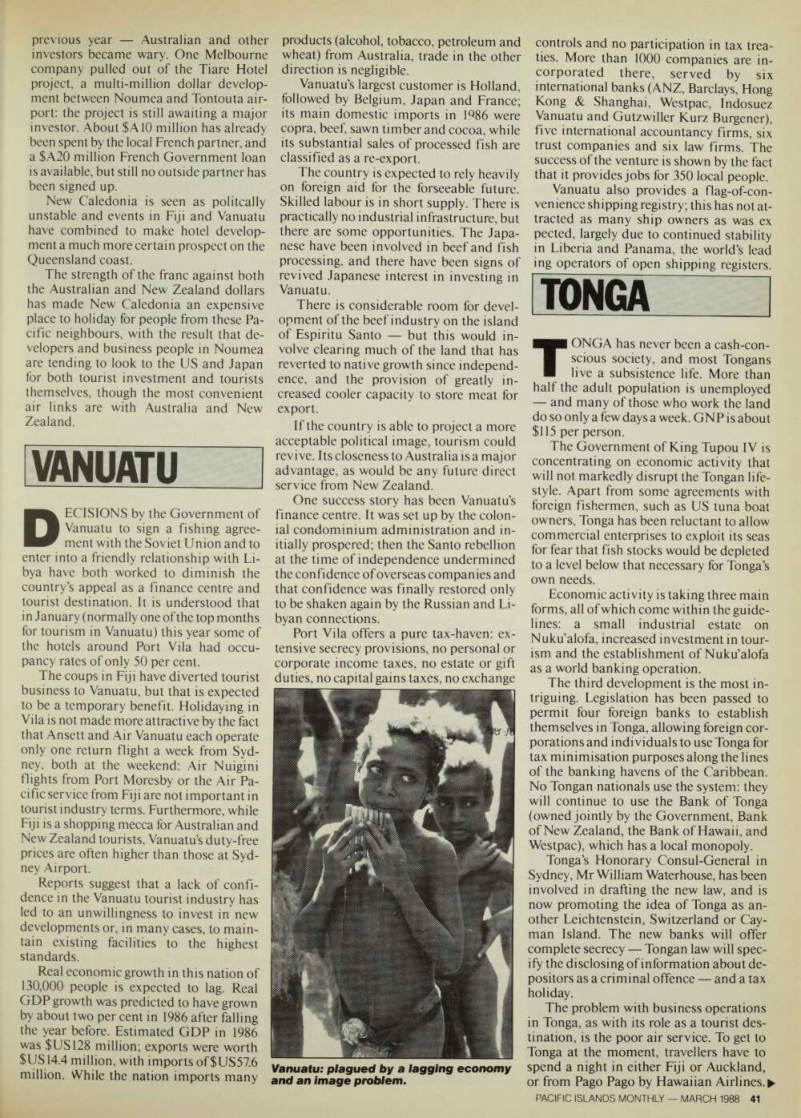
Vanuatu: plagued by a lagging economy and an image problem.