Trade Winds
pp. 33-35 · Read in the full issue

□ Fiji Plans Privatisation
FIJIAN authorities are considering sell ing the country’s Government-run mails and communications services to private enterprise. Radio Fiji said the Ministry of Finance in Suva produced a paper outlin ing the privatisation plans to be consid ered by Cabinet. Prime Minister Ratu Sir Kamisese Mara last year attended a pri vatisation conference in Fiji, which gave extensive coverage to the American Government’s support for private, rather than public, enterprise.
□ Flying Friendly Skies
TONGA’S FRIENDLY Islands Airways will use one of three newly leased planes to begin services to Australia and New Zealand. The Tongan airline will lease two Twin Otters and one McDonnell Douglas MDB7 from an Irish aviation company under a five-year agreement just signed.
The Twin Otter, to carry 19 passengers, will be used mainly for local services and flights between Tonga and American Sa moa. The MDB7 airliner, which seats 115 people, will link Tonga with Sydney, Auckland, Fiji, Western Samoa and American Samoa. It is expected to be in service in late July.
The first of the Twin Otters is due in Tonga at the end of this month, while the second should arrive next month.
□ Bougainville Output Down
THE BOUGAINVILLE Copper Mine in PNG produced more than 15 tonnes of gold in 1987. Releasing production figures for the calendar year, Bougainville Copper Limited directors said the mine’s gold out put improved in the final quarter to more than four tonnes, to lift total output for the year to just under 15.1 tonnes.
The figure is down by more than a tonne on the 1986 figure. Silver produc tion for 1987 was slightly up at 50.6 tonnes and copper production remained stable at 178,000 tonnes.
□ Fiji’S Sweet Surprise
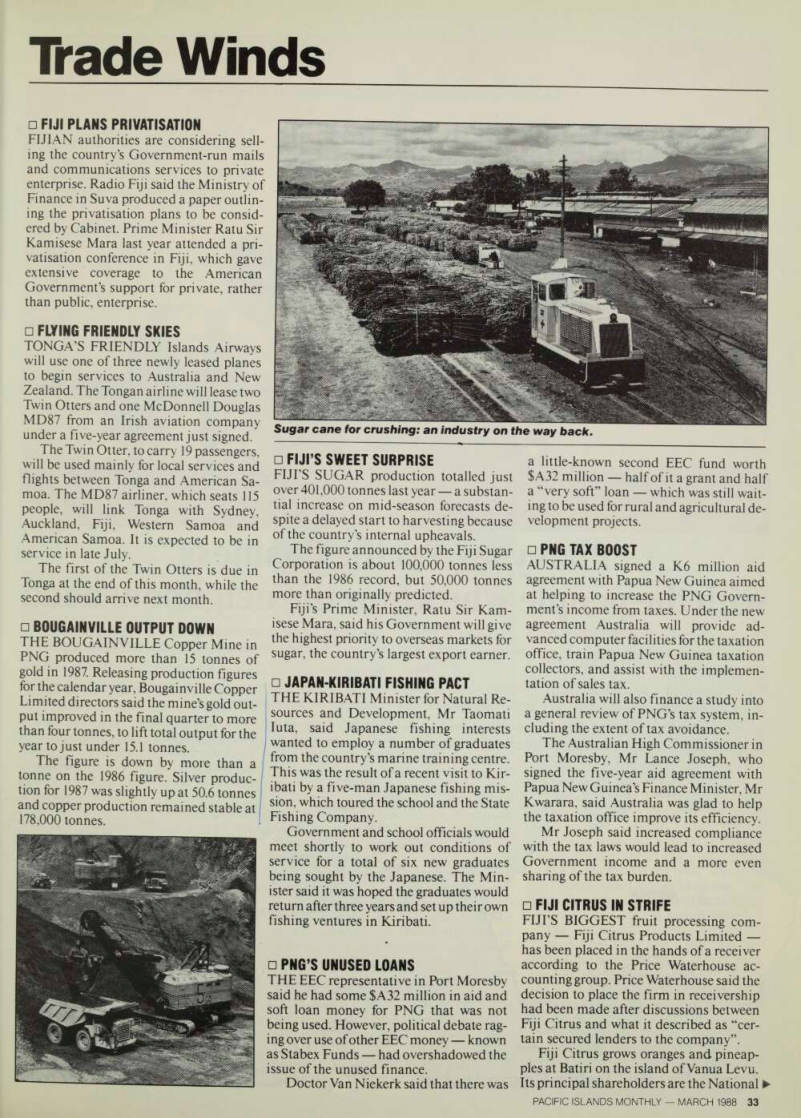
FIJI’S SUGAR production totalled just over 401,000 tonnes last year a substan tial increase on mid-season forecasts de spite a delayed start to harvesting because of the country’s internal upheavals.
The figure announced by the Fiji Sugar Corporation is about 100,000 tonnes less than the 1986 record, but 50,000 tonnes more than originally predicted.
Fiji’s Prime Minister, Ratu Sir Kam isese Mara, said his Government will give the highest priority to overseas markets for sugar, the country’s largest export earner.
□ Japan-Kiribati Fishing Pact
THE KIRIBATI Minister for Natural Re sources and Development, Mr Taomati luta, said Japanese fishing interests wanted to employ a number of graduates from the country’s marine training centre.
This was the result of a recent visit to Kir ibati by a five-man Japanese fishing mis sion, which toured the school and the State Fishing Company.
Government and school officials would meet shortly to work out conditions of service for a total of six new graduates being sought by the Japanese. The Min ister said it was hoped the graduates would return after three years and set up their own fishing ventures in Kiribati.
□ Png’S Unused Loans
THE EEC representative in Port Moresby said he had some SA32 million in aid and soft loan money for PNG that was not being used. However, political debate rag ing over use of other EEC money known as Stabex Funds had overshadowed the issue of the unused finance.
Doctor Van Niekerk said that there was
a little-known second EEC fund worth $ A 32 million half of it a grant and half a “very soft” loan which was still wait ing to be used for rural and agricultural de velopment projects.
□ Png Tax Boost
AUSTRALIA signed a K 6 million aid agreement with Papua New Guinea aimed at helping to increase the PNG Govern ment’s income from taxes. Under the new agreement Australia will provide ad vanced computer facilities for the taxation office, train Papua New Guinea taxation collectors, and assist with the implemen tation of sales tax.
Australia will also finance a study into a general review of PNG’s tax system, in cluding the extent of tax avoidance.
The Australian High Commissioner in Port Moresby, Mr Lance Joseph, who signed the five-year aid agreement with Papua New Guinea’s Finance Minister, Mr Kwarara, said Australia was glad to help the taxation office improve its efficiency.
Mr Joseph said increased compliance with the tax laws would lead to increased Government income and a more even sharing of the tax burden.
□ Fiji Citrus In Strife
FIJI’S BIGGEST fruit processing com pany Fiji Citrus Products Limited has been placed in the hands of a receiver according to the Price Waterhouse ac counting group. Price Waterhouse said the decision to place the firm in receivership had been made after discussions between Fiji Citrus and what it described as “cer tain secured lenders to the company”.
Fiji Citrus grows oranges and pineap ples at Batiri on the island of Vanua Levu.
Its principal shareholders are the National ►
Sugar cane for crushing: an industry on the way back.
◄ Marketing Authority, the Fiji Develop ment Bank and the Commonwealth De velopment Corporation.
The company has been a major sup plier of orange and pineapple juice to the domestic and New Zealand markets.
□ Nz Hands Out Aid
NEW ZEALAND eased slightly its freeze on foreign aid to Fiji by handing over a cheque for Fiji’s pine tree industry. The SA6OOO cheque brings to SA2O million New Zealand’s total contribution to the Fiji pine industry since 1976.
Because of New Zealand’s large invest ment in Fiji’s forest industry, the assist ance did not come under the current freeze on New Zealand aid to that country.
□ Copra Price Improves
THE WORLD price of copra continued to improve following the disastrous prices of the past two years. The world benchmark the price of Philippines copra delivered to European ports has more than dou bled since the middle of 1986 and is usu ally more than 50 per cent up on what it was early last year.
In mid-1986, the world copra price hit a low of less than SAI4O a tonne, but has now passed $390 a tonne. The improve ment is welcome news for Pacific island nation copra growers, who have been hit by the poor prices of the past two years.
However, the world price is still well below the more than $6OO a tonne it reached in 1984.
□ Link Between Countries
THE Indonesian airline, Garuda, and the Fiji international carrier, Air Pacific, are to conduct a joint survey on possible serv ices between the two countries. Air Pacif ic’s chief executive, Mr John Schaap, said the survey was likely to be made this month.
Fiji has been strengthening trade ties with Indonesia since the cooling of rela tions with traditional partners Australia and New Zealand since the coups last year.
Australia’s overseas airline, Qantas, is a 19 per cent shareholder in Air Pacific and has provided managerial services for the Fiji airline since April 1985.
□ Fiji Resort In Receivership
THE BANK of New Zealand has ap pointed receivers for Castaway Resorts Fiji Ltd, an arm of the Pacific Sun Hotels Ltd group. The group, registered in Nassau (Bahamas) was suspended from the NZ Stock Exchange before Christmas.
□ Warning On Dried Coconut
DESICCATED coconut from Singapore
being sold in New Zealand could contain Salmonella bacteria, a cause of food poi soning, the NZ Health Department chief scientist has warned. The department re cently seized a shipment at Christchurch after it was found to contain two types of Salmonella : earlier reports of illness came from Melbourne.
In NZ, chief scientist Jim Fraser said the shipment would be returned to Sin gapore if authorities there allowed it but would first have to be turned into oil for non-human consumption.
□ Bellamy Slams Japan
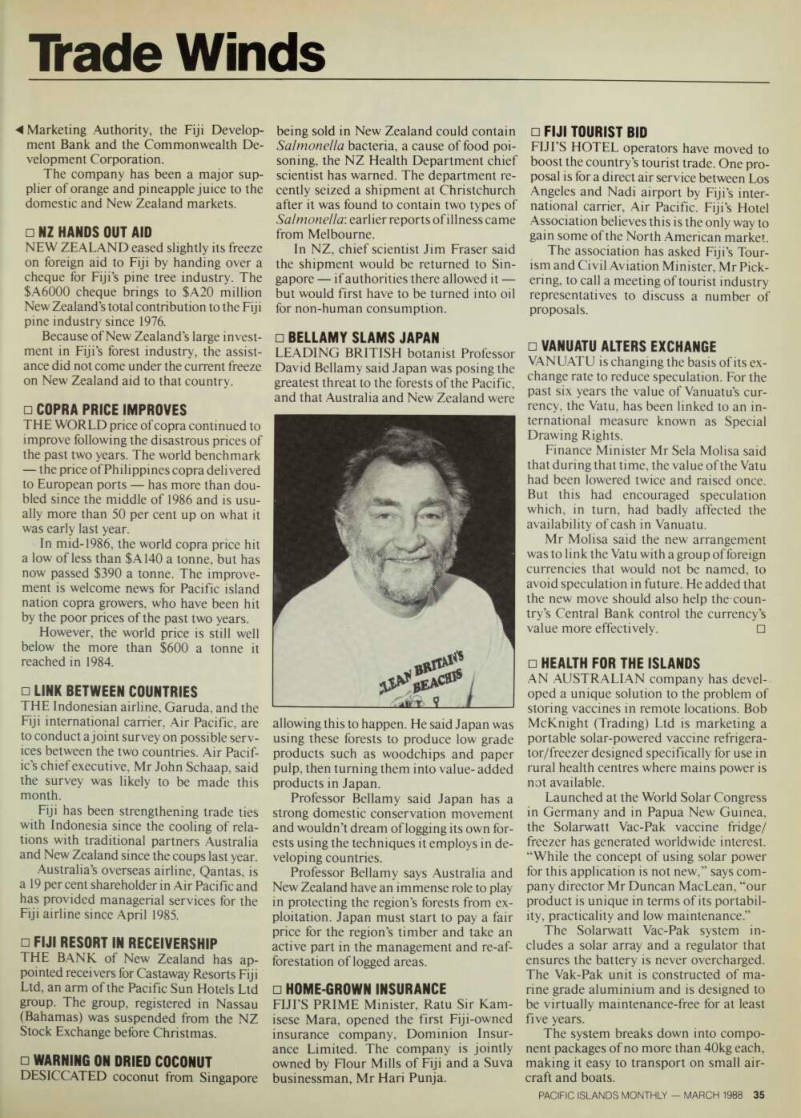
LEADING BRITISH botanist Professor David Bellamy said Japan was posing the greatest threat to the forests of the Pacific, and that Australia and New Zealand were
allowing this to happen. He said Japan was using these forests to produce low grade products such as woodchips and paper pulp, then turning them into value- added products in Japan.
Professor Bellamy said Japan has a strong domestic conservation movement and wouldn’t dream of logging its own for ests using the techniques it employs in de veloping countries.
Professor Bellamy says Australia and New Zealand have an immense role to play in protecting the region’s forests from ex ploitation. Japan must start to pay a fair price for the region’s timber and take an active part in the management and re-af forestation of logged areas.
□ Home-Grown Insurance
FIJI’S PRIME Minister, Ratu Sir Kam isese Mara, opened the first Fiji-owned insurance company, Dominion Insur ance Limited. The company is jointly owned by Flour Mills of Fiji and a Suva businessman, Mr Hari Punja.
□ Fiji Tourist Bid
FIJI’S HOTEL operators have moved to boost the country’s tourist trade. One pro posal is for a direct air service between Los Angeles and Nadi airport by Fiji’s inter national carrier, Air Pacific. Fiji’s Hotel Association believes this is the only way to gain some of the North American market.
The association has asked Fiji’s Tour ism and Civil Aviation Minister, Mr Pick ering, to call a meeting of tourist industry representatives to discuss a number of proposals.
□ Vanuatu Alters Exchange
VANUATU is changing the basis of its ex change rate to reduce speculation. For the past six years the value of Vanuatu’s cur rency, the Vatu, has been linked to an in ternational measure known as Special Drawing Rights.
Finance Minister Mr Sela Molisa said that during that time, the value of the Vatu had been lowered twice and raised once.
But this had encouraged speculation which, in turn, had badly affected the availability of cash in Vanuatu.
Mr Molisa said the new arrangement was to link the Vatu with a group of foreign currencies that would not be named, to avoid speculation in future. He added that the new move should also help the coun try’s Central Bank control the currency’s value more effectively. □
□ Health For The Islands
AN AUSTRALIAN company has devel oped a unique solution to the problem of storing vaccines in remote locations. Bob McKnight (Trading) Ltd is marketing a portable solar-powered vaccine refrigera tor/freezer designed specifically for use in rural health centres where mains power is not available.
Launched at the World Solar Congress in Germany and in Papua New Guinea, the Solarwatt Vac-Pak vaccine fridge/ freezer has generated worldwide interest.
“While the concept of using solar power for this application is not new,” says com pany director Mr Duncan Mac Lean, “our product is unique in terms of its portabil ity, practicality and low maintenance.”
The Solarwatt Vac-Pak system in cludes a solar array and a regulator that ensures the battery is never overcharged.
The Vak-Pak unit is constructed of ma rine grade aluminium and is designed to be virtually maintenance-free for at least five years.
The system breaks down into compo nent packages of no more than 40kg each, making it easy to transport on small air craft and boats.