Indonesia: A Giant Awakens
pp. 26-28 · Read in the full issue
Forum
John Connell and Michael van Langenberg assess an ambitious neighbour
THIRTY YEARS ago, when there was no Indonesia only the Neth erlands Indies the Dutch as a co lonial power took their place in South Pacific decision-making. Not only did they play some role in ensuring that the western half of Papua New Guinea became part of Indonesia, but they were founder mem bers of the South Pacific Commission along with France, the United States, Brit ain, Australia and New Zealand ... all of whom remain in the region. In those thor oughly colonial times, there had also been close relations between France and the Netherlands; between the wars Javanese were sent to the mines and fields of New Caledonia, and have remained there ever since as an important political minority.
But in 1949 when Indonesia effectively became independent, the Dutch packed their bags and went home. Indonesia look its place as a Southeast Asian power, Irian Jaya was no more than a neglected Indo nesian province and the Javanese of New Caledonia were largely forgotten. More re cently, after emphasising its presence in Irian Jaya through transmigration and what Robin Osborne has described as a “secret war”, precipitating the migration of refugees into Papua New Guinea and taking over the Portuguese colony of East Timor, Indonesia appeared to be seeking influence and power further east. Papua New Guinea has had a mutual friendship treaty with Indonesia for two years, and in the past months the Indonesian presence has become more dramatically evident with General Murdani’s alleged donations to Brigadier Ted Diro’s campaign fund and new economic relations between Fiji and Indonesia. Indonesia, it seems, is on the verge of becoming another global power m the ocean of the future.
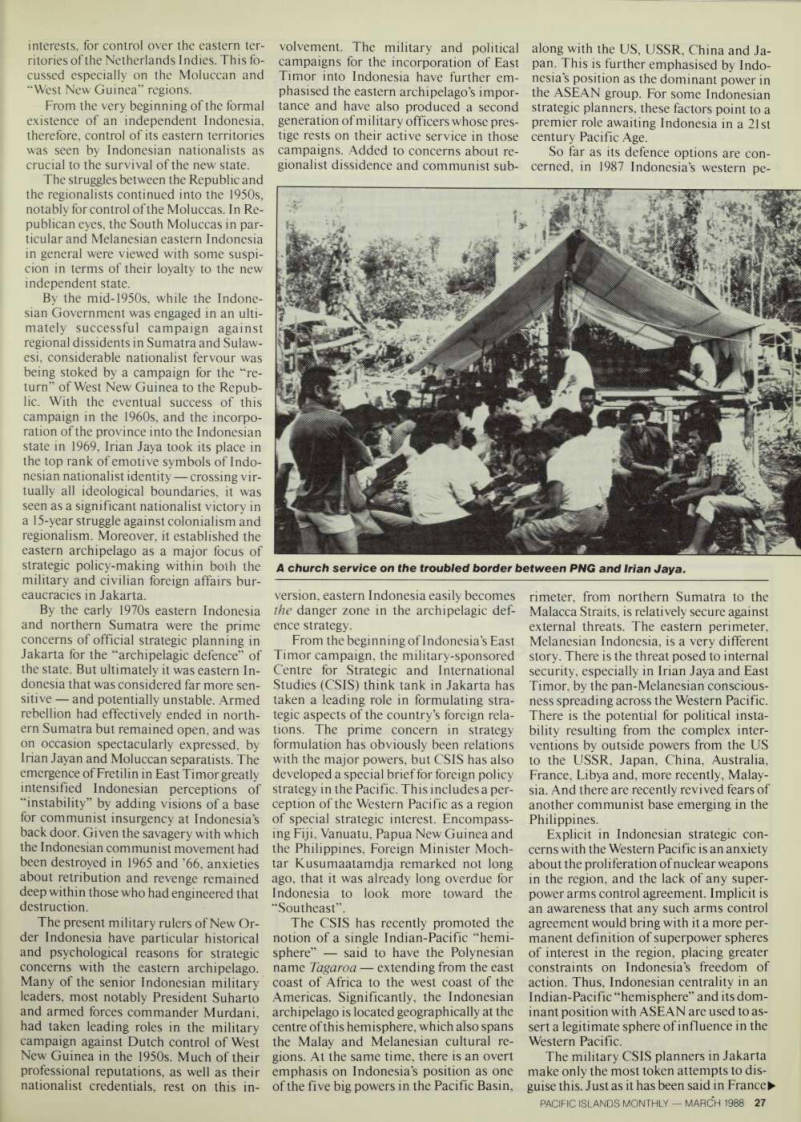
Already military incursions across an ill-defined border and Irian Jayan refu gees in border camps have caused enor mous problems for PNG. These problems have their repercussions in Australia, where former South Australian Premier Don Dunstan has recently described the Australian and PNG governments atti tudes to the refugees as “supine . Ameri can troops will soon begin exercises on these troublesome borders. The issue of the “lost Melanesian brothers”, just as it is in New Caledonia, is a divisive issue for each of the Melanesian states as Asian culture slowly overwhelms the western half of Papua New Guinea.
Certainly Indonesia’s presence has be come a dramatic one. The alleged funding of former Foreign Minister Ted Diros
election campaign by Indonesian army chief General Benny Murdani has caused widespread concern in PNG, where even in remote villages there have been long fears that the neighbouring Indonesian giant would one day spill over its borders.
Luke Sela, editor of the Papua New Guinea Post Courier , has claimed that the Government s desire to control the media was caused by its embarrassment over the Diro issue.
The Indonesian connection has proved troublesome for Papua New Guinea. Op position leaders, notably Bernard Nara kobi, have claimed that PNG has become the target of a secret Indonesian plan to dominate the entire Pacific region through ties of industry, commerce and even transmigration. Prime Minister Paias Wingti countered on his arrival in Aus
tralia in December with an assurance that “Indonesia has no in tention of interfering in Papua New Guin ea’s internal affairs.”
Without question, re lations with Indone sia will remain a critical foreign affairs issue for PNG.
Further east, the Indonesia connec tion in Fiji has been benevolent: there are promises of a mili tary alliance between the two states, direct air transport links that would reduce Fi ji’s dependence on Australia, and new trade measures. A private Indonesian trade mission visited Suva last November and agreed to buy Fi jian sugar, molasses, canned fish and tim ber a potentially significant boost to the Republic’s ailing
agricultural econ
omy. In exchange Fiji will take Indonesia’s maize, tea and var ious spare parts for its sugar production ma chinery. And, most crucially, Indonesia may well offer Fiji ships and aircraft. But
after all, why not? Australia may see the Pacific being transformed into an Asian- American lake, but all the global evidence suggests that it is those small island states with the greatest and most diverse exter nal ties that do best in aid, trade and cru cial economic concessions... and Fiji will need all of these.
Most Indonesian political leaders to day are particularly conscious of the im portant historical role played by Indonesian nationalism in the decoloni sation of Southeast Asia and the Pacific after World War 11. Indonesian interest in the Pacific, as foreign policy strategy, be gan in 1945, with the beginning of the mil itary struggle between the Republic of Indonesia and the Dutch colonial state.
Embedded in that larger struggle was an other, involving pro-Dutch regionalisl
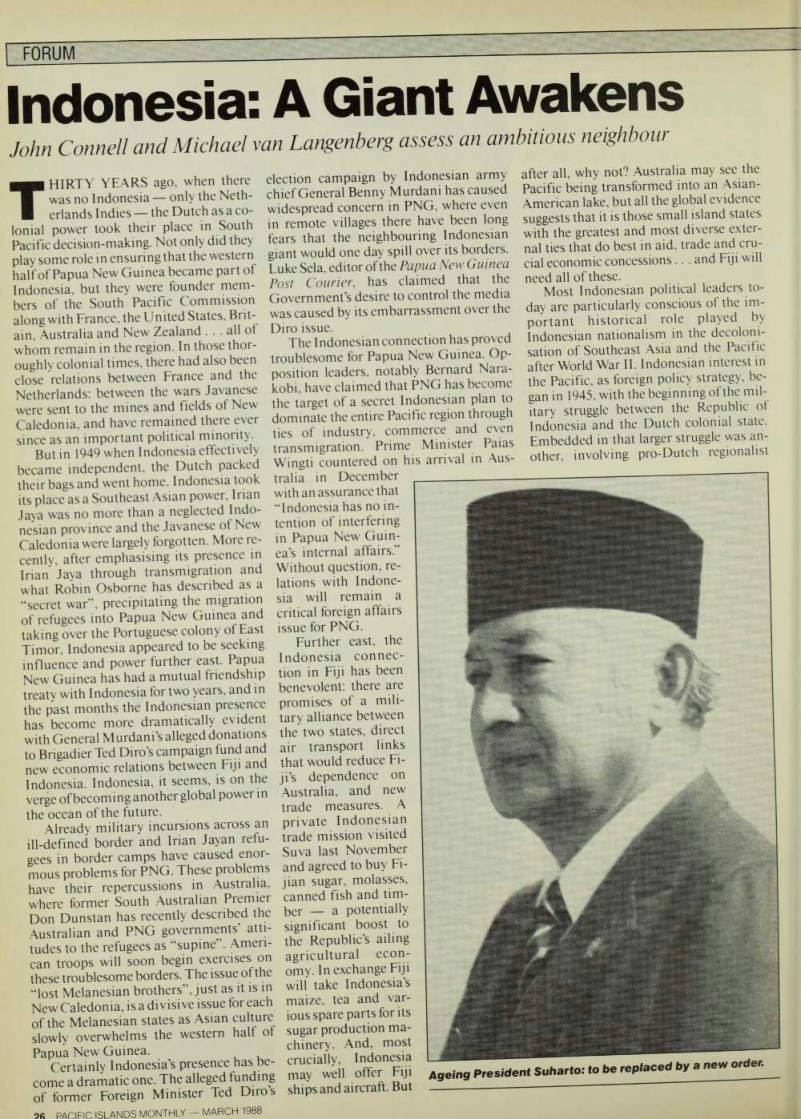
Ageing President Suharto: to be replaced by a new order.
interests, for control over the eastern ter ritories of the Netherlands Indies. This fo cussed especially on the Moluccan and “West New Guinea” regions.
From the very beginning of the formal existence of an independent Indonesia, therefore, control of its eastern territories was seen by Indonesian nationalists as crucial to the survival of the new state.
The struggles between the Republic and the regionalists continued into the 19505, notably for control of the Moluccas. In Re publican eyes, the South Moluccas in par ticular and Melanesian eastern Indonesia in general were viewed with some suspi cion in terms of their loyalty to the new independent state.
By the mid-19505, while the Indone sian Government was engaged in an ulti mately successful campaign against regional dissidents in Sumatra and Sulaw esi, considerable nationalist fervour was being stoked by a campaign for the “re turn” of West New Guinea to the Repub lic. With the eventual success of this campaign in the 19605, and the incorpo ration of the province into the Indonesian state in 1969, Irian Jaya took its place in the top rank of emotive symbols of Indo nesian nationalist identity crossing vir tually all ideological boundaries, it was seen as a significant nationalist victory in a 15-year struggle against colonialism and regionalism. Moreover, it established the eastern archipelago as a major focus of strategic policy-making within both the military and civilian foreign affairs bur eaucracies in Jakarta.
By the early 1970 s eastern Indonesia and northern Sumatra were the prime concerns of official strategic planning in Jakarta for the “archipelagic defence” of the state. But ultimately it was eastern In donesia that was considered far more sen sitive and potentially unstable. Armed rebellion had effectively ended in north ern Sumatra but remained open, and was on occasion spectacularly expressed, by Irian Jayan and Moluccan separatists. The emergence of Fretilin in East Timor greatly intensified Indonesian perceptions of “instability” by adding visions of a base for communist insurgency at Indonesia’s back door. Given the savagery with which the Indonesian communist movement had been destroyed in 1965 and ’66, anxieties about retribution and revenge remained deep within those who had engineered that destruction.
The present military rulers of New Or der Indonesia have particular historical and psychological reasons for strategic concerns with the eastern archipelago.
Many of the senior Indonesian military leaders, most notably President Suharto and armed forces commander Murdani, had taken leading roles in the military campaign against Dutch control of West New Guinea in the 19505. Much of their professional reputations, as well as their nationalist credentials, rest on this in
volvement. The military and political campaigns for the incorporation of East Timor into Indonesia have further em phasised the eastern archipelago’s impor tance and have also produced a second generation of military officers whose pres tige rests on their active service in those campaigns. Added to concerns about re gionalist dissidence and communist sub-
version, eastern Indonesia easily becomes the danger zone in the archipelagic def ence strategy.
From the beginning of Indonesia’s East Timor campaign, the military-sponsored Centre for Strategic and International Studies (CSIS) think tank in Jakarta has taken a leading role in formulating stra tegic aspects of the country’s foreign rela tions. The prime concern in strategy formulation has obviously been relations with the major powers, but CSIS has also developed a special brief for foreign policy strategy in the Pacific. This includes a per ception of the Western Pacific as a region of special strategic interest. Encompass ing Fiji, Vanuatu, Papua New Guinea and the Philippines, Foreign Minister Modi tar Kusumaatamdja remarked not long ago, that it was already long overdue for Indonesia to look more toward the “Southeast”.
The CSIS has recently promoted the notion of a single Indian-Pacific “hemi sphere” said to have the Polynesian name Tagaroa extending from the east coast of Africa to the west coast of the Americas. Significantly, the Indonesian archipelago is located geographically at the centre of this hemisphere, which also spans the Malay and Melanesian cultural re gions. At the same time, there is an overt emphasis on Indonesia’s position as one of the five big powers in the Pacific Basin,
along with the US, USSR, China and Ja pan. This is further emphasised by Indo nesia’s position as the dominant power in the ASEAN group. For some Indonesian strategic planners, these factors point to a premier role awaiting Indonesia in a 21st century Pacific Age.
So far as its defence options are con cerned, in 1987 Indonesia’s western pe
rimeter, from northern Sumatra to the Malacca Straits, is relatively secure against external threats. The eastern perimeter, Melanesian Indonesia, is a very different story. There is the threat posed to internal security, especially in Irian Jaya and East Timor, by the pan-Melanesian conscious ness spreading across the Western Pacific.
There is the potential for political insta bility resulting from the complex inter ventions by outside powers from the US to the USSR, Japan, China, Australia, France, Libya and, more recently, Malay sia. And there are recently revived fears of another communist base emerging in the Philippines.
Explicit in Indonesian strategic con cerns with the Western Pacific is an anxiety about the proliferation of nuclear weapons in the region, and the lack of any super power arms control agreement. Implicit is an awareness that any such arms control agreement would bring with it a more per manent definition of superpower spheres of interest in the region, placing greater constraints on Indonesia’s freedom of action. Thus, Indonesian centrality in an Indian-Pacific “hemisphere” and its dom inant position with ASEAN are used to as sert a legitimate sphere of influence in the Western Pacific.
The military CSIS planners in Jakarta make only the most token attempts to dis guise this. Just as it has been said in France►
A church service on the troubled border between PNG and Irian Jaya.
Over the next five years Indonesian foreign policy will pay considerably more attention to the Western Pacific region
◄that “we are there because the Pacific is there”, so Dr Djalal, a senior official in the Indonesian Ministry of Foreign Affairs, has proclaimed that the Pacific is “where all the major powers of the world are, so why not Indonesia? We certainly wish to have a place there”. Moreover, Indonesian foreign policy makers are conscious of the potential fragility of internal PNG politics and the possible flow of this instability into Irian Jaya.
Indonesia fears a “Lebanon trap” with a breakdown of political stability in PNG, the rise of a variety of dissident factions, the growth of further pan-Melanesian sen timent and a flow-on effect that would strengthen the separatist Free Papua Movement (OPM) in Irian Jaya. Pressures will then develop within Indonesia for military intervention inside PNG.
The cycle of escalation may be irresist ible and costly. Indonesia is now playing an active role in attempting to maintain a “co-operative” and stable political system in PNG hence its considerable “sphere of influence” interest in PNG politics
expressed in regular consultations about strategic planning, promises of special re lations between PNG and ASEAN and even financial assistance from Indonesia.
The sphere of interest emphasis in In donesian foreign policy is likely to in crease as a new, more confident generation of leaders takes over in Jakarta. They will be less concerned by a need to draw a sharp contrast with the aggressive Sukarnoist policies of the 1960 s than Suharto’s government has been.
There are even signs of a yearning among some of the younger civilian and military politicians for the national pride of the days of Guided Democracy and their aggressive foreign policy.
So far as recent developments in Fiji are concerned, Indonesia has much to be wary about in the politics of indigenous Me lanesian power being asserted there. For the immediate future, Indonesia must ac commodate to these developments and ensure there is no spillover into Melane sian Indonesia: Jakarta certainly does not share Malaysia’s new enthusiasm for the
direction of Fiji’s republican politics.
For the longer term, the potentially destabilising influences in Melanesian In donesia from the Taukei and Kanaky movements must be a matter of consid erable concern in Jakarta’s strategic-plan ning bureaucracy. Over the next five years Indonesian foreign policy will pay consid erably more attention to the Western Pa cific. The border with PNG, in particular, will be less sacrosanct in Indonesian eyes if perceived strategic interests and nation alist pride in Jakarta are threatened. After 1993, when Suharto’s term as president ends, political control of the New Order government in Jakarta will most probably have passed entirely to the hands of a new generation of military and civilian leaders.
And Indonesia is not the only Asian power to take an interest in the region. Ja pan, of course, has widespread business interests and is now a major aid donor (and also the largest aid donor in Indonesia).
China has a diplomatic presence in West ern Samoa and Fiji. Taiwan has an hon orary consul in Tonga, while the Solomon Islands is the only country in the world that has managed to recognise both Chinas.
South Korea is expanding its trade and mining interests and was one of the first countries to recognise Colonel Rabukas regime in Fiji. More recently Malaysia is also taking its place.
Indeed, virtually every substantial state in Asia is currently expanding its interests in the Pacific and now especially in politi cally unstable Fiji. Though Malaysia has had an embassy in Fiji for some years, the nature of the relationship has changed emphatically since the coups. There will be much closer trade links, and Malaysia’s constitution has been a partial model for that of Fiji. Not surprisingly, many Fiji ans see Malaysia as a model for the kind of state they wish to become, with the “sons of the soil” firmly in control.
Australia’s Foreign Minister, Bill Hay den, has drawn a similar conclusion. Here, at least, one Asian nation has gone far be yond trade: it has become a model for a new Fijian future. And in a last irony, PNG is reported to be contemplating member ship in ASEAN. Many thousands of years ago, the ancestors of Pacific islanders mi grated south and east from Asia: now such ancient ties are being brought together again. For better or worse, Asia is moving closer to the South Pacific. □
Dr John Connell and Dr Michael van Langenberg are researchers with the Re search Institute for Asia and the Pacific at the University of Sydney.