Fiji Returns To The Fold
pp. 7-8 · Read in the full issue
Opinion
Whatever the rights or wrongs of resuming aid to Fiji, assistance from neighbours is the nation’s best hope of rehabilitation
THE resumption of Australian and New Zealand aid to Fiji and of US recognition has been criticised both by former Prime Minister Timoci Bavadra, and in some small states of the South Pacific. The move constitutes, they say, a de facto recognition of the Govern ment and implicit approval of the coups of last year.
Papua New Guinea PM Paias Wingti, on the other hand, has hailed the re sumption of aid as a counter to Fiji’s threat ened “isolation” in a re gion where mutual dependence extends be yond traditional ties to the 20th century world of trade, diplomacy and most important of all to defence.
Both positions are un derstandable and contain elements of truth neither proponents or opponents have acknowledged. The
Republic of Fiji has in some ways been recognised by the Australian Government’s decision to deal diplomatically with states rather than governments; a deliberate and pragmatic move into Realpolitik and global strategy that is not so much “supine”, as former South Australian Pre mier and vocal Rabuka critic Don Dunstan has claimed, as cognisant of Fiji’s vital role in South Pacific defence and of its central position in a region where too many small states have become aid dependencies.
In fact, Fiji’s new Government (in many ways simply its Alliance Government in new clothes) has played the game as well as the larger nations have and more cold bloodedly than its detractors would have believed possi ble. It has flirted with powers none of those larger nations would like to see gaining influence in the region, such as
France and Indonesia, of fering them concessions in return for generous aid and hardware before taking only what it wanted and turning back to its older, more familiar partners such as Australia and New Zealand, which in the past few weeks have re-estab lished economic and mil itary ties.
The real pawns in this game are not abstractions of power or technical as sistance, but the people of Fiji. Trade relations, aid packages and defence agreements translate as employment, health care and badly needed exper tise to the Melanesian, Po lynesian, European and Indian citizens of a nation hit hard by the events of the past year. Unemployment is crippling communities where no provisions exist for assisting those out of work; the “brain drain” has left ordinary Fijians as well as the members of the eth nic and military elites without medical, emer
gency and technical services. All that is set to change, and it seems everyone will be a winner.
Chinese doctors are being attracted by generous em ployment provisions, and Chinese energy experts are coming to expand Fiji’s rural power grid with solar gen erators; Australian medical aid will flow to public hos pitals and community health care facilities; Australian, New Zealand and French mining personnel will unlock the promise of mineral riches that will bring Fiji not only desperately needed foreign exchange, but jobs in a variety of industries.
Australia will see its former position regained in great part, with “fine print” guidelines that are designed to route aid to those most in need. New Zealand’s occupation of ►
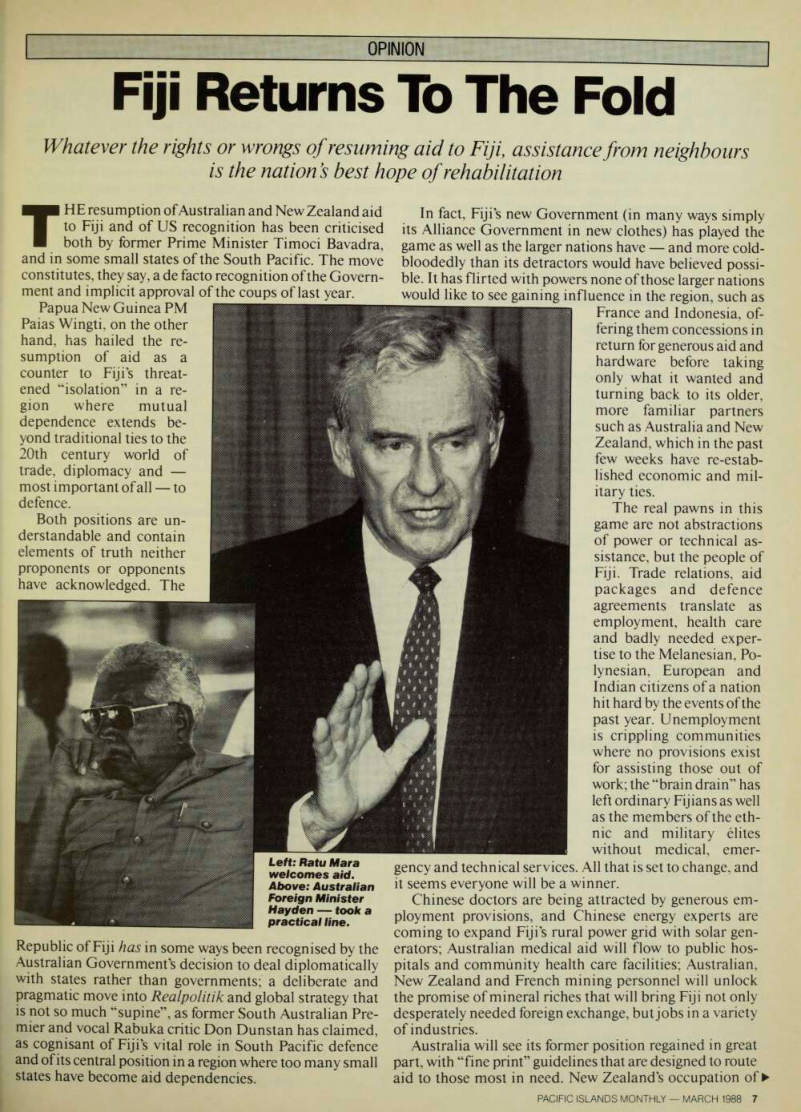
Left: Ratu Mara welcomes aid.
Above: Australian Foreign Minister Hayden -took a practical line.
the high moral ground in the South Pacific will be strengthened by the stringent conditions it has promised to place on its dealings with Fiji.
France and Indonesia will profit by their toeholds in the Pacific, allowing both nations to present themselves as disinterested benefactors rather than the bogeymen so often used to scare the wayward children of the region.
But, most importantly, the people of Fiji will be given the assistance they need to begin rebuilding; to cast off the fatuities of “Fiji for the Fijians” in search of maturity and an awareness of the responsibility it carries as an example to other Pacific nations and to the world.