Aggie In Her Heyday
p. 58 · Read in the full issue
Out Of The Past
Aggie Grey and her hotel have become a part of South Seas folklore.
SOUTH PACIFIC history is very much a history of men and their deeds. Women’s role, though of un deniable importance, is generally a back ground one.
There have, however, been a few women whose involvement in the story of the South Pacific has received widespread at tention; women whose lives and person alities have become legend. Three women stand out; all were queens, though only one was a member of “official” royalty.
Queen Salote ruled Tonga with wis dom, benevolence and deft skill for 47 years, during which her delightful person ality and innate nobility endeared her and her country to the world.
“Queen” Emma ruled her own comer of Papua New Guinea from 1890 to 1913, bending tens of thousands of her subjects (and not a few attractive young men) to her will before suiciding in Monte Carlo in 1913.
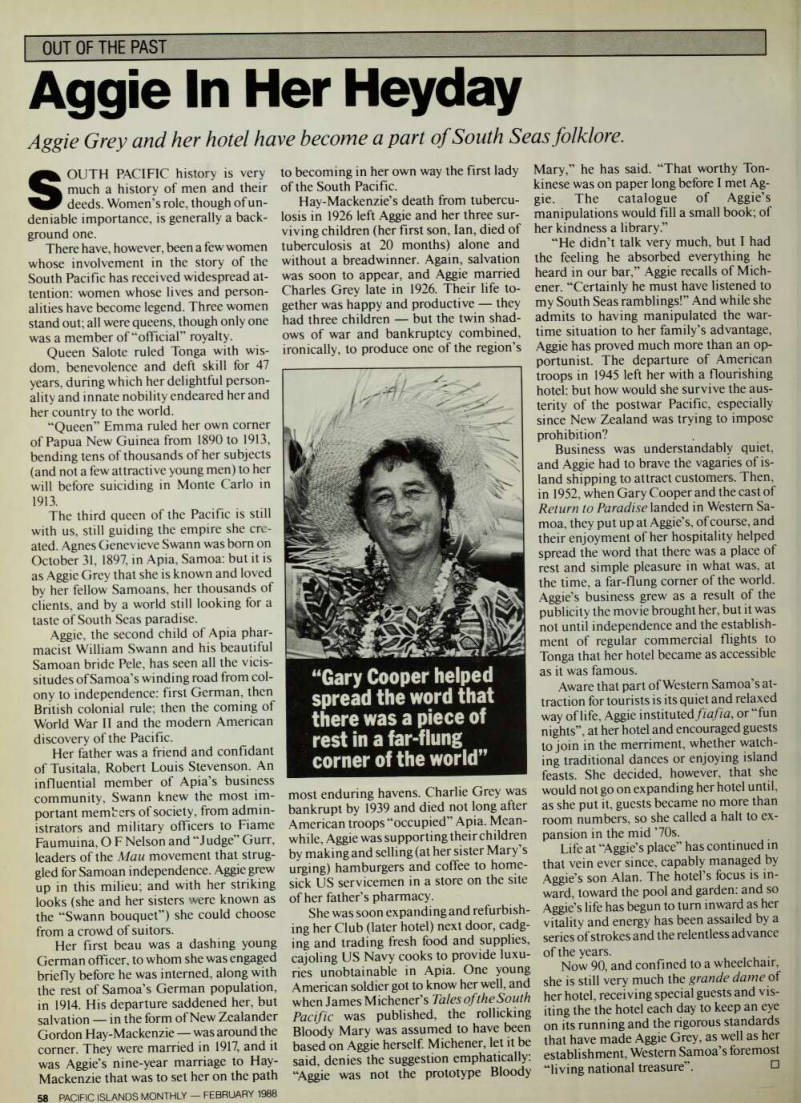
The third queen of the Pacific is still with us, still guiding the empire she cre ated. Agnes Genevieve Swann was bom on October 31, 1897, in Apia, Samoa: but it is as Aggie Grey that she is known and loved by her fellow Samoans, her thousands of clients, and by a world still looking for a taste of South Seas paradise.
Aggie, the second child of Apia phar macist William Swann and his beautiful Samoan bride Pele, has seen all the vicis situdes of Samoa’s winding road from col ony to independence: first German, then British colonial rule; then the coming of World War II and the modem American discovery of the Pacific.
Her father was a friend and confidant of Tusitala, Robert Louis Stevenson. An influential member of Apia’s business community, Swann knew the most im portant members of society, from admin istrators and military officers to Fiame Faumuina, O F Nelson and “Judge” Gurr, leaders of the Mau movement that strug gled for Samoan independence. Aggie grew up in this milieu; and with her striking looks (she and her sisters were known as the “Swann bouquet”) she could choose from a crowd of suitors.
Her first beau was a dashing young German officer, to whom she was engaged briefly before he was interned, along with the rest of Samoa’s German population, in 1914. His departure saddened her, but salvation in the form of New Zealander Gordon Hay-Mackenzie was around the corner. They were married in 1917, and it was Aggie’s nine-year marriage to Hay- Mackenzie that was to set her on the path
to becoming in her own way the first lady of the South Pacific.
Hay-Mackenzie’s death from tubercu losis in 1926 left Aggie and her three sur viving children (her first son, lan, died of tuberculosis at 20 months) alone and without a breadwinner. Again, salvation was soon to appear, and Aggie married Charles Grey late in 1926. Their life to gether was happy and productive they had three children but the twin shad ows of war and bankruptcy combined, ironically, to produce one of the region’s
most enduring havens. Charlie Grey was bankrupt by 1939 and died not long after American troops “occupied” Apia. Mean while, Aggie was supporting their children by making and selling (at her sister Mary’s urging) hamburgers and coffee to home sick US servicemen in a store on the site of her father’s pharmacy.
She was soon expanding and refurbish ing her Club (later hotel) next door, cadg ing and trading fresh food and supplies, cajoling US Navy cooks to provide luxu ries unobtainable in Apia. One young American soldier got to know her well, and when James Michener’s Tales of the South Pacific was published, the rollicking Bloody Mary was assumed to have been based on Aggie herself. Michener, let it be said, denies the suggestion emphatically: “Aggie was not the prototype Bloody
Mary,” he has said. “That worthy Ton kinese was on paper long before I met Ag gie. The catalogue of Aggie’s manipulations would fill a small book; of her kindness a library.”
“He didn’t talk very much, but I had the feeling he absorbed everything he heard in our bar,” Aggie recalls of Mich ener. “Certainly he must have listened to my South Seas ramblings!” And while she admits to having manipulated the war time situation to her family’s advantage, Aggie has proved much more than an op portunist. The departure of American troops in 1945 left her with a flourishing hotel; but how would she survive the aus terity of the postwar Pacific, especially since New Zealand was trying to impose prohibition?
Business was understandably quiet, and Aggie had to brave the vagaries of is land shipping to attract customers. Then, in 1952, when Gary Cooper and the cast of Return to Paradise landed in Western Sa moa, they put up at Aggie’s, of course, and their enjoyment of her hospitality helped spread the word that there was a place of rest and simple pleasure in what was, at the time, a far-flung corner of the world.
Aggie’s business grew as a result of the publicity the movie brought her, but it was not until independence and the establish ment of regular commercial flights to Tonga that her hotel became as accessible as it was famous.
Aware that part of Western Samoa’s at traction for tourists is its quiet and relaxed way of life, Aggie instituted/ifl/ifl, or “fun nights”, at her hotel and encouraged guests to join in the merriment, whether watch ing traditional dances or enjoying island feasts. She decided, however, that she would not go on expanding her hotel until, as she put it, guests became no more than room numbers, so she called a halt to ex pansion in the mid ’7os.
Life at “Aggie’s place” has continued in that vein ever since, capably managed by Aggie’s son Alan. The hotel’s focus is in ward, toward the pool and garden: and so Aggie’s life has begun to turn inward as her vitality and energy has been assailed by a series of strokes and the relentless advance of the years.
Now 90, and confined to a wheelchair, she is still very much the grande dame of her hotel, receiving special guests and vis iting the the hotel each day to keep an eye on its running and the rigorous standards that have made Aggie Grey, as well as her establishment, Western Samoa’s foremost “living national treasure”. D
"Gary Cooper helped spread the word that there was a picece of rest in a far-flung corner of the world"