Book Reviews
p. 49 · Read in the full issue
FIRST CONTACT New Guinea’s Highlanders Encounter the Outside World.
By Bob Connolly and Robin Anderson Reviewed by Chris Ashton LET ME DECLARE at the outset the bias I bring to my review of First Contact, the new book on the Eu ropean penetration of the New Guinea Highlands. I know and admire the au thors, Bob Connolly and Robin Ander son, for their film First Contact, and my friendship with the family of the central figure of their story, Michael Leahy, goes back to the 19505. I am the antithesis of the impartial observer.
A few words first about the film that spurred Anderson and Connolly to write the book. Funded by the übiquitous mil lionaire Sydney adventures Dick Smith, it focuses on the role in the early 1930 s of the Leahy brothers prospecting for gold in the densely populated valleys of the Western Highlands, hitherto unknown and thought to be entirely mountainous and sparsely inhabited. The film First Contact was nominated for an Academy Award in 1984 and a swag of other awards. Rightly so. It’s a wonderful story, and one of the best do cumentaries to come out of Australia . . . even if it does omit Jim Taylor’s role in the European exploration of the Highlands: imagine a film about Burke and Wills that was solely about Burke.
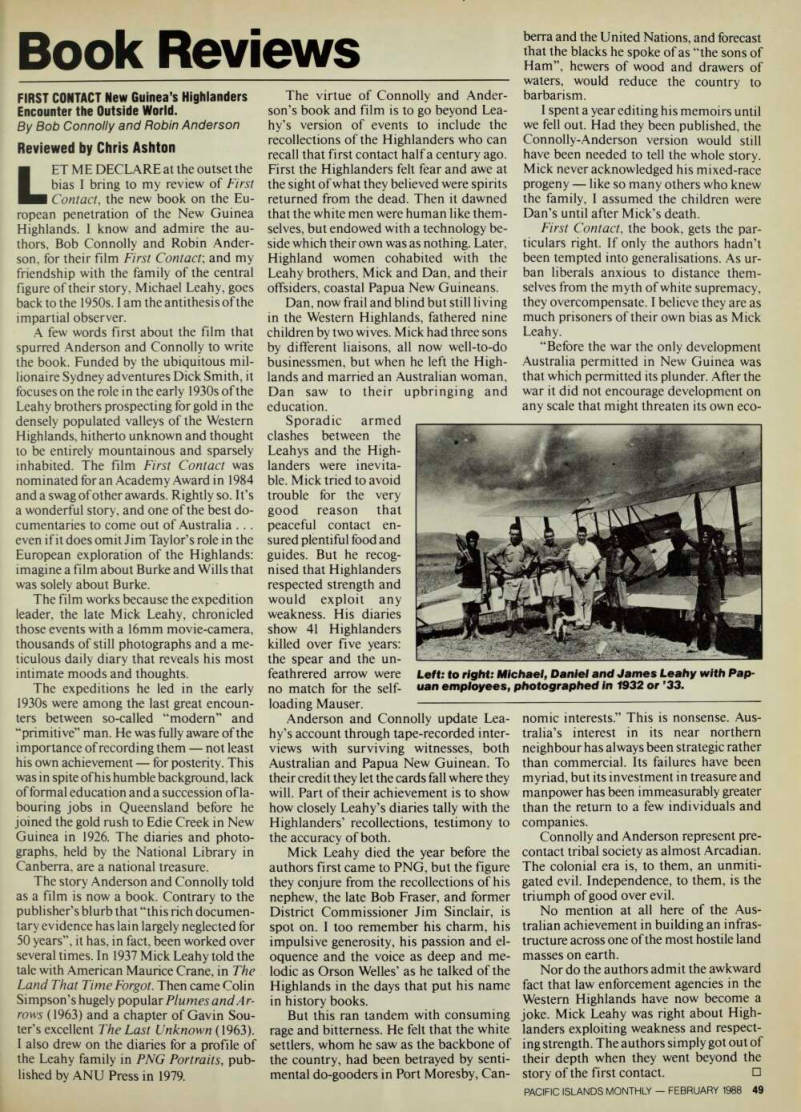
The film works because the expedition leader, the late Mick Leahy, chronicled those events with a 16mm movie-camera, thousands of still photographs and a me ticulous daily diary that reveals his most intimate moods and thoughts.
The expeditions he led in the early 1930 s were among the last great encoun ters between so-called “modem” and “primitive” man. He was fully aware of the importance of recording them not least his own achievement for posterity. This was in spite of his humble background, lack of formal education and a succession of la bouring jobs in Queensland before he joined the gold rush to Edie Creek in New Guinea in 1926. The diaries and photo graphs, held by the National Library in Canberra, are a national treasure.
The story Anderson and Connolly told as a film is now a book. Contrary to the publisher’s blurb that “this rich documen tary evidence has lain largely neglected for 50 years”, it has, in fact, been worked over several times. In 1937 Mick Leahy told the tale with American Maurice Crane, in The Land That Time Forgot. Then came Colin Simpson’s hugely popular Plumes and Ar rows (1963) and a chapter of Gavin Sou ter’s excellent The Last Unknown (1963).
I also drew on the diaries for a profile of the Leahy family in PNG Portraits, pub lished by ANU Press in 1979.
The virtue of Connolly and Ander son’s book and film is to go beyond Lea hy’s version of events to include the recollections of the Highlanders who can recall that first contact half a century ago.
First the Highlanders felt fear and awe at the sight of what they believed were spirits returned from the dead. Then it dawned that the white men were human like them selves, but endowed with a technology be side which their own was as nothing. Later, Highland women cohabited with the Leahy brothers, Mick and Dan, and their oflfsiders, coastal Papua New Guineans.
Dan, now frail and blind but still living in the Western Highlands, fathered nine children by two wives. Mick had three sons by different liaisons, all now well-to-do businessmen, but when he left the High lands and married an Australian woman, Dan saw to their upbringing and education.
Sporadic armed clashes between the Leahys and the High landers were inevita ble. Mick tried to avoid trouble for the very good reason that peaceful contact en sured plentiful food and guides. But he recog nised that Highlanders respected strength and would exploit any weakness. His diaries show 41 Highlanders killed over five years: the spear and the un feathrered arrow were no match for the self loading Mauser.
Anderson and Connolly update Lea hy’s account through tape-recorded inter views with surviving witnesses, both Australian and Papua New Guinean. To their credit they let the cards fall where they will. Part of their achievement is to show how closely Leahy’s diaries tally with the Highlanders’ recollections, testimony to the accuracy of both.
Mick Leahy died the year before the authors first came to PNG, but the figure they conjure from the recollections of his nephew, the late Bob Fraser, and former District Commissioner Jim Sinclair, is spot on. I too remember his charm, his impulsive generosity, his passion and el oquence and the voice as deep and me lodic as Orson Welles’ as he talked of the Highlands in the days that put his name in history books.
But this ran tandem with consuming rage and bitterness. He felt that the white settlers, whom he saw as the backbone of the country, had been betrayed by senti mental do-gooders in Port Moresby, Can
berra and the United Nations, and forecast that the blacks he spoke of as “the sons of Ham”, hewers of wood and drawers of waters, would reduce the country to barbarism.
I spent a year editing his memoirs until we fell out. Had they been published, the Connolly-Anderson version would still have been needed to tell the whole story.
Mick never acknowledged his mixed-race progeny like so many others who knew the family, I assumed the children were Dan’s until after Mick’s death.
First Contact , the book, gets the par ticulars right. If only the authors hadn’t been tempted into generalisations. As ur ban liberals anxious to distance them selves from the myth of white supremacy, they overcompensate. I believe they are as much prisoners of their own bias as Mick Leahy.
“Before the war the only development Australia permitted in New Guinea was that which permitted its plunder. After the war it did not encourage development on any scale that might threaten its own eco-
nomic interests.” This is nonsense. Aus tralia’s interest in its near northern neighbour has always been strategic rather than commercial. Its failures have been myriad, but its investment in treasure and manpower has been immeasurably greater than the return to a few individuals and companies.
Connolly and Anderson represent pre contact tribal society as almost Arcadian.
The colonial era is, to them, an unmiti gated evil. Independence, to them, is the triumph of good over evil.
No mention at all here of the Aus tralian achievement in building an infras tructure across one of the most hostile land masses on earth.
Nor do the authors admit the awkward fact that law enforcement agencies in the Western Highlands have now become a joke. Mick Leahy was right about High landers exploiting weakness and respect ing strength. The authors simply got out of their depth when they went beyond the story of the first contact. □
Left; to right: Michael, Daniel and James Leahy with Pap uan employees, photographed in 1932 or ’33.