Japan’s Business Invasion
pp. 32-33 · Read in the full issue
Forum
Tony Siaguru, leader of PNG’s League for National Advancement, has a warning for those who welcome Japan’s burgeoning Pacific presence
AT FIRST glance there appears to be a psychological element of some dimension in Pacific islands’ atti tudes to Japan: a mixture of fear, doubt regarding Japan’s trustworthiness, resent ment of Japanese expressions of cultural superiority and economic exploitation, and apprehension of Japanese economic imperialism. The conflict inspires reflec tion as a result of the repeated assurances of Japanese concern for our wellbeing and the benefits of mutual co-operation that pervade the speeches of Japanese official dignitaries who tour the region. Japanese altruism is invariably the keynote of all such addresses.
Are the Japanese still sensitive about the effects of their military expansion in
lie 1930 s and ’4os? Apart from China, whose oc togenarian leadership has not forgotten or forgiven Japan’s mil itary incursions, most countries in the region harbour little resent ment toward the Japa nese for their military past, and this must be apparent to the Japanese themselves. Indeed, the new generation of lead ership appearing in Ja pan is understandably
much less conscious of the war years.
My own considered belief, based on my observations and experiences as a citizen of a developing Pacific nation, is that the message of Japanese altruism is not a function of some psychological commit ment, but part of a balancing act per formed by the Japanese Foreign Ministry.
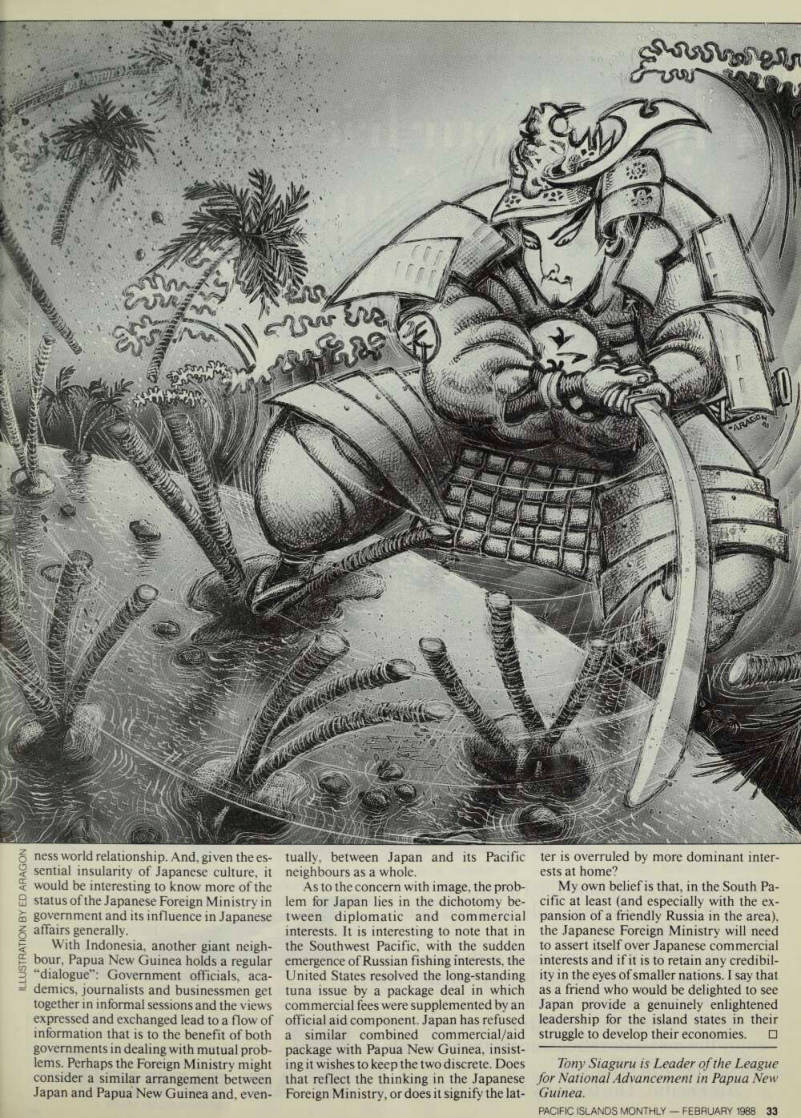
The model of altruism presented by Jap anese officials is in marked contrast to the aggressively self-seeking approach of Jap anese industrial and commercial interests.
One of the most telling examples of this contrast is an advertisement in Time mag azine a few years ago. It proclaimed the su periority of a particular Japanese conglomerate in the international market place ... and depicted a Tyrannosaurus rex dinosaur savagely attacking a brows ing brontosaurus. It is certainly hard to forget that image when Japanese dignitar ies speak of mutual interests and under
standing. And the practice of many Japanese commercial interests in Papua New Guinea and other small Pacific countries brings the image very much to life: believe it or not, less than 20 years ago, one giant Japanese conglomerate was ac tually trying to buy Papua New Guinea from Australia, while another sought to lease the country for 50 years in order to “develop” it.
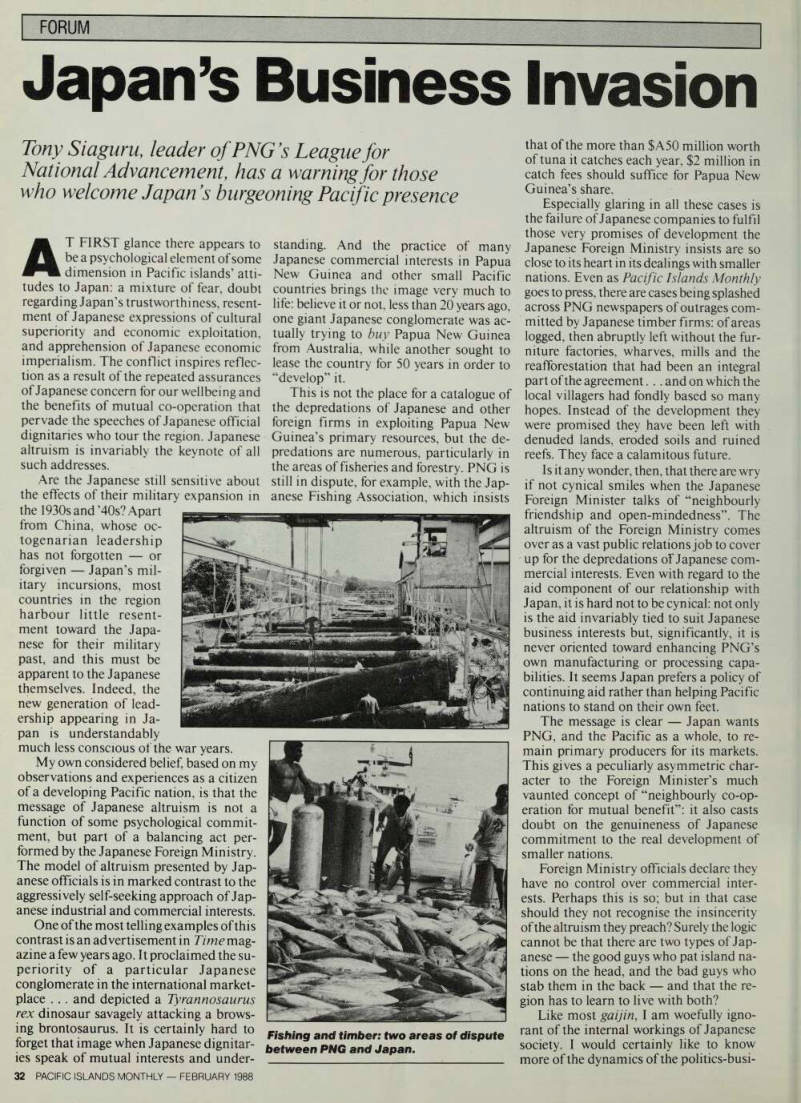
This is not the place for a catalogue of the depredations of Japanese and other foreign firms in exploiting Papua New Guinea’s primary resources, but the de predations are numerous, particularly in the areas of fisheries and forestry. PNG is still in dispute, for example, with the Jap anese Fishing Association, which insists
that of the more than SASO million worth of tuna it catches each year, $2 million in catch fees should suffice for Papua New Guinea’s share.
Especially glaring in all these cases is the failure of Japanese companies to fulfil those very promises of development the Japanese Foreign Ministry insists are so close to its heart in its dealings with smaller nations. Even as Pacific Islands Monthly goes to press, there are cases being splashed across PNG newspapers of outrages com mitted by Japanese timber firms: of areas logged, then abruptly left without the fur niture factories, wharves, mills and the reafforestation that had been an integral part of the agreement... and on which the local villagers had fondly based so many hopes. Instead of the development they were promised they have been left with denuded lands, eroded soils and ruined reefs. They face a calamitous future.
Is it any wonder, then, that there are wry if not cynical smiles when the Japanese Foreign Minister talks of “neighbourly friendship and open-mindedness”. The altruism of the Foreign Ministry comes over as a vast public relations job to cover up for the depredations of Japanese com mercial interests. Even with regard to the aid component of our relationship with Japan, it is hard not to be cynical: not only is the aid invariably tied to suit Japanese business interests but, significantly, it is never oriented toward enhancing PNG’s own manufacturing or processing capa bilities. It seems Japan prefers a policy of continuing aid rather than helping Pacific nations to stand on their own feet.
The message is clear Japan wants PNG, and the Pacific as a whole, to re main primary producers for its markets.
This gives a peculiarly asymmetric char acter to the Foreign Minister’s much vaunted concept of “neighbourly co-op eration for mutual benefit”: it also casts doubt on the genuineness of Japanese commitment to the real development of smaller nations.
Foreign Ministry officials declare they have no control over commercial inter ests. Perhaps this is so; but in that case should they not recognise the insincerity of the altruism they preach? Surely the logic cannot be that there are two types of Jap anese the good guys who pat island na tions on the head, and the bad guys who stab them in the back and that the re gion has to learn to live with both?
Like most gaijin, I am woefully igno rant of the internal workings of Japanese society. I would certainly like to know more of the dynamics of the politics-busi-
Fishing and timber: two areas of dispute between PNG and Japan.
ness world relationship. And, given the es sential insularity of Japanese culture, it would be interesting to know more of the status of the Japanese Foreign Ministry in government and its influence in Japanese affairs generally.
With Indonesia, another giant neigh bour, Papua New Guinea holds a regular “dialogue”: Government officials, aca demics, journalists and businessmen get together in informal sessions and the views expressed and exchanged lead to a flow of information that is to the benefit of both governments in dealing with mutual prob lems. Perhaps the Foreign Ministry might consider a similar arrangement between Japan and Papua New Guinea and, even
tually, between Japan and its Pacific neighbours as a whole.
As to the concern with image, the prob lem for Japan lies in the dichotomy be tween diplomatic and commercial interests. It is interesting to note that in the Southwest Pacific, with the sudden emergence of Russian fishing interests, the United States resolved the long-standing tuna issue by a package deal in which commercial fees were supplemented by an official aid component. Japan has refused a similar combined commercial/aid package with Papua New Guinea, insist ing it wishes to keep the two discrete. Does that reflect the thinking in the Japanese Foreign Ministry, or does it signify the lat
ter is overruled by more dominant inter ests at home?
My own belief is that, in the South Pa cific at least (and especially with the ex pansion of a friendly Russia in the area), the Japanese Foreign Ministry will need to assert itself over Japanese commercial interests and if it is to retain any credibil ity in the eyes of smaller nations. I say that as a friend who would be delighted to see Japan provide a genuinely enlightened leadership for the island states in their struggle to develop their economies. □
Tony Siaguru is Leader of the League for National Advancement in Papua New Guinea.