How Tanna’s Water Flowed Again
p. 47 · Read in the full issue
Vanuatu
Cyclone Uma cut Vanuatu’s water supply. Billy Williams tells how it was restored
IN TROPICAL Vanuatu it’s hard to imagine that fresh water could ever be in short supply. And especially so in the aftermath of cyclone Uma, which dumped nearly three metres of rain on the island of Tanna during a 24-hour period in Febru ary, 1987.
Such a volume of rain, the most in re corded history on the island, caused mas sive earth slippages with millions of tonnes of soil being washed away from the moun tains and hillsides to the beaches below.
Huge trees more than 300 hundred years old were washed away in an avalanche of timber and earth that took everything in its path. Whole villages along with their vegetable gardens and fruit trees were wiped out as the full force of the cyclone was unleashed on this small island of 17,000 people.
One of the main cas ualties of the cyclone was the island’s rural water supply system, which provides the villages with fresh potable water on a gravity-fed principle from natural mountain springs. Thousands of metres of polythene water pipe were ripped out of the ground and smashed.
Land slippage wreaked its toll. What was once a small creek is now a large one, and what was once a large creek is
now a massive ravine. On some parts of Tanna, the only soil remaining is on the tops of ridges.
Australia has been a major contributor to the establishment of rural water sup plies in Vanuatu through funding by the Australian International Development Assistance Bureau (AIDAB) from the in ception of the program in 1975. Since 1979, under the Australian Defence Co-opera tion Program, the Army has provided technical skills in the form of engineers, plumbers and drillers to assist the local authorities install the water supply. Three officers from the Royal Australian Engi neers are now stationed in Vanuatu.
Within a few days of the cyclone pass ing, Rural Water Engineer Captain Alan Sheridan flew from his base in Vila to in spect the damage on Tanna and other smaller islands. Sheridan walked the length of four water supply systems on Tanna to gauge the extent of the damage so a reconstruction proposal could be put
to the international com munity for the supply of new materials.
“The amount of land slippage was almost un believable in its magni tude and the size of some ravines meant the pipes would have to be sus pended by steel wire
ropes,” Sheridan said.
An urgent response was required be cause of the health risk associated with in adequate and polluted surface water supplies. Within two weeks of the cyclone, Captain Sheridan and the Rural Water Supply Section in Vila had prepared a de tailed report of the damage to the rural water supplies, for inclusion in Vanuatu’s cyclone reconstruction program.
“We estimated that the cost to restore the water supply system in the affected areas would be somewhere around SA 1.25 million, which represents 25 to 30 per cent of the initial capital cost,” Captain Sheri dan said.
The international community made a quick and positive response to the recon struction program. Australia provided $2.7 million last financial year and has agreed to commit an additional $4 million over the next three years toward the reconstruc tion program. Other countries making a contribution are New Zealand, the UK,
Japan, the European Community and the United States.
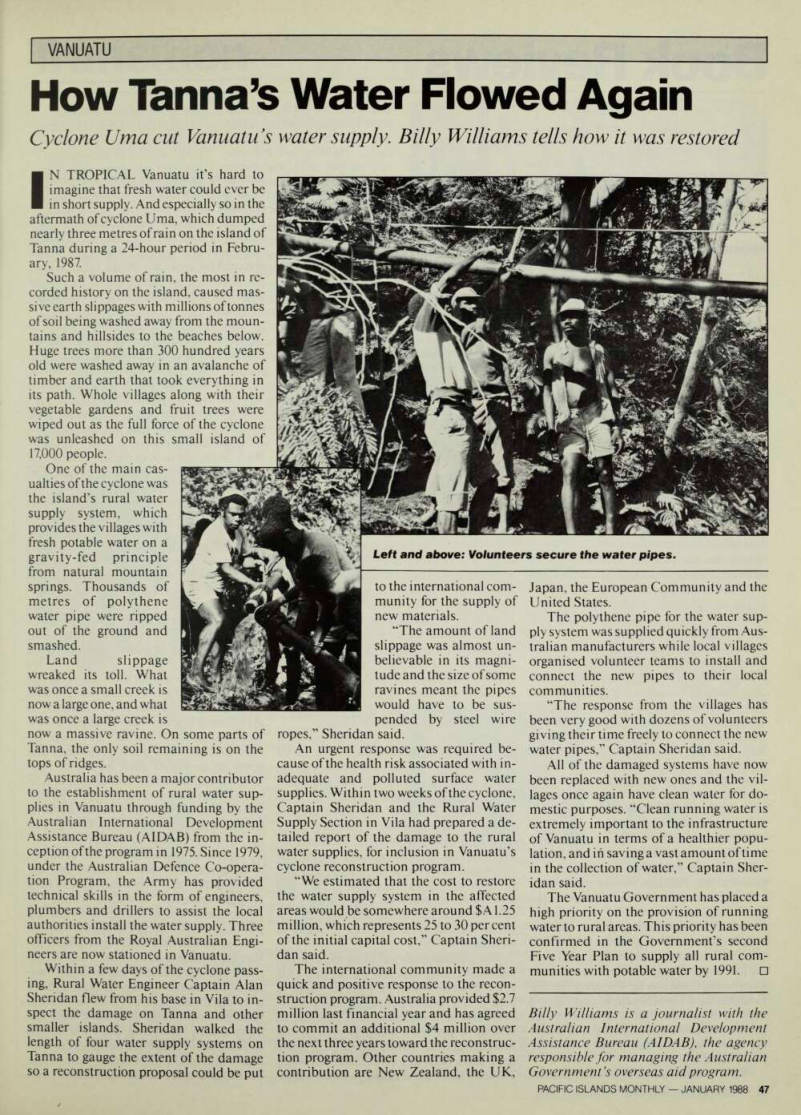
The polythene pipe for the water sup ply system was supplied quickly from Aus tralian manufacturers while local villages organised volunteer teams to install and connect the new pipes to their local communities.
“The response from the villages has been very good with dozens of volunteers giving their time freely to connect the new water pipes,” Captain Sheridan said.
All of the damaged systems have now been replaced with new ones and the vil lages once again have clean water for do mestic purposes. “Clean running water is extremely important to the infrastructure of Vanuatu in terms of a healthier popu lation, and in saving a vast amount of time in the collection of water,” Captain Sher idan said.
The Vanuatu Government has placed a high priority on the provision of running water to rural areas. This priority has been confirmed in the Government’s second Five Year Plan to supply all rural com munities with potable water by 1991. □
Billy Williams is a journalist with the Australian International Development Assistance Bureau (AIDAB), the agency responsible for managing the Australian Government’s overseas aid program.
Left and above: Volunteers secure the water pipes.