Skin-Diving For Submarines
pp. 44-45 · Read in the full issue
Travel
Skin-Diving For Submarines Off Papua New Guinea
It ’sthe perfect tropical adventure, going down for a fish-eye view of sunken World War II ships and planes in the calm, clear waters of Papua New Guinea. Story by Glen Roach
PROMOTED as “Adventure Coun try”, Papua New Guinea offers dramatic landforms that range from coral atolls to snow-capped mountains, the Sepik and Fly Rivers, active volcanoes and hot springs, geysers and boiling mud.
The increasing number of tourists dis covering its unusual attractions are also coming to know what the world’s divers have known for years Papua New Guinea has some of the best diving in the Pacific. Crystal water, teeming marine life, safe conditions, modern facilities and the most accessible World War II wrecks anywhere add up to an underwater enthu siast’s idea of heaven.
Two of the country’s most experienced divers. Bob and Dinah Halstead, who op erate Tropical Diving Adventures in Port Moresby, last year made a discovery the diving fraternity dreams about... a pre viously untouched wreck.
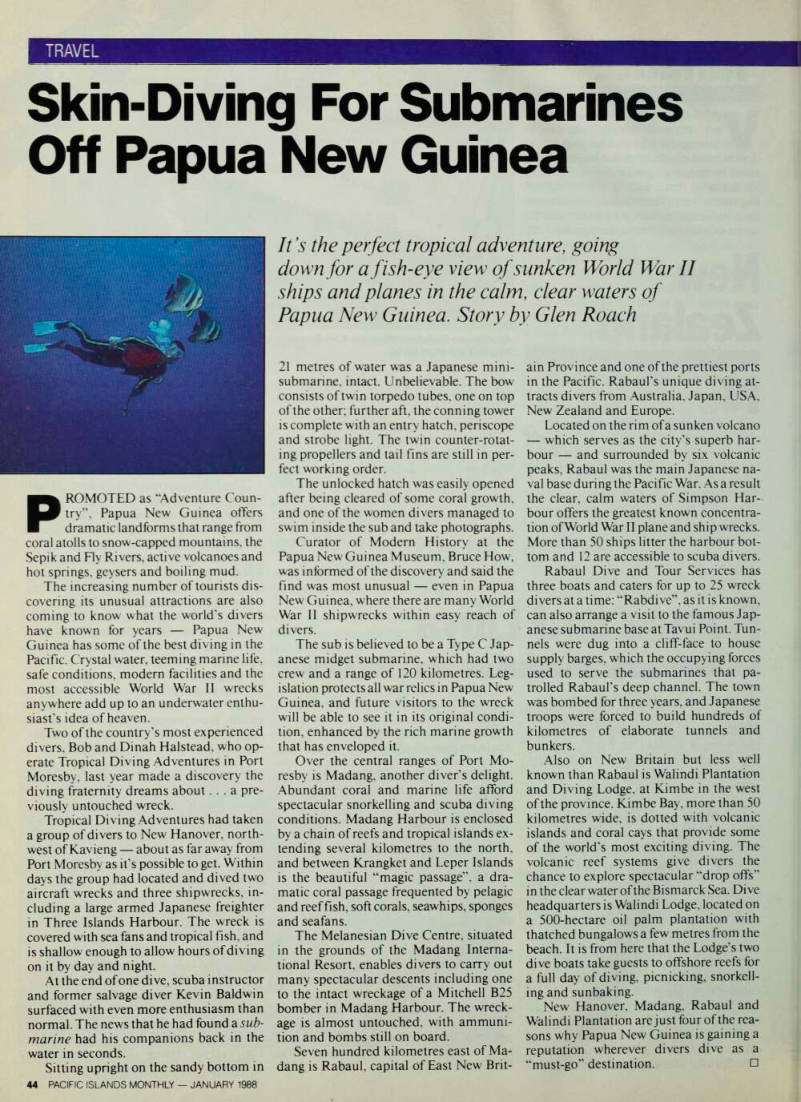
Tropical Diving Adventures had taken a group of divers to New Hanover, north west of Kavieng about as far away from Port Moresby as it’s possible to get. Within days the group had located and dived two aircraft wrecks and three shipwrecks, in cluding a large armed Japanese freighter in Three Islands Harbour. The wreck is covered with sea fans and tropical fish, and is shallow enough to allow hours of diving on it by day and night.
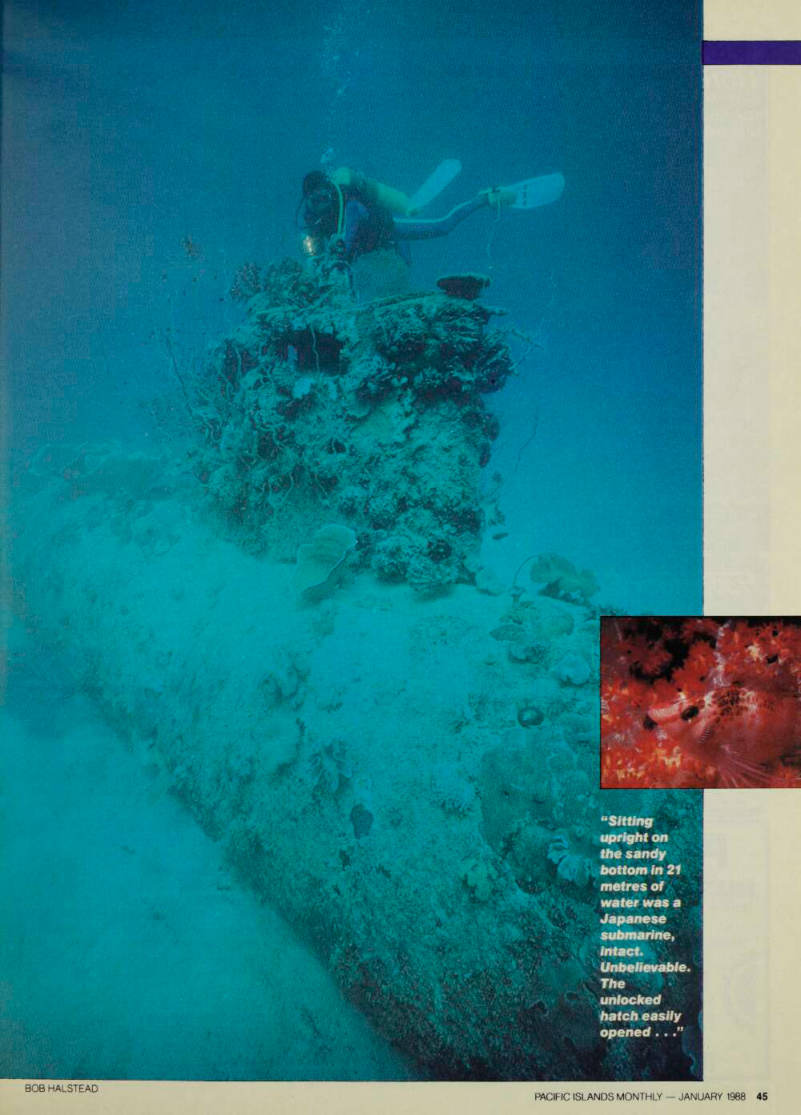
At the end of one dive, scuba instructor and former salvage diver Kevin Baldwin surfaced with even more enthusiasm than normal. The news that he had found a sub marine had his companions back in the water in seconds.
Sitting upright on the sandy bottom in
21 metres of water was a Japanese mini submarine, intact. Unbelievable. The bow consists of twin torpedo tubes, one on top of the other; further aft, the conning tower is complete with an entry hatch, periscope and strobe light. The twin counter-rotat ing propellers and tail fins are still in per fect working order.
The unlocked hatch was easily opened after being cleared of some coral growth, and one of the women divers managed to swim inside the sub and take photographs.
Curator of Modern History at the Papua New Guinea Museum, Bruce How, was informed of the discovery and said the find was most unusual even in Papua New Guinea, where there are many World War II shipwrecks within easy reach of divers.
The sub is believed to be a Type C Jap anese midget submarine, which had two crew and a range of 120 kilometres. Leg islation protects all war relics in Papua New Guinea, and future visitors to the wreck will be able to see it in its original condi tion, enhanced by the rich marine growth that has enveloped it.
Over the central ranges of Port Mo resby is Madang, another diver’s delight.
Abundant coral and marine life afford spectacular snorkelling and scuba diving conditions. Madang Harbour is enclosed by a chain of reefs and tropical islands ex tending several kilometres to the north, and between Krangket and Leper Islands is the beautiful “magic passage”, a dra matic coral passage frequented by pelagic and reef fish, soft corals, seawhips, sponges and seafans.
The Melanesian Dive Centre, situated in the grounds of the Madang Interna tional Resort, enables divers to carry out many spectacular descents including one to the intact wreckage of a Mitchell 825 bomber in Madang Harbour. The wreck age is almost untouched, with ammuni tion and bombs still on board.
Seven hundred kilometres east of Ma dang is Rabaul, capital of East New Brit
ain Province and one of the prettiest ports in the Pacific. Rabaul’s unique diving at tracts divers from Australia, Japan, USA, New Zealand and Europe.
Located on the rim of a sunken volcano which serves as the city’s superb har bour and surrounded by six volcanic peaks, Rabaul was the main Japanese na val base during the Pacific War. As a result the clear, calm waters of Simpson Har bour offers the greatest known concentra tion of World War II plane and ship wrecks.
More than 50 ships litter the harbour bot tom and 12 are accessible to scuba divers.
Rabaul Dive and Tour Services has three boats and caters for up to 25 wreck divers at a time: “Rabdive”, as it is known, can also arrange a visit to the famous Jap anese submarine base at Tavui Point. Tun nels were dug into a cliff-face to house supply barges, which the occupying forces used to serve the submarines that pa trolled Rabaul’s deep channel. The town was bombed for three years, and Japanese troops were forced to build hundreds of kilometres of elaborate tunnels and bunkers.
Also on New Britain but less well known than Rabaul is Walindi Plantation and Diving Lodge, at Kimbe in the west of the province. Kimbe Bay, more than 50 kilometres wide, is dotted with volcanic islands and coral cays that provide some of the world’s most exciting diving. The volcanic reef systems give divers the chance to explore spectacular “drop offs” in the clear water of the Bismarck Sea. Dive headquarters is Walindi Lodge, located on a 500-hectare oil palm plantation with thatched bungalows a few metres from the beach. It is from here that the Lodge’s two dive boats take guests to offshore reefs for a full day of diving, picnicking, snorkell ing and sunbaking.
New Hanover, Madang, Rabaul and Walindi Plantation are just four of the rea sons why Papua New Guinea is gaining a reputation wherever divers dive as a “must-go” destination. □
“Sitting upright on the sandy bottom in 21 metres of water was a Japanese submarine , intact.
Unbelievable.
The unlocked hatch easily opened . . ."