The Superpowers
pp. 38-40 · Read in the full issue
THE growing Soviet naval presence and the projection of that power into the South and Southwest Pacific af forded by the base at Cam Ranh Bay in Vietnam must be seen as a challenge to what has long been an American military influence. The Soviet military presence has been backed by a matching trade and diplomatic offensive aimed at extending the USSR’s influence in the region.
Soviet fishing agreements have been concluded with Kiribati and Vanuatu and approaches have been made to Fiji, Tonga and Papua New Guinea. These are de fended by the Soviets as legitimate trade offers but are seen by some as efforts to ex tend political and, eventually, military influence.
Moscow has further muddied the waters by supporting the Lange Govern ment’s anti-nuclear stand and by acceding to the South Pacific Forum’s calls for a South Pacific Nuclear Free Zone at the propaganda expense of the United States albeit under careful caveats. It has also expressed its support for New Caledonia independence.
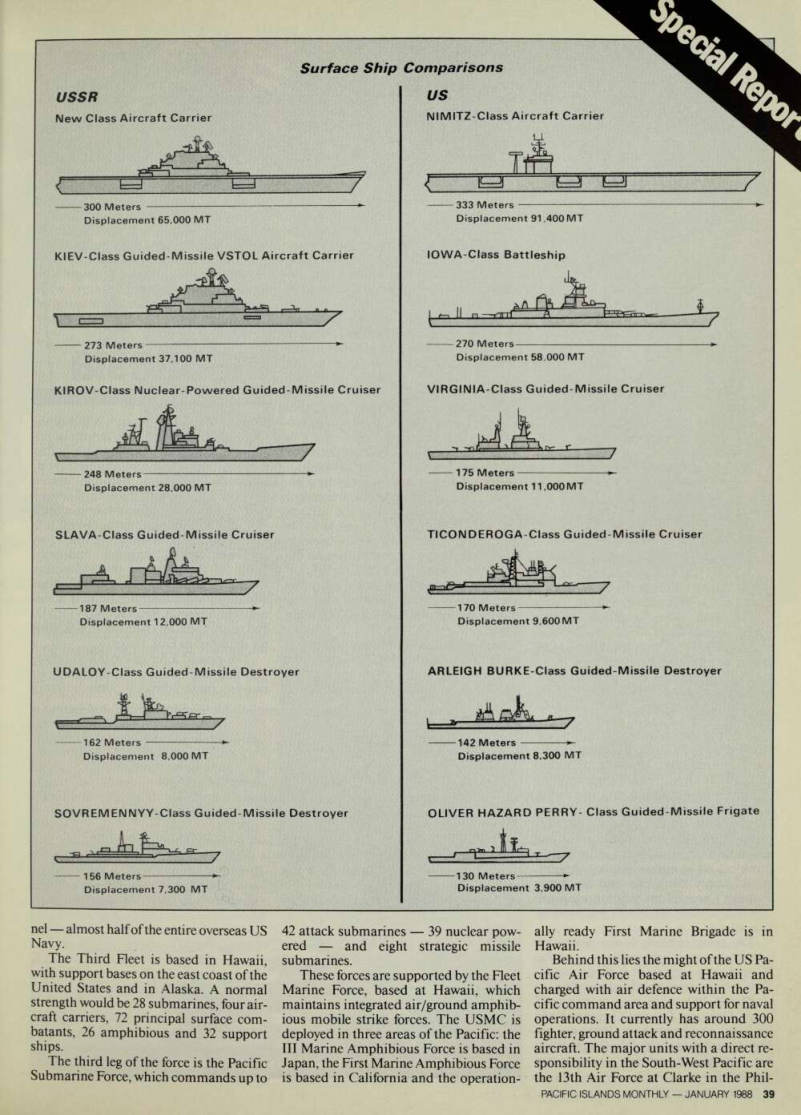
The Soviet Pacific military capability is awesome, and has grown dramatically over the past decade. The Far Eastern “Red Flag” Fleet is now the largest of the four
includes patrol combatants, amphibious warfare craft, coastal patrol/river-roadstead craft, underway replenishment ships, material support ships, fleet support ships, and other auxiliaries. 2 Not available. Approximate. 4 Excludes Strategic Defense Interceptors.
fleets: The Pacific Ocean Theatre of Military Operations (TVD) consisted in 1986 of more than 80 surface combat vessels, 32 ballistic missile submarines and 90 attack submarines (almost all nuclear-powered), supported by 500 naval aircraft, one naval infantry division and around 7000 troops and special forces units.
Since November, 1985, three new prin-
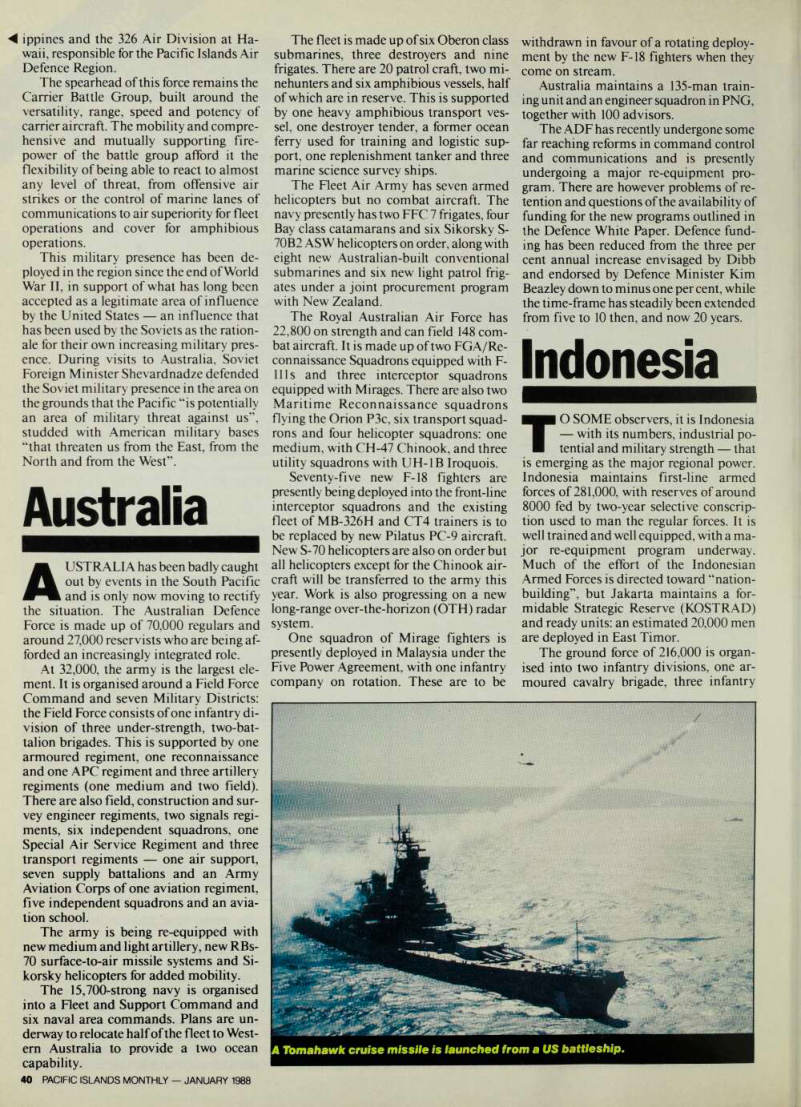
cipal surface combatants have been trans ferred to the Pacific Ocean Fleet: Kirov Class nuclear-powered guided missile cruisers, Sovremenny Class guided mis sile destroyers and Udaloy Class destroy ers. Western military analysts believe that as many as two Kirov cruisers, five So vremenny and four Udaloys may eventu ally be assigned to the fleet.
According to senior American sources, the size, lethal potential, mobility, range and diversity of these forces are aimed at the intimidation of weaker countries and the realisation of strategic aims in the Pa cific. These forces, they warn, are now ca pable of threatening the interests and values of states from Burma to Japan and Australia.
This assessment was endorsed in Au gust, 1987, when Australian Foreign Min ister Bill Hayden claimed he had no doubt the Soviet Union “aspired to drive out the US presence and influence in the region militarily in the first instance in or der to reap the security, political and eco nomic benefits its own proximity and military predominance might then be ex pected to bring”.
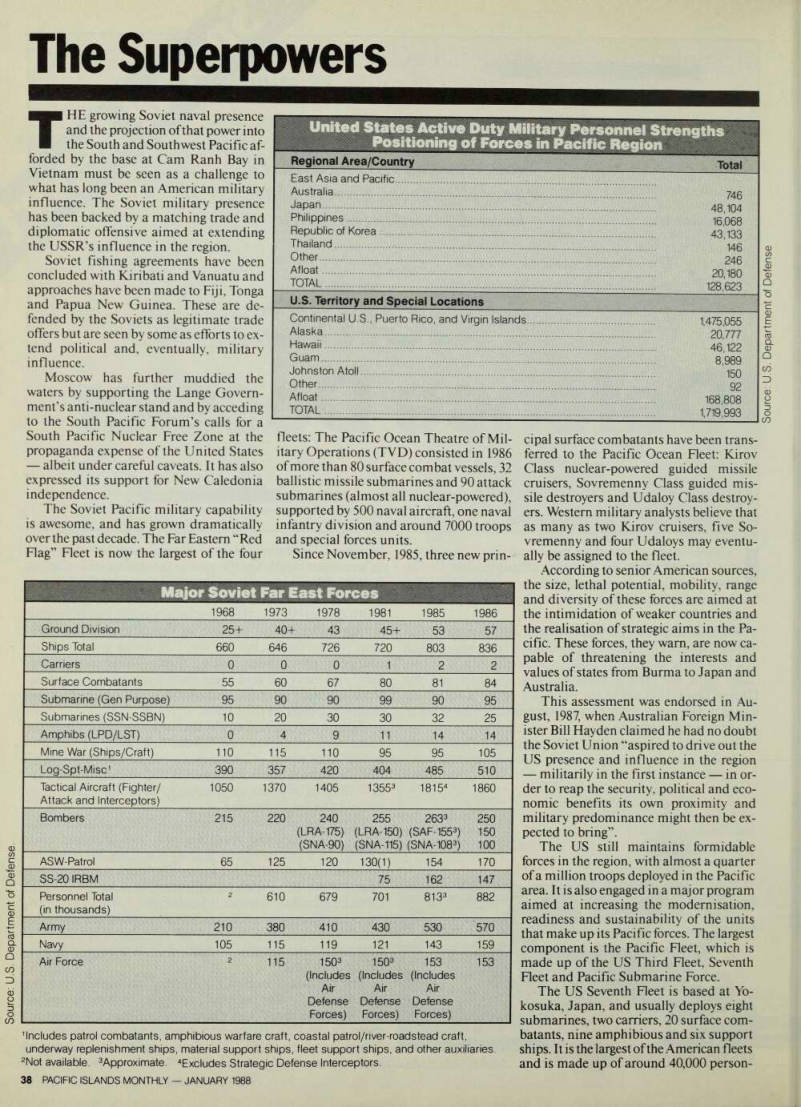
The US still maintains formidable forces in the region, with almost a quarter of a million troops deployed in the Pacific area. It is also engaged in a major program aimed at increasing the modernisation, readiness and sustainability of the units that make up its Pacific forces. The largest component is the Pacific Fleet, which is made up of the US Third Fleet, Seventh Fleet and Pacific Submarine Force.
The US Seventh Fleet is based at Yo kosuka, Japan, and usually deploys eight submarines, two carriers, 20 surface com batants, nine amphibious and six support ships. It is the largest of the American fleets and is made up of around 40,000 person-
Source: U.S. Department of Defense.
Source: U.S. Department of Defense
United States Active Duty Military Personnel Strengths Positioning of Forces in Pacific Region Regional Area/Country Total East Asia and Pacific 1 Australia jar Japan Philippines Republic of Korea Thailand 48,104 16,068 43.133 Afloat on iftn
Total
128.623 U.S. Territory and Special Locations Continental U.S., Puerto Rico, and Virgin Islands Alaska 1,475,055 20 777 Hawaii 46 122 Guam 8 989 Johnston Atoll Other 150 92 Afloat
Total
168,808 1,719,993
I Major Soviet Far East Forces 1968 1973 1978 1981 1985 1986 Ground Division 25+ 40+ 43 45+ 53 57 Ships Total 660 646 726 720 803 836 Carriers 0 0 0 1 2 2 Surface Combatants 55 60 67 80 81 84 Submarine (Gen Purpose) 95 90 90 99 90 95 Submarines (SSN-SSBN) 10 20 30 30 32 25 Amphibs (LPD/LST) 0 4 9 11 14 14 Mine War (Ships/Craft) 110 115 110 95 95 105 Log-Spt-Misc 1 390 357 420 404 485 510 Tactical Aircraft (Fighter/ Attack and Interceptors) 1050 1370 1405 1355 3 1815 4 1860 Bombers 215 220 240
(Lra-175)
(Sna-90)
255 263 3
(Lra-150) (Saf-155 3 )
(Sna-115) (Sna-108 3 )
250 150 100 ASW-Patrol 65 125 120 130(1) 154 170
Ss-20 Irbm
75 162 147 Personnel Total (in thousands) 2 610 679 701 813 3 882 Army 210 380 410 430 530 570 Navy 105 115 119 121 143 159 Air Force 2 115 150 3 (Includes Air Defense Forces) 150 3 (Includes Air Defense Forces) 153 (Includes Air Defense Forces) 153
nel almost half of the entire overseas US Navy.
The Third Fleet is based in Hawaii, with support bases on the east coast of the United States and in Alaska. A normal strength would be 28 submarines, four air craft carriers, 72 principal surface com batants, 26 amphibious and 32 support ships.
The third leg of the force is the Pacific Submarine Force, which commands up to
-42 attack submarines 39 nuclear pow ered and eight strategic missile submarines.
These forces are supported by the Fleet Marine Force, based at Hawaii, which maintains integrated air/ground amphib ious mobile strike forces. The USMC is deployed in three areas of the Pacific: the 111 Marine Amphibious Force is based in Japan, the First Marine Amphibious Force is based in California and the operation
ally ready First Marine Brigade is in Hawaii.
Behind this lies the might of the US Pa cific Air Force based at Hawaii and charged with air defence within the Pa cific command area and support for naval operations. It currently has around 300 fighter, ground attack and reconnaissance aircraft. The major units with a direct re sponsibility in the South-West Pacific are the 13th Air Force at Clarke in the Phil-
M ippines and the 326 Air Division at Ha waii, responsible for the Pacific Islands Air Defence Region.
The spearhead of this force remains the Carrier Battle Group, built around the versatility, range, speed and potency of carrier aircraft. The mobility and compre hensive and mutually supporting fire power of the battle group afford it the flexibility of being able to react to almost any level of threat, from offensive air strikes or the control of marine lanes of communications to air superiority for fleet operations and cover for amphibious operations.
This military presence has been de ployed in the region since the end of World War II, in support of what has long been accepted as a legitimate area of influence by the United States — an influence that has been used by the Soviets as the ration ale for their own increasing military pres ence. During visits to Australia, Soviet Foreign Minister Shevardnadze defended the Soviet military presence in the area on the grounds that the Pacific “is potentially an area of military threat against us”, studded with American military bases “that threaten us from the East, from the North and from the West”.