Practical Visionary
pp. 32-36 · Read in the full issue

Papua New Guinea
Paias Wingti Practical Visionary
The Prime Minister of Papua New Guinea is the Pacific’s man of destiny, facing momentous challenges with intelligence, energy and self-confidence. In an exclusive interview with Pacific Islands Monthly editor Larry Writer, he speaks out on his rural development revolution, the machinations of holding office, law and order, foreign policy, the Diro scandal, and more.
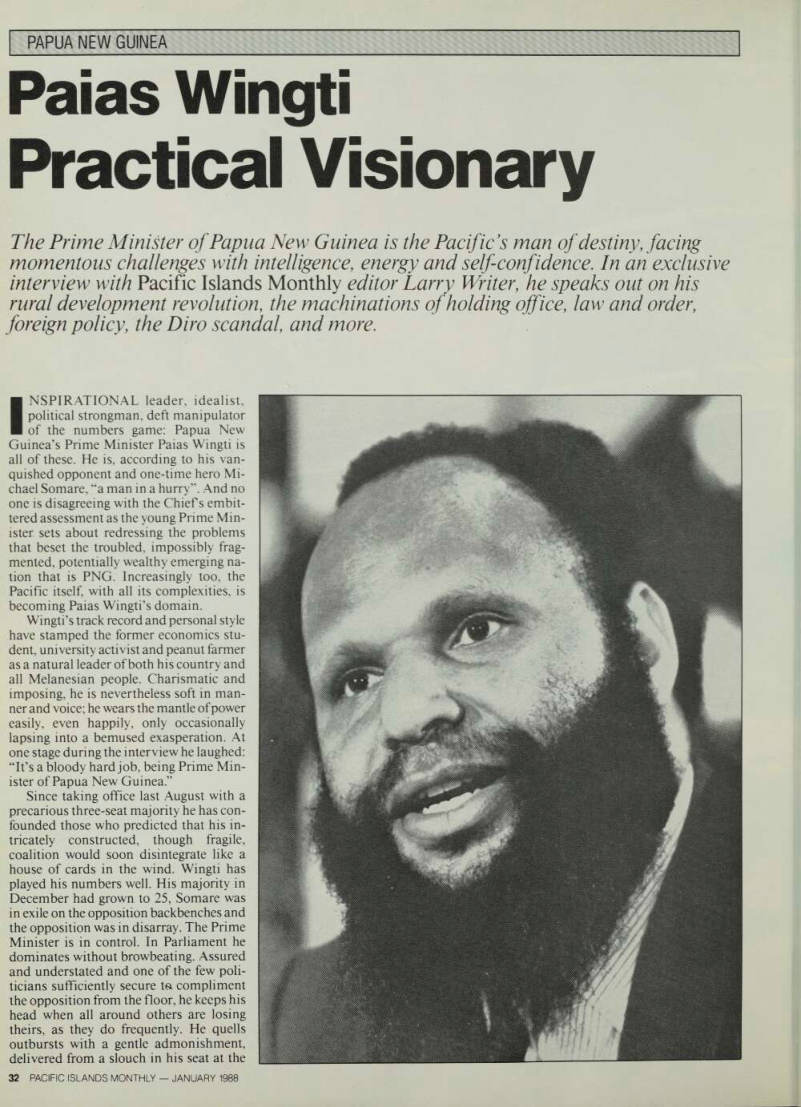
INSPIRATIONAL leader, idealist, political strongman, deft manipulator of the numbers game: Papua New Guinea’s Prime Minister Paias Wingti is all of these. He is, according to his van quished opponent and one-time hero Mi chael Somare, “a man in a hurry”. And no one is disagreeing with the Chiefs embit tered assessment as the young Prime Min ister sets about redressing the problems that beset the troubled, impossibly frag mented, potentially wealthy emerging na tion that is PNG. Increasingly too, the Pacific itself, with all its complexities, is becoming Paias Wingti’s domain.
Wingti’s track record and personal style have stamped the former economics stu dent, university activist and peanut farmer as a natural leader of both his country and all Melanesian people. Charismatic and imposing, he is nevertheless soft in man ner and voice; he wears the mantle of power easily, even happily, only occasionally lapsing into a bemused exasperation. At one stage during the interview he laughed: “It’s a bloody hard job, being Prime Min ister of Papua New Guinea.”
Since taking office last August with a precarious three-seat majority he has con founded those who predicted that his in tricately constructed, though fragile, coalition would soon disintegrate like a house of cards in the wind. Wingti has played his numbers well. His majority in December had grown to 25, Somare was in exile on the opposition backbenches and the opposition was in disarray. The Prime Minister is in control. In Parliament he dominates without browbeating. Assured and understated and one of the few poli ticians sufficiently secure ta compliment the opposition from the floor, he keeps his head when all around others are losing theirs, as they do frequently. He quells outbursts with a gentle admonishment, delivered from a slouch in his seat at the
Speaker’s end of the Government frontbench.
Such self-possession is remarkable when the challenges that face him are counted: urban drift and unemployment; political scandal and instability; lawless ness; a disaffected media; and unprece dented complexities in the Pacific All these shape as a giant compound migraine for the 38-year-old leader. But Wingti is his country’s best hope for a solution. He is as secure as a PNG Prime Minister can be, is healthy, intelligent and has a driving en ergy for the task, working regular 18-hour days and perplexing his staff, which likes to try to pack him off as often as possible to his home province, the place he is able to unwind best.
AT the rambling bougainvillaea covered bungalow that is his offi cial residence in Boroko, near Port Moresby, the Prime Minister discussed his achievements and the challenges of office.
For the interview he was dressed in sports shirt, slacks and patterned socks. His father, a tiny white-haired and bearded replica of his son, introduced himself and gently hovered throughout the interview.
The furniture was simple, functional. An airconditioner rumbled nearby. A picture of the PM with Pope John Paul II was prominently displayed.
“I’ve tried to change our people’s thinking,” said Prime Minister Wingti when asked his major achievement since taking office. “I’ve let them see they have good reason to be confident about them selves, to achieve for themselves, and not to depend on the Government to do every thing for them.” Though the country had gained independence, he said, it could not be truly self-reliant until the people real ised they had a responsibility to contrib ute. “In a nation where most people cannot read and write and so many languages are spoken, this is not an easy concept to get across,” he said.
This advocating of self-reliance dove tails with Mr Wingti’s masterplan to de velop PNG’s rural sector and to create a viable agricultural base. For him, the key to prosperity is agricultural development.
In PNG, 87 per cent of people live in a ru ral area, many on arable land, but few have the knowledge or equipment to farm it. The Government has allocated funds from the Budget and poured taxes imposed on for eign mining companies into an agricul tural bank set up to lend money to village people wishing to involve themselves in agriculture. “All we ask of the recipient is that he wants to work and shows he is doing something for himself,” said the PM.
Every kina invested in agricultural devel opment, he said, had a multiple effect: providing employment; generating in come; earning foreign exchange for the country; and stemming urban migration.
It is fitting that his dream of a thriving farm economy is fuelled by taxes levied on
mining companies tapping the nation’s vast mineral wealth. At present, they pay a minimum of 36 per cent tax, which pays at least 40 per cent of PNG’s internal rev enue. Said Mr Wingti; “Mining is exhaus tible, so money earned from mining must be invested very carefully to benefit the country in the long term.” The Govern ment has set up a Mining Stabilisation Fund from which money is drawn and al-
Utopia anywhere” but feels his coun try’s wild and woolly reputation is unjus tified. He blames the foreign press, particularly, for highlighting a problem he claims is no greater than in other Pacific nations. “The outside media make you think our law and order situation is getting worse. In fact it’s getting better. We have to face it that from time to time there will be theft, murder, rape. But I’d like to see
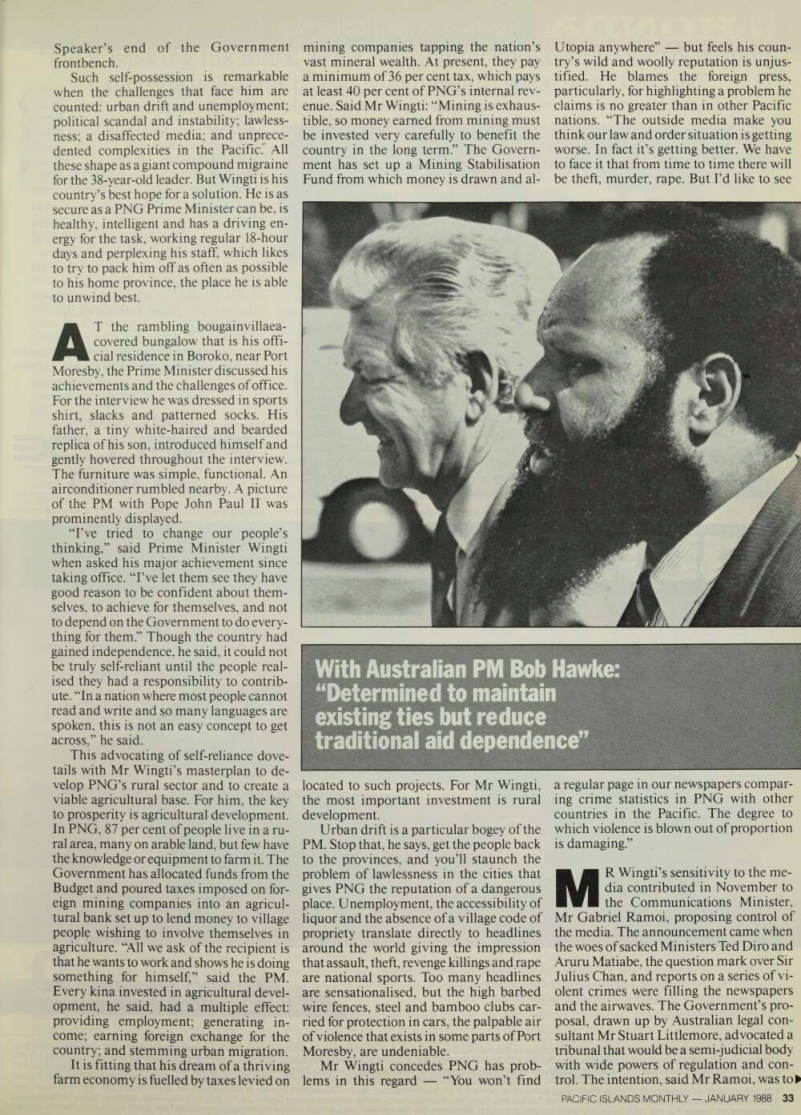
With Australian PM Bob Hawke: “Determined to maintain existing ties but reduce traditional aid dependence”
located to such projects. For Mr Wingti, the most important investment is rural development.
Urban drift is a particular bogey of the PM. Stop that, he says, get the people back to the provinces, and you’ll staunch the problem of lawlessness in the cities that gives PNG the reputation of a dangerous place. Unemployment, the accessibility of liquor and the absence of a village code of propriety translate directly to headlines around the world giving the impression that assault, theft, revenge killings and rape are national sports. Too many headlines are sensationalised, but the high barbed wire fences, steel and bamboo clubs car ried for protection in cars, the palpable air of violence that exists in some parts of Port Moresby, are undeniable.
Mr Wingti concedes PNG has prob lems in this regard “You won’t find
a regular page in our newspapers compar ing crime statistics in PNG with other countries in the Pacific. The degree to which violence is blown out of proportion is damaging.”
MR Wingti’s sensitivity to the me dia contributed in November to the Communications Minister, Mr Gabriel Ramoi, proposing control of the media. The announcement came when the woes of sacked Ministers Ted Diro and Arum Matiabe, the question mark over Sir Julius Chan, and reports on a series of vi olent crimes were filling the newspapers and the airwaves. The Government’s pro posal, drawn up by Australian legal con sultant Mr Stuart Littlemore, advocated a tribunal that would be a semi-judicial body with wide powers of regulation and con trol. The intention, said Mr Ramoi, was toP
“He is making his mark as an influential spokesman for the region and guiding light of the Melanesian Spearhead Group”
the media “sensitive to PNG’s na tional mood” and answerable to the people. The media responded angrily.
“This is the sort of legislation you would expect to find under a dictatorship, and not in a democratic country like PNG,” said Papua New Guinea Post Courier general manager, Mr Don Kennedy.
Nevertheless Mr Wingti plans to press on with the controls. “There has been an over-reaction from the press and a lack of understanding of our aims by the private sector.” Everybody loudly opposing the plan, he says is, was doing so without ever discussing with him ways of working to gether. “Our aim was to involve the me dia, the church, the unions and the opposition members of parliament in dis cussions about the legislation. I hope we still can.”
Paias Wingti is more comfortable with the ordinary people than the highflyers of the private sector: “I’m still not sure what they (business leaders) think of me but I’d like to sit down with them soon and ex change ideas.” He agreed that often what is best for big business was not best for Papua New Guineans. A forthright, down to-earth man with crystal vision and sim ple tastes (he reportedly dislikes socialis ing and eats canned meat and rice), Mr Wingti prefers to leave the business of business to his deputy, Sir Julius Chan.
TV, soon to be available outside cities and large towns, will, under the media control proposal, come under strict government scrutiny. Mr Wingti is con cerned by the diet of aged American series and cartoons served up by the stations. He feels, strongly, that TV has a major role to play in helping to preserve a unique cul ture. “A major function of the mass media tribunal will be to ensure that PNG cul ture, languages and performing arts are seen on TV. Television is such a good communicator, especially in a country such as ours where people are often far flung and in inaccessible regions,” he says.
This perceived loss of traditional identity, exacerbated, he believes, by the drift away from the rich life in villages to the anony mous cities, is a preoccupation of the Prime Minister. “A majority of TV programs should be in line with what we consider Papua New Guinea goals and principles.”
ONE of the main challenges every PNG leader must face is staying in power. The inherent instability of the system makes playing the numbers game an essential daily routine. In Papua New Guinea, it seems, government is as much about rewarding supporters as for mulating policies and principles. The Constitution allows only 28 ministries, so
other supporters are rewarded with appointments to statutory posts and boards or are given perquisites. A PM needs the support of all regions and gives them his patronage in return. This can lead to charges of patch-up solutions, corruption and graft. Vote-buying is an integral part of the system, but often those people bought off choose to stay loyal only until a more generous benefactor comes along, Some candidates openly auction their support. All of this switching of allegiance puts any government at the whim of the wheelers and dealers.
Playing the numbers takes up too much of the PM’s time, he admits. (But he does it masterfully, having increased his majority from three to 25 since August.) However, he sees no easy alternative. He is lukewarm to the proposal of Melanesian Alliance leader Father John Momis, for a “recall” bill requiring members to face reelection every time they deviate from the platform on which they won office. “In some ways it could help,” says the Prime Minister. “But we do not want to take away the right of a citizen to make a decision according to his conscience. We have to be sure, though, that when a member of par- Lament changes direction he is doing it for legitimate purposes and in the interests of the people.”
The major crisis faced so far by Mr Wingti has been the scandal involving Mr Ted Diro, former Defence Forces Commander, Forests Minister, Foreign Affairs Minister, Minister Without Portfolio. He
resigned after the Commission of Inquiry into the PNG timber industry approved applications to change him on three counts of perjury. Handing down his ruling, Mr Justice Barrett said Mr Diro had know ingly lied in sworn testimony about his knowledge of a request for donations from Santa Investments, totalling SUS 127,500, to entertain government officers and pol iticians; that Mr Diro gave false informa tion regarding gifts and benefits he allegedly received from Angus (PNG) Pty Ltd; that he lied about Angus shares held by persons on his behalf. Mr Diro also al leged that Indonesia’s armed forces chief, General Benny Murdani, supplied the bulk of his People’s Action Party funds for last year’s general election.
The revelations rocked the country, inevitably destabilising the Government coalition though Mr Diro assured the Prime Minister that his supporters would stay with Mr Wingti “for the time being”.
That Mr Wingti’s reputation as a man above corruption has not been tainted by allegations against his friend and col league is testimony to his standing. Mr Wingti recalls with genuine sorrow the days when the chain of revelations about Mr Diro broke. “Ted is a great Papua New Guinean, a good man and a friend. He has done a lot for our country. He has made some mistakes. I am disappointed be cause we spoke together often throughout the period under investigation and never did he mention a word about his problems.” ►
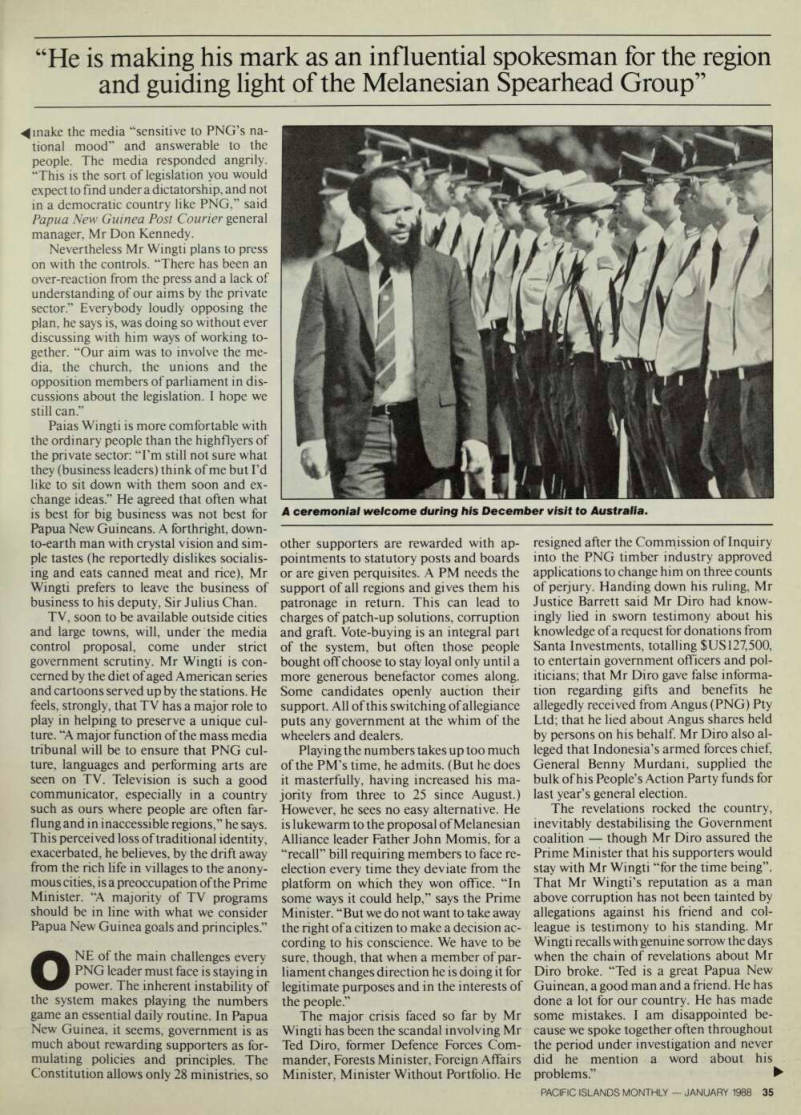
A ceremonial welcome during his December visit to Australia.
“Wingti feels strongly that television has a role to play in helping to preserve a unique culture in Papua New Guinea”
UT Mr Wingti has risen above the Diro issue and others, such as his mm deputy Sir Julius Chan’s contro versial involvement with Placer shares and the tribulations of Mr Aruru Matiabe. sacked as Foreign Minister after claiming that political loans from overseas coun tries, such as that alleged from Murdani to Diro. were commonplace and who is now embroiled in a university funding contro versy as Education Minister.
Recently, too. Mr Legu Vagi, the Police Minister and the deputy to Mr Wingti in the Prime Minister's People's Democratic Movement Party, lost his seat over elec tion irregularities.
Such internal problems were once the PM’s major concern. But since CHOGM and his open declaration of support for the Fiji Republic, he has made his mark as an influential spokesman for the region and the guiding light and conscience of the Melanesian Spearhead group, which in cludes PNG. Vanuatu and The Solomons and has the support of Fiji and the kanaks of New Caledonia.
Mr Wingti said the group was formed to preserve the identity of the Melanesian people. “Excluding Australia and New Zealand, Melanesians comprise 80 per cent of the people of the Pacific,” he said.
“We felt it was important for Melanesian leaders to gather each year to discuss bilat eral issues and decide things we can do to gether instead of spending resources doing things on our own.”
So far there were plans to pursue trade agreements, aircraft landing rights and sign cultural, legal and educational agree ments. The leaders of Vanuatu and The Solomons were soon to join Mr Wingti in signing a Joint Set of Principles to for malise the group.
The Melanesian Spearhead group is firmly in favour of the Fiji Republic. While not condoning Brigader Ranbuka’s method of winning power, Mr Wingti ins ists on the right of Melanesians, such as indigenous Fijians, to make their own de cisions: “We recognise Fiji as an inde pendent state and, by extension, we recognise whoever is in authority there. We cannot change events. What has taken place has taken place. We have a respon sibility to the friendly countries in the re gion which have done so much to provide stability here.”
Mr Wingti does not want to see a sit uation where independent states are iso lated by former friends and begin looking for alternative partners, so causing long term problems. “As Melanesians we un derstand the difficulties involved in Fiji, the social and political problems the in
digenous Fijians and the Indians are facing.”
Mr Wingti, no admirer of the French, is equally hardline on New Caledonia, calling for full independence for the kan aks. “But such independence can only come when the indigenous kanaks. New Caledonians and others living in New Ca ledonia are united, not divided as they are
today by outside interests.”
The Prime Minister visited Australia in De cember to sign with Aus tralian Prime Minister Bob Hawke a Joint Dec laration of Principles, a document comprehen sively covering ail agree ments aid. trade, defence between the two countries. His Government is deter mined to reduce PNG’s reliance on Australian aid and replace it with mutually beneficial trade agreements. His aim is to reduce Australian aid from its present level of
19 per cent of PNG’s national Budget to less than 5 per cent by the end of the cur rent five-year term.
While he feels it is important to main tain existing ties with Australia, Mr Wingti is keen to develop links with the US, Ja pan, Soviet Union, China and Indonesia.
The pact of Friendship, Co-operation and Mutual Respect with Indonesia has helped, he says, to defuse the problem on the Irian Jaya border. The treaty has so far curbed Indonesian intrusions across the border into PNG. The whole issue is now in the hands of the United Nations High Commissioner for Refugees. “We have a very firm understanding with the Indo nesian Government. We see no threat from the Indonesians; rather friendship and co operation. We gam a lot from their tech nology, food production and rural devel opment schemes.”
The PM hopes Indonesia’s financial institutions will invest in PNG’s tourism and cottage industries. With its position in the region stabilised, Mr Wingti is courting other countries further afield: the United States (a team of military advisers will be sent to the Irian Jaya border this year), Canada, where a double tax treaty has been signed, “and we are looking at the ASEAN countries where there is a big market for the things we produce.”
This year should be a momentous one for Papua New Guinea. Mr Wingti is fond
of calling 1988 the “year for national building”.
“For the first time,” he says, “We have increased our budget in real terms by five per cent or K 1 billion. We’ll mobilise the manpower in the country and look at ways of utilising the defence force and pris oners, though the UN and others will complain. Fifty new roads will be built.
There’ll be more funds for the agricultural sector and we’ll make it easier for people in the provinces to take land titles and bor row money from the bank for mortgages.
We hope to spend less money on law and order, social services and administration.”
When he is not running the country, Mr Wingti, who is not married, relaxes by reading, swimming and watching sport.
He enjoys big rugby league games. He was a keen jogger until suffering a knee injury.
But mostly he likes to spend time with close friends and return to the more peace ful concerns of his native Mt Hagen.
“The province is a place where the is sues you discuss are quite different from the running of the country,” he says. “Here, I’m surrounded by advisers, concerned with the complicated business of running the nation. In the village it’s different. I turn my mind to simple things and this slows my mind, relaxes me.”
There would, however, be no relaxing for Mr Wingti this day. After the inter view, as he escorted me to the gate of the residence, we negotiated a holding pattern of politicians and public servants milling in the driveway, seeking an audience.
Some had been waiting in 40 degree heat for hours. It was midday Saturday and there was work to do. Rustic contempla tion at Mt Hagen was out. Being Prime Minister of Papua New Guinea can, in deed, be a bloody hard job. □
Statesmanship comes easy for the Prime Minister.