Pacific Report
pp. 25-26 · Read in the full issue
□ Fiji, China In Talks
FIJI’S then Foreign Minister, Mr Bole, held talks in Beijing with China’s Government leaders on strengthening diplomatic rela tions between the two countries and to dis cuss new trade contracts. It was the first visit to China by a member of the Suva Government since the second military coup in September. Mr Bole held talks with China’s Foreign Minister. Mr Wu Xue qian, but Beijing’s recognition of the Suva Government did not arise; it is believed China is trying to establish economic re lations with Fiji while remaining wary about recognising it.
□ Nz Satellite Plan
NEW ZEALAND is to build its own def ence satellite communications station. The Prime Minister, Mr Lange, said the sta tion would be built on a remote site near Blenheim at the northern tip of the South Island. The station will be operational by 1989 and will allow New Zealand to gather intelligence independently.
New Zealand has been excluded from the ANZUS defence treaty with the US and Australia since 1986 because of Welling ton’s anti-nuclear policies and, as a result, has received much less defence intelli gence from other ANZUS members.
□ High Spirits Quelled
IN THE southern highlands of Papua New Guinea a liquor ban was imposed at Tari in December following an attack on the district police station by angry villagers.
The three-month ban was imposed as a re sult of a meeting of concerned citizens who complained that the looting of the police station was the climax to a worsening law and order problem among the Huli people.
After the attack a police riot squad made more than 50 arrests.
□ Veterans Rewarded
THE PNG Government is to provide a further K 1 million for compensation pay ments for ex-servicemen and World War II carriers. The scheme provides pay ments to those who served either the Jap anese or the Allies. The system of payments is to be altered in 1988 to reduce the high cost of administering the scheme.
□ Military Exchange
AUSTRALIA’S Defence Minister, Mr Beazley, welcomed the report that the United States would be sending a Special Forces contingent to Papua New Guinea for training purposes. He said the move would not infringe on Australia’s stronger and more long-standing defence relation ship with PNG.
The Special Forces team will take part
in a 20-day training exercise at Wewak early this year.
□ Mururoa’S 90Th Test
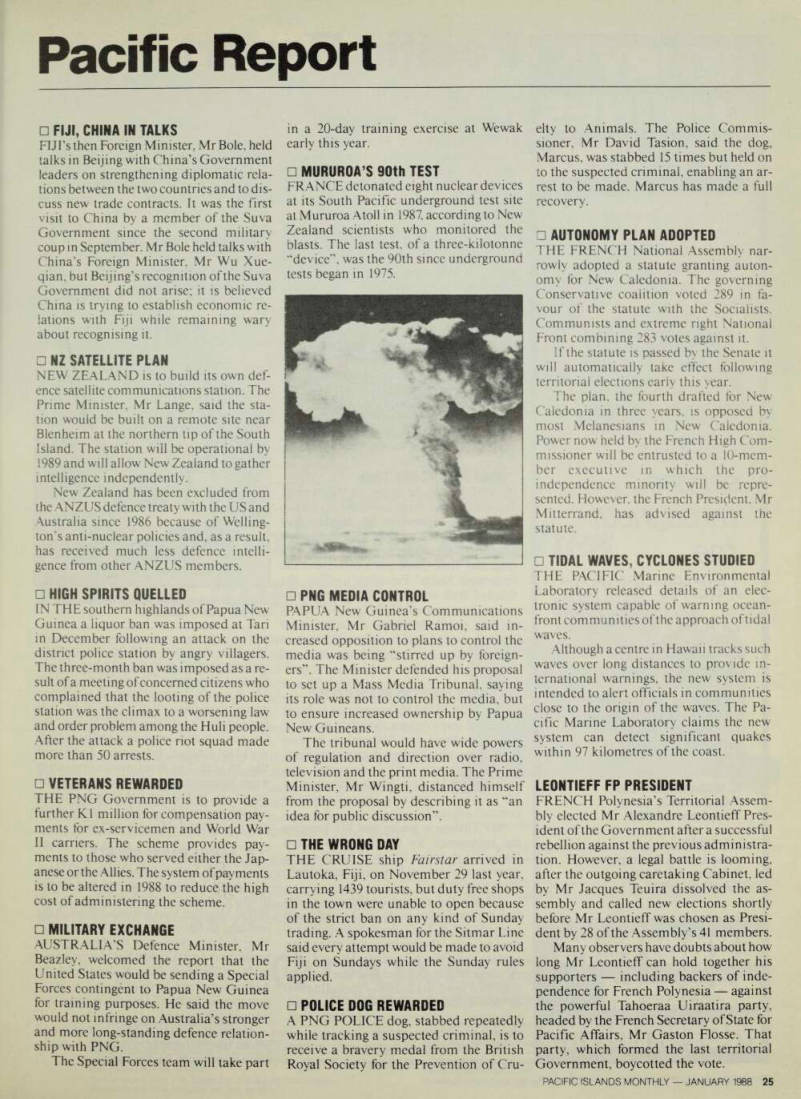
FRANCE detonated eight nuclear devices at its South Pacific underground lest site at Mururoa Atoll in 1987, according to New Zealand scientists who monitored the blasts. The last test, of a three-kilotonne “device”, was the 90th since underground tests began in 1975.
□ Png Media Control
PAPUA New Guinea’s Communications Minister, Mr Gabriel Ramoi, said in creased opposition to plans to control the media was being “stirred up by foreign ers”. The Minister defended his proposal to set up a Mass Media Tribunal, saying its role was not to control the media, but to ensure increased ownership by Papua New Guineans.
The tribunal would have wide powers of regulation and direction over radio, television and the print media. The Prime Minister, Mr Wingti, distanced himself from the proposal by describing it as “an idea for public discussion”.
□ The Wrong Day
THE CRUISE ship Fairstar arrived in Lautoka, Fiji, on November 29 last year, carrying 1439 tourists, but duty free shops in the town were unable to open because of the strict ban on any kind of Sunday trading. A spokesman for the Sitmar Line said every attempt would be made to avoid Fiji on Sundays while the Sunday rules applied.
□ Police Dog Rewarded
A PNG POLICE dog, stabbed repeatedly while tracking a suspected criminal, is to receive a bravery medal from the British Royal Society for the Prevention of Cru
elty to Animals. The Police Commis sioner, Mr David Tasion, said the dog, Marcus, was stabbed 15 times but held on to the suspected criminal, enabling an ar rest to be made. Marcus has made a full recovery.
□ Autonomy Plan Adopted
THE FRENCH National Assembly nar rowly adopted a statute granting auton omy for New Caledonia. The governing Conservative coalition voted 289 in fa vour of the statute with the Socialists.
Communists and extreme right National Front combining 283 votes against it.
If the statute is passed by the Senate it will automatically lake effect following territorial elections early this year.
The plan, the fourth drafted for New Caledonia in three years, is opposed by most Melanesians in New Caledonia.
Power now held by the French High Com missioner will be entrusted to a 10-mem ber executive in which the pro independence minority will be repre sented. However, the French President, Mr Mitterrand, has advised against the statute.
□ Tidal Waves, Cyclones Studied
THE PACIFIC Marine Environmental Laboratory released details of an elec tronic system capable of warning ocean front communities of the approach of tidal waves.
Although a centre in Hawaii tracks such waves over long distances to provide in ternational warnings, the new system is intended to alert officials in communities close to the origin of the waves. The Pa cific Marine Laboratory claims the new system can detect significant quakes within 97 kilometres of the coast.
Leontieff Fp President
FRENCH Polynesia’s Territorial Assem bly elected Mr Alexandre Leontieff Pres ident of the Government after a successful rebellion against the previous administra tion. However, a legal battle is looming, after the outgoing caretaking Cabinet, led by Mr Jacques Teuira dissolved the as sembly and called new elections shortly before Mr Leontieff was chosen as Presi dent by 28 of the Assembly’s 41 members.
Many observers have doubts about how long Mr Leontieff can hold together his supporters including backers of inde pendence for French Polynesia against the powerful Tahoeraa Uiraatira party, headed by the French Secretary of State for Pacific Affairs, Mr Gaston Flosse. That party, which formed the last territorial Government, boycotted the vote.
□ French Claims Slammed
NEW ZEALAND’S Foreign Minister, Russell Marshall, reacted angrily to alle gations by the French Secretary of State for South Pacific Affairs, Mr Gaston Flosse, that New Zealand and Australia are fi nancing the region’s destabilisation.
Saying he was “outraged” by the claims, Mr Marshall challenged Mr Flosse to prove that French authorities had “proof’ Can berra and Wellington were behind those groups seeking independence from France.
The Foreign Minister said France had made no representations to New Zealand over the issue, and that the only proven act of terrorism in the region had been per petrated by the French secret service against the Greenpeace vessel Rainbow Warrior in New Zealand.
Mr Marshall added that France would be putting on blinkers if it believed recent troubles in Tahiti had been caused by others.
□ Nina Devastates Truk
IN THE Federated States of Micronesia, Tropical Storm Nina smashed into Truk Lagoon on November 24, leaving five people dead, 19 injured and thousands homeless. According to a joint statement from the Truk Governor’s office and the Federated States’ President’s office, the State of Truk was immediately declared a major disaster area: 60 per cent of housing in Truk was destroyed or damaged, most crops destroyed, and health problems were a danger due to clogged sewer lines and lack of fresh water.
□ Kanaks “Incited Revolution”
FRANCE’S PUBLIC prosecutor ordered a judicial inquiry into speeches made in New Caledonia last November by two kanak separatist leaders. A statement from the prosecutor’s office described the speeches by Mr Jean-Marie Tjibaou and Mr Yeiwene Yeiwene as an incitement to commit offences.
Mr Tjibaou is leader and Mr Yeiwene the spokesman for the Kanak Socialist National Liberation Front (FLNKS) which advocates New Caledonian independence from France.
During the annual conference of his Caledonian Union party, the largest group in the FLNKS, Mr Tjibaou called on kan aks to arm themselves for protection against pro-French loyalists. He said a ju ry’s acquittal in October of seven loyalists who shot dead 10 kanaks including two of Mr Tjibaou’s brothers in 1984, amounted to a licence to kill New Cale donia’s indigenous people.
Mr Yiewene said that to survive, kan aks must reorganise their own means of
self-defence, and compare their situation with that of the French who resisted the German occupation in World War 11.
Under French law, an investigating magistrate will decide whether to charge the two FLNKS leaders with instigating violence a criminal offence.
□ Png Boom Under Threat
PAPUA NEW GUINEA’S potential gold and oil boom may be in danger because of unreasonable compensation demands and allegedly outrageous statements by politi cal leaders.
In his 1988 Budget speech, Papua New Guinea’s Minerals and Energy Minister,
Mr John Kaputin, said he was increas ingly concerned over the number of “out rageous statements” by political leaders.
Mr Kaputin further warned his fellow parliamentarians that it was time they learned the “hard facts of life”. Papua New Guinea was still dependent on the outside world for finance, investment and exper tise, he said. The investment community must be convinced PNG was worth in vesting in, but outlandish statements and ridiculous demands made potential inves tors understandably very nervous.
□ W. Samoa Warns Soviets
WESTERN Samoa told the Soviet Union it remained strongly opposed to a Soviet military presence in the South Pacific. The Prime Minister Vaai Kolone delivered the message to the new Soviet Ambassador, Yuri Sokilov, who was visiting Apia to present credentials. Mr Sokolov is based in New Zealand. Vaai Kolone told the Ambassador any form of Soviet military presence in the Pacific would increase ten sions in the region.
However, Western Samoa welcomed Soviet involvement in economic co-oper ation with South Pacific nations. □
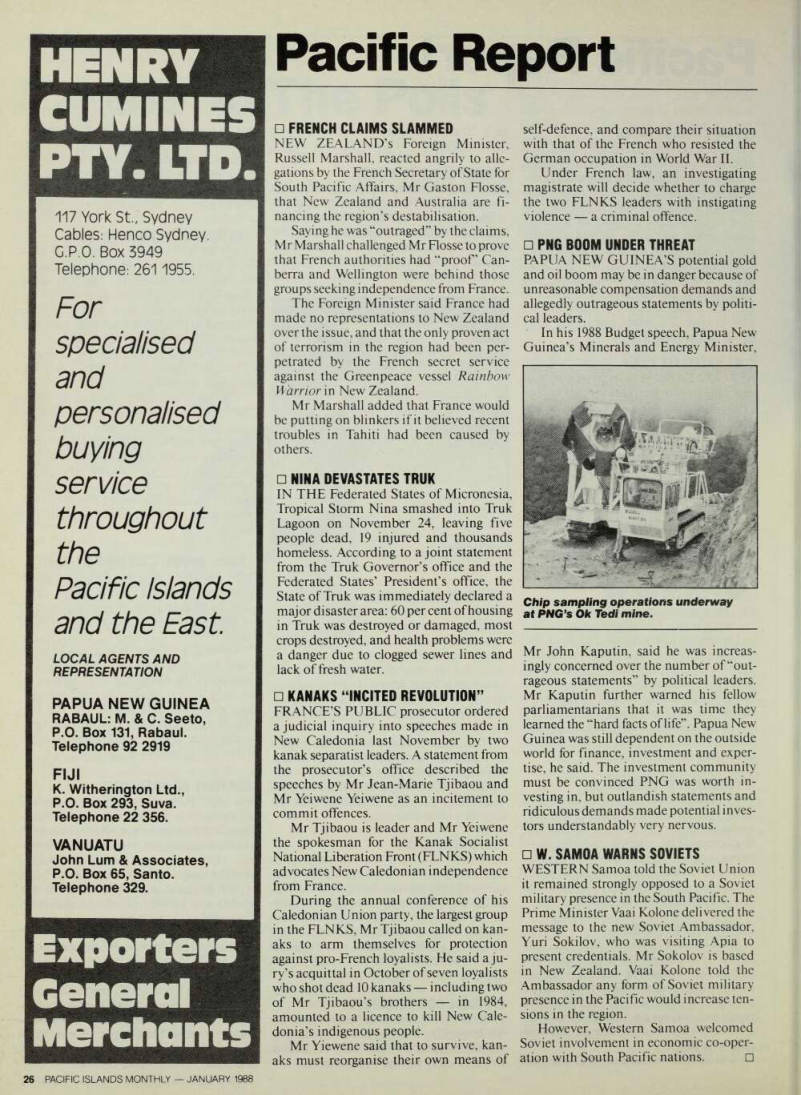
Chip sampling operations underway at PNG’s Ok Tedi mine.