Expats To The Polls
p. 24 · Read in the full issue
The Region
By David S North
The Pacific votes for a President.
A HANDFUL of United Stales is land politicians but about 100,000 French citizens in the Pa cific will participate in this year’s Pres idential elections in those two nations.
Only about 30 or so people from Guam and American Samoa will help select the Republican and Democratic candidates for President in the November election: but no one from the American islands can vote in the contest between the candidates.
In New Caledonia, French Polynesia and Wallis and Futuna, all registered vot ers can vole directly for their choice for President. In the 1981 contest Francois Mitterrand was swamped in the islands by
his conservative oppo nent, Giscard d’Esiamg. with the latter ahead by a margin of about 77,000 to 29,000.
The United States has complex three-step Presidential elections. In the first phase, during summer conventions, thousands of party dele gates choose the nomi nees for President. All slates, the District of Co lumbia and most terri tories send delegates. The second phase is in No
vember. when voters choose members of the Electoral College; all states and the District of Columbia participate in this process, but the territories do not. Finally, during December of the election year, in a normally pro forma procedure, the Elec toral College chooses the President.
During the nomination phase Guam has more to say than Samoa: Guam will have four delegate voles at the 2277-vote Republican convention in New Orleans: similarly, it will have four delegate votes among 4157 at the Democratic convention in Atlanta.
American Samoa will not oe repre sented at the Republican convention, de spite earlier efforts to obtain delegates bv former Governor Peter Tali Coleman, and the territory’s Democrats will have be tween tour and six votes at the Democratic convention.
The Commonwealth of the Northern Mariana Islands might have been able to secure delegate seats, now that the Mari anas (like Puerto Rico) has Common wealth status, but no efforts have been made to secure recognition from either party. The three other former trust terri-
taries, Federated States of Micronesia, Pa lau and the Marshalls, are completely outside the Mainland political system.
In all. 30 Guamanian and Samoan pol iticians will help choose their parties’ can didates for President, and some of these delegates are in effect already selected.
Most delegates, however, cast only a frac tional vote: a quarter for Democratic Na tional Committee members and half for some others.
Certain to be among Samoan delegates is Governor Lutali, a Democrat. How ever, the Democratic National Commit tee did not know about the presence of a Democrat governor in American Samoa
until asked about it.
Likely selections among Guam’s Republicans are Congressman Ben Blaz and Governor Joseph F Ada. wno defeated the convicted Democratic incumbent. Richard Bordallo, in November. 1986: among those ex pected to attend the Democratic convention is Democratic national committeewoman Madeline Bordallo, spouse of the ex-Gover nor. who was recently
elected to the island Senate.
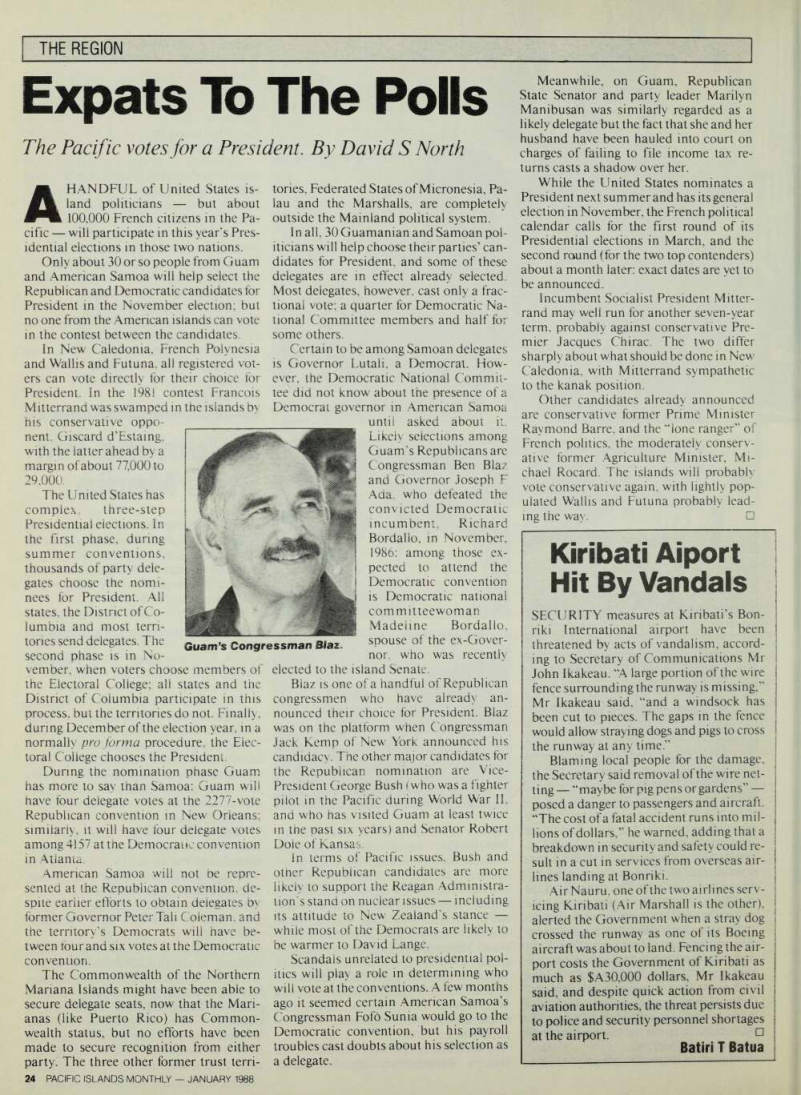
Blaz is one of a handful of Republican congressmen who have already an nounced their choice for President. Blaz was on the platform when Congressman Jack Kemp of New York announced his candidacv. The other major candidates for the Republican nomination are Vice- President George Bush i who was a fighter pilot in the Pacific during World War 11. and who has visited Guam at least twice in tne oast six years) and Senator Robert Dole of Kansas.
In terms of Pacific issues. Bush and other Republican candidates are more likely to support the Reagan Administra tion's stand on nuclear issues including its attitude to New Zealand's stance while most of the Democrats are likely to be warmer to David Lange.
Scandals unrelated to presidential pol itics will play a role in determining who will vote at the conventions. A few months ago it seemed certain American Samoa’s Congressman Fofd Sunia would go to the Democratic convention, but his payroll troubles cast doubts about his selection as a delegate.
Meanwhile, on Guam, Republican State Senator and party leader Marilyn Manibusan was similarly regarded as a likely delegate but the fact that she and her husband have been hauled into court on charges of failing to file income tax re turns casts a shadow over her.
While the United Slates nominates a President next summer and has its general election in November, the French political calendar calls for the first round of its Presidential elections in March, and the second round (for the two top contenders) about a month later: exact dales are yet to be announced.
Incumbent Socialist President Mitter rand may well run for another seven-year term, probably against conservative Pre mier Jacques Chirac. The two differ sharply about what should be done in New Caledonia, with Mitterrand sympathetic to the kanak position.
Other candidates already announced are conservative former Prime Minister Raymond Barre. and the “lone ranger” of French politics, the moderately conserv ative former Agriculture Minister, Mi chael Rocard. The islands will probably vole conservative again, with lightly pop ulated Wallis and Futuna probably lead ing the way. □
Guam’s Congressman Blaz.